Coveo vs Constructor.io: Top Differences and Similarities (2026)
A fact-by-fact comparison of Coveo and Constructor.io for Shopify Plus: search, ranking, merchandising, Shopify Markets, catalog sync, AI agents, pricing, and reviews. Every claim cited, verified August 2026.
Key takeaways
Overview
These two rank enterprise discovery about equally well. Where they part ways is scope and packaging: one is a broad relevance platform with tiered add-ons, the other a single discovery engine with everything in one contract.
Coveo is an enterprise AI relevance platform founded in 2005 and publicly traded on the TSX. It indexes many content sources into one cloud index and serves commerce, customer service, workplace, and website search from a single platform. It has been a Gartner Magic Quadrant Leader for Search and Product Discovery three years running.
Constructor.io is an enterprise product-discovery platform founded in 2015. It does one thing: rank ecommerce search and browse results toward a business goal. Its published customer list includes Sephora, Petco, and Birkenstock, and it sells through a hands-on sales and solutions process rather than self-serve.
Below, each capability gets a verdict and a citation, then the closing section names which team should sign with which vendor.
Top differences between Coveo and Constructor.io
The matrix uses four verdicts: Yes works as stated, Gated needs a higher tier or a rep to switch on, Partial works with limits, No. Each one is sourced in the sections below, and every cell was verified in August 2026.
Platform and Shopify fit
| Capability | Coveo | Constructor.io |
|---|---|---|
| Built only for Shopify | No | No |
| Native Shopify taxonomy ingestion | No (delimited string) | No (custom mapping) |
| Combined listings and bundles | No | Partial (combined listings only) |
| Native Shopify Markets | Partial, base currency only | Partial (index key per market) |
| One index across locales | No | No |
| Catalog sync latency | 15-minute batch refresh | Batch, 5-minute minimum |
| Shopify App Store rating | 0 / 5 (0 reviews) | 0 / 5 (0 reviews) |
Search
| Capability | Coveo | Constructor.io |
|---|---|---|
| Keyword search, prefix, typo tolerance | Yes | Yes |
| Semantic / vector search | Gated (CSE, rep-enabled) | Yes (included) |
| Behavioral re-ranking | Yes (ART, IAPR) | Yes (retrains several times daily) |
| Query intent to auto-filters | Yes (DNE) | Yes (NLP) |
| Acronym / abbreviation expansion | Partial (manual thesaurus) | Yes (native) |
| Camera / image-to-search | Partial (self-built vision API) | Yes (Image Search v2) |
Merchandising
| Capability | Coveo | Constructor.io |
|---|---|---|
| No-code merchandiser UI | Yes (Merchandising Hub) | Partial (algorithm-first) |
| Rules engine, boost / bury / pin | Yes | Yes (six rule types) |
| Drag-and-drop pin interface | Yes | Partial (recommendations only) |
| Business metrics in ranking | Partial (no return rate) | Yes (margin, returns) |
| Blend metrics into one ranking score | Yes (weighted rules) | Yes (eight-signal model) |
| Scheduling and segment targeting | Yes (segments partly beta) | Yes (Audience Hub) |
AI, pricing, and reviews
| Capability | Coveo | Constructor.io |
|---|---|---|
| Semantic and AI ranking with no upgrade | No (CSE add-on, Enterprise plan) | Yes (one platform, one contract) |
| Built-in AI shopping agent | Yes (RGA, add-on) | Yes (AI Shopping Agent) |
| MCP server for outside assistants | No public MCP | Partial (claimed, unverified) |
| Free tier / self-serve start | No | No |
| Pricing transparency | Quote only | Quote only |
| Public review base | Dozens, enterprise-heavy | Dozens, enterprise-heavy |
How does each engine find products?
Semantic retrieval is where the packaging flips. Coveo has a deep semantic stack that a rep must switch on. Constructor bakes it into the one platform, no toggle required.
Coveo runs hybrid lexical and vector retrieval. Its Catalog Semantic Encoder retrieves products by meaning through multilingual encoders and NLP. The capability is real and mature, but not in the base tier: the docs say to "contact your Coveo representative to enable" it, and Commerce is Enterprise-Platform-Plan-only.
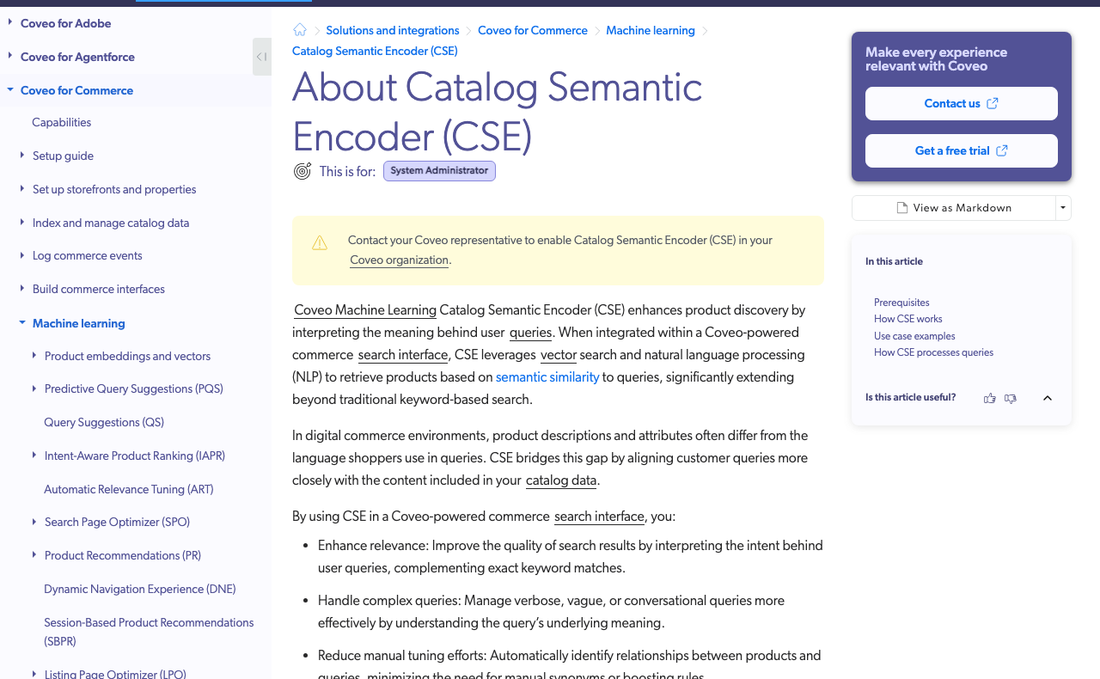
Coveo's semantic encoder is rep-enabled, and its left-menu shows the depth of its ML stack. Source.
Constructor runs two retrieval systems on every query. An in-house Inverted Index handles keyword matching, and Cognitive Embeddings Search matches on meaning. That pairing lets a vague query like "office" or "summer outfit" still return something, and semantic retrieval ships with the one platform, not as a line item you unlock later.
Constructor also ships native Image Search v2, where a shopper uploads a scene photo and gets results for each detected item. Coveo has no native image input; its only documented path is a self-built third-party vision API.
- Keyword search: included on every tier for both.
- Semantic search: included on Constructor; rep-enabled on Coveo.
- Image-to-search: native on Constructor; self-built third-party on Coveo.
Semantic search out of the box
How does each rank results?
Machine-learned ranking is a real strength on each side. The split is how business metrics enter the model: Constructor bakes them into one score, Coveo layers weighted rules on top.
Constructor's ranking model scores each item across eight signal groups, including popularity, personalization, segment behavior, and newness, and blends them into one score tuned to a KPI you set: revenue per visitor, average order value, profit, or conversions. It retrains from clickstream several times a day, and margin and returns are documented signals.
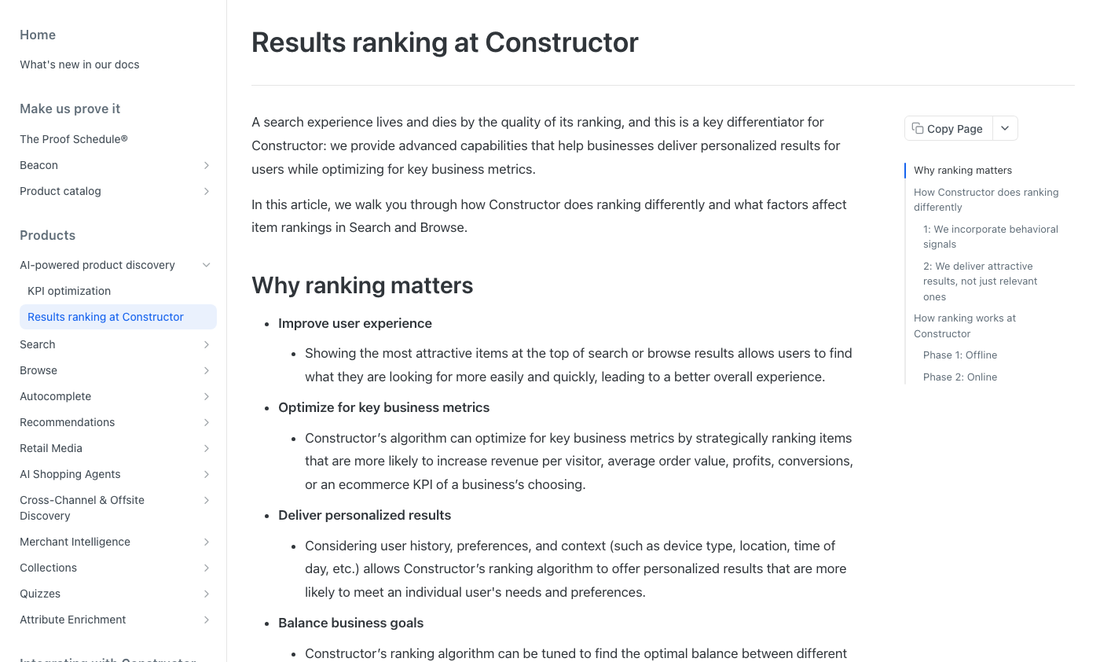
Constructor's ranking documentation. Its model optimizes to a KPI like revenue per visitor or profit. Source.
Coveo's Automatic Relevance Tuning and Intent-Aware Product Ranking learn from behavior, and the Coveo Merchandising Hub blends weighted boost and bury rules over the ML score. It can feature high-margin or high-stock products, though return rate is not a documented ranking input.
So both blend signals into ranking. Constructor optimizes automatically to a business KPI with returns included; Coveo gives merchandisers weighted rules but no return-rate signal.
- Constructor: eight-signal model optimizing to a KPI, margin and returns included.
- Coveo: ML ranking plus weighted merchandising rules; margin yes, return rate no.
Revenue-tuned ranking with returns, out of the box
Can merchandisers run each one without developers?
This is Coveo's clearest edge. Both give merchandisers controls, but Coveo hands them a visual hub, while Constructor's model owns the base ranking.
Coveo ships the Merchandising Hub, "designed with merchandisers in mind," with boost, bury, pin, and drag-and-drop sequencing, included in Coveo for Commerce. A merchandiser can reorder results directly, though reaching the hub still means a developer-built Atomic or Headless storefront.
Constructor ships a full rules engine with six rule types, scheduling, and segment targeting through its Audience Hub. The limit is philosophy, not feature count: because the model owns the base ranking, merchant overrides sit on top of it, and one reviewer notes that "reliance on automated algorithms can limit a merchant's ability to override results" (Gartner). Drag-and-drop exists for recommendation carousels, not core search merchandising.
- Coveo: a visual Merchandising Hub with drag-and-drop, included.
- Constructor: broad no-code rules, but the AI model owns the base ranking.
Direct merchandiser control of results
Coveo: Merchandising Hub, drag-and-drop ✅
How well does each fit Shopify Plus?
On Shopify, the two converge almost point for point. Each connects through a multi-platform app, each shows 0 App Store reviews, and neither ingests Shopify's product taxonomy natively.
Coveo's AI Search & Discovery app has sat at 0 reviews since it launched in March 2025. It is free to install but needs a separate paid Coveo license, provisions GraphQL sources under the hood, flattens category into a delimited string, and ingests neither combined listings nor bundles.
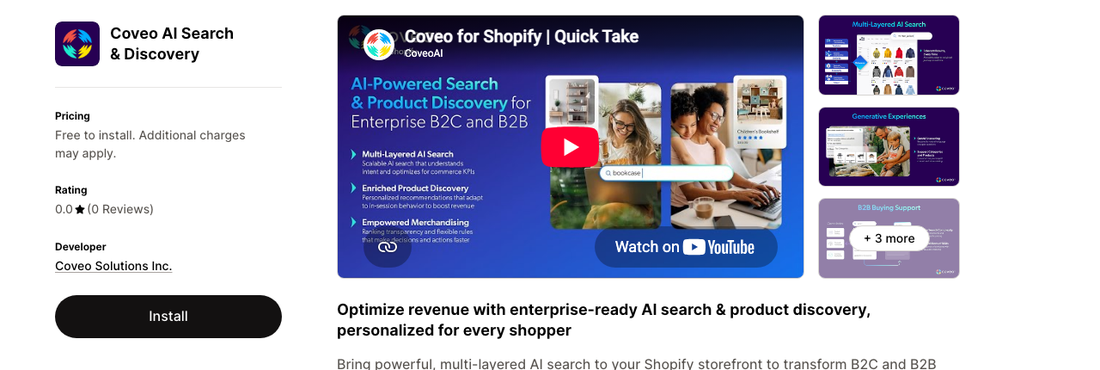
Coveo on the Shopify App Store: 0 reviews, and it requires a separate Coveo license. Source.
Constructor's Connect app launched in September 2024 and also has 0 reviews. It is one of 8 or more platform connectors, and it does not natively ingest Shopify's Standard Product Taxonomy; extra attributes need custom mapping.
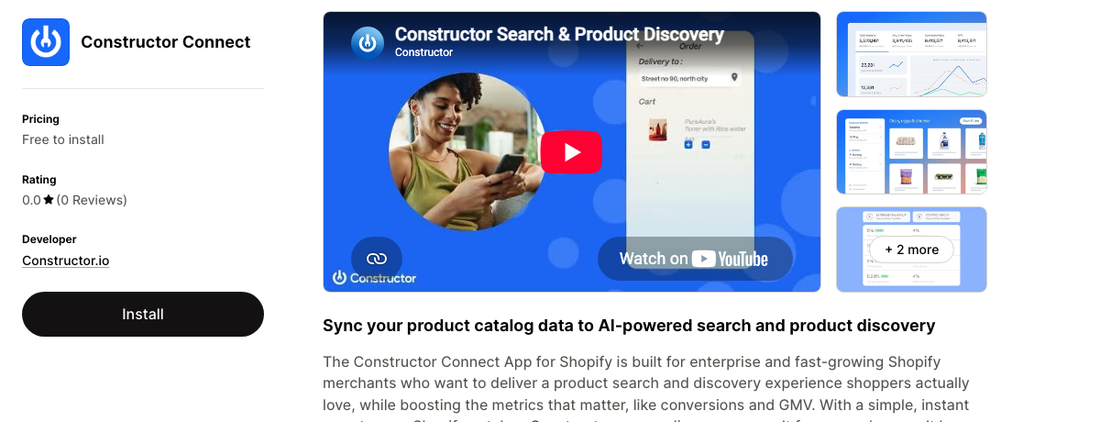
Constructor Connect on the Shopify App Store: 0 reviews as of August 2026. Source.
The engines are not the issue. The Shopify surface is: young, unproven in public, and reliant on field mapping instead of native taxonomy on both sides.
Proven, native Shopify connector
Coveo: 0 reviews, needs a license ❌
Constructor.io: young, 0 reviews ❌
How do they handle Shopify Markets?
Run more than one storefront and each engine shards the catalog. Neither serves one index across markets, and Coveo piles a currency limit on top of the split.
For Shopify Markets, Coveo spins up a separate source per market and language and duplicates each product per locale. Its app "only supports base currencies, not local currencies," and since local per-region pricing is the defining capability of Markets, that limit is a real gap.
Constructor needs a separate index key per market and locale, with prices scoped per market. There is no single index across markets, so a brand running US, UK, CA, and AU storefronts maintains several parallel indexes at once.
If you want a single index across Shopify Markets, the per-region model taxes both engines, and Coveo's base-currency-only limit makes it the weaker of the two.
Shopify Markets with local currency
Constructor.io: index per market, prices scoped ⚠️
How fresh is the catalog on each?
Freshness is the gap between the price a shopper sees and the price in the index. On the Shopify connector, each engine polls in batches instead of listening for a webhook, so the lag runs in minutes.
The packaged Coveo Shopify app refreshes every 15 minutes and rescans hourly, and its Push API bottoms out at a documented 2-to-5-minute floor. A newer native connector promises faster field updates, but it is early access, not generally available.
Constructor recommends a daily full sync plus intraday deltas, and its docs state that updates more frequently than every five minutes are not recommended. That is minutes-level latency, not event-driven seconds.
For a flash sale, a price drop, or fast-moving inventory, both lag the live catalog by minutes. Neither is webhook-driven on the Shopify connector.
Near-real-time catalog sync
Constructor.io: 5-minute batch floor ⚠️
Which is readier for AI shopping agents?
Each ships agent features, and each leaves a Shopify Plus buyer with the same unanswered question: what does the agent actually read?
Coveo's bets are inside its own platform: Relevance Generative Answering, Conversational Product Discovery, and Coveo for Agentforce. Capable features, all of them, but gated add-ons on the Enterprise plan, with no public MCP for an outside assistant to call.
Constructor ships a generative AI Shopping Agent that runs conversational search inside the storefront, plus a Merchant Intelligence Agent for merchandising teams. It also states it supports emerging MCP integrations, though that is a vendor claim we could not independently verify.
What matters for a Shopify Plus brand is what the agent can actually read. Raw search results are not the same as your merchandising rules and curation, and that gap decides whether an agent pushes the products you want to sell.
- Coveo: proprietary generative and agentic features, gated add-ons, no public MCP.
- Constructor: shopper and merchant agents shipped; MCP support is claimed, not verified.
Open, verified agent readiness
Coveo: gated add-ons, no public MCP ⚠️
Constructor.io: agents shipped, MCP unverified ⚠️
What does each actually cost?
Six figures a year, quote-only, no free tier, no self-serve on either side. The packaging is the difference: Coveo sells add-ons on top, Constructor sells one platform with no feature gating.
Coveo sells enterprise contracts only, billed on Queries Per Month. Commerce sits on the Enterprise Platform Plan, and semantic search and generative answering are charged as add-ons on top.
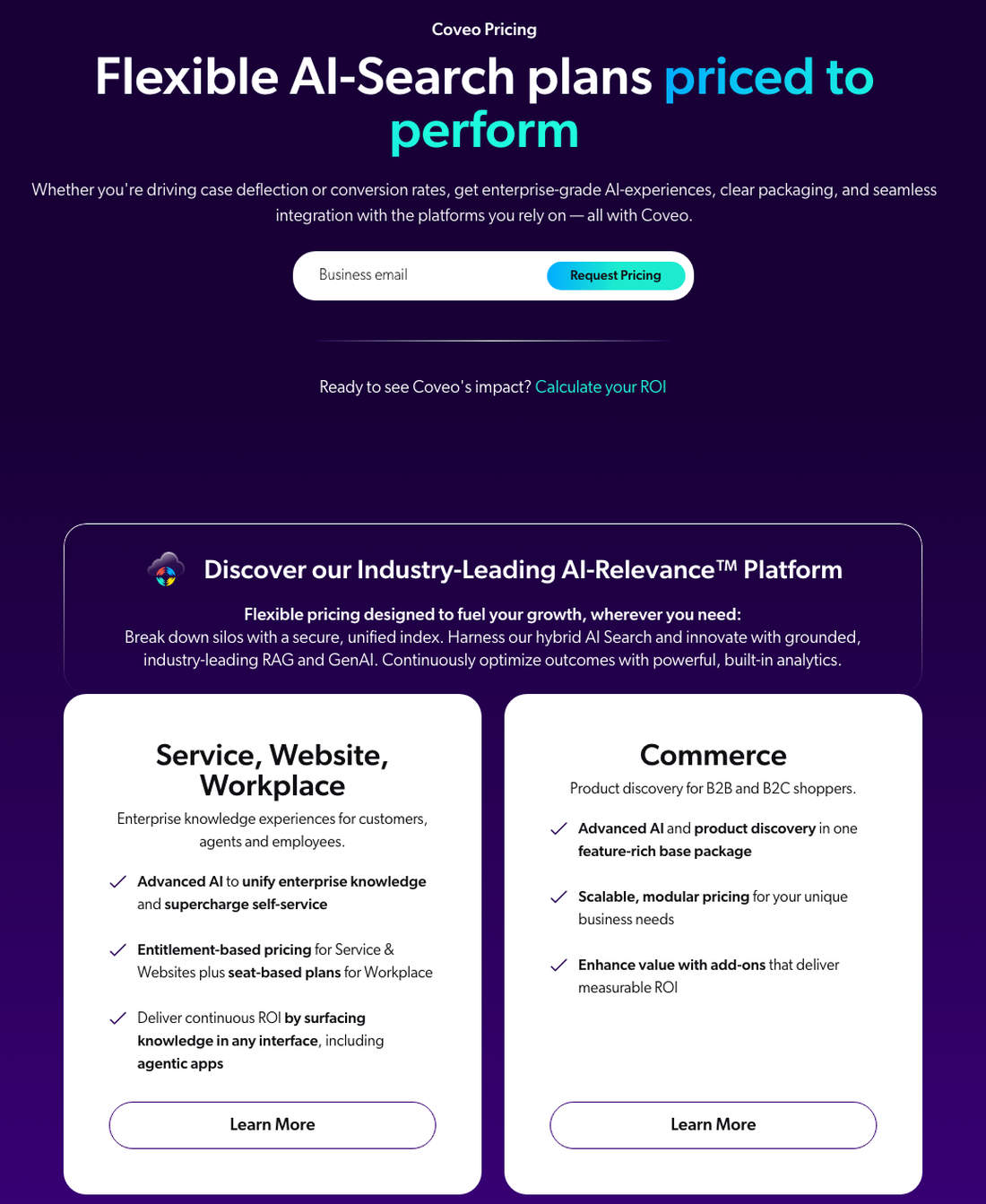
Coveo's pricing page: quote-only, with Commerce sold as a base package plus add-ons. Source.
- Average deal: independent teardowns cite $10,000 to $20,000 per month, with three-year cost above $500,000.
- The catch: the semantic and generative layers are add-ons on top of the Enterprise plan.
Constructor has no public pricing, no free tier, and no self-serve path. Every customer signs a custom annual contract for the whole platform.
- Average contract: around $150,000 a year, with a redline near $200,000 and one proposal near $300,000, per Vendr.
- The upside: no feature gating, so semantic search and business-metric ranking are in the one contract.
- Query-based estimate: roughly $24K to $120K a year depending on volume.
Every number here is a third-party estimate, not a vendor figure.
Full AI with no add-ons
Coveo: semantic and generative are add-ons ❌
Constructor.io: one platform, no gating ✅
What are customers saying?
Enterprise reviewers rate each one highly, from small, enterprise-heavy samples. Neither has a Shopify App Store review base yet.
Coveo rates 4.5 on Gartner Peer Insights across 46 ratings and 4.3 on G2 across about 145, with 0 reviews on the Shopify App Store. Praise clusters on relevance quality, ML depth, and support. Gripes cluster on cost, consumption pricing, and a developer-heavy rollout.
"Coveo fits into our workflow as the core engine of our search. The AI-powered search actually helps our team by allowing users to search for products based on their preferences. This has increased our throughput time and the number of users engaged with our application, leading to more purchases." Lead Engineer at Adobe, PeerSpot
"Coveo provides an enterprise level AI and relevance platform but licensing model is challenging." IT reviewer, $30B+ firm, Gartner Peer Insights
Constructor rates 4.9 on Gartner Peer Insights across 59 ratings and 4.8 on G2 across about 57, with no Shopify App Store reviews yet. Praise clusters on ranking quality and the support relationship. Gripes cluster on implementation effort and limited override of the model.
"Constructor's support and communication provided during the sales, contract and implementation phases have been second to none. Their fast response times made our rollout smooth and frictionless." Head of Ecommerce, Retail, Gartner Peer Insights
"Reliance on automated algorithms can limit a merchant's ability to override results, though manipulation of search and merchandising results exists, this does reduce flexibility in specific use cases." Verified reviewer, Gartner Peer Insights
Read both with the context attached. Coveo's reviews come from large enterprise buyers; Constructor's are high but from a small, enterprise-heavy sample. Neither has a mid-market Shopify signal in it yet.
Independent review base
Constructor.io: dozens, high scores ✅
Top similarities between Coveo and Constructor.io
Differences make the headline. For a Shopify Plus buyer, the shared ground is where the harder truths sit, and six of them apply to each.
Neither is built for Shopify
Both are enterprise engines with a Shopify adapter, not Shopify-native tools. Coveo lists Shopify among 25-plus connectors and Constructor among 8 or more connectors. Taxonomy, Markets, and catalog sync are all downstream of that build-for-any-platform choice.
Both are enterprise, quote-only, and six-figure
Neither publishes pricing or offers self-serve. Coveo runs around $10,000 to $20,000 a month by third-party estimate, and Vendr pegs Constructor near $150,000 a year. A serious deployment on either lands firmly in six figures.
Both shard a multi-market catalog
Shopify Markets multiplies overhead rather than running from one unified index. Coveo creates a source per market and language, and Constructor an index key per market and locale. Four regions means four or more parallel indexes to merchandise on both.
Both are batch-oriented on catalog sync
Neither offers webhook-driven, seconds-level propagation on the Shopify connector. Coveo refreshes on a 15-minute cycle, and Constructor floors deltas at five minutes. For flash sales and fast inventory, both can lag the live catalog by minutes.
Both need a solutions team to deploy
Each ships AI ranking plus a rules layer, and reviewers on both cite a services-led, developer-heavy rollout. Neither is a tool a lean merchandising team stands up alone, so budget for engineering or a partner on either.
Both are capable, proven discovery engines
This one is not a knock on either. Coveo is a Gartner Magic Quadrant Leader, and Constructor holds a 4.9 on Gartner Peer Insights. Both do keyword search, faceting, autocomplete, behavioral ranking, and rules-based merchandising well. The decision comes down to fit and delivery on Shopify Plus, not to whether the core search works.
How to choose
Search quality is a tie at the top, so it will not decide this for you. The call turns on packaging and control: whether you want everything in one contract, and how much direct merchandiser control you need. That packaging choice, no gating versus modular add-ons, predicts your two-year bill more than any single row in the matrix above.
Choose Coveo if you need one relevance platform across commerce, customer service, and internal search, you want a visual Merchandising Hub your team runs directly, and a six-figure enterprise contract with add-ons fits your budget.
Choose Constructor.io if you are a large retailer with high traffic and a big catalog, you want AI ranking tuned to revenue with semantic search and returns included in one contract, and you value a hands-on solutions team over hands-on merchandiser override.
Is there an option built only for Shopify Plus?
On the onboarding calls we run with Shopify Plus brands, this pairing comes up as two strong engines that both make you rebuild for Shopify. Coveo and Constructor are both multi-platform enterprise engines. If Shopify Plus is your only storefront, a native engine skips the field mapping, the per-region indexes, and the batch feeds that both of them carry. We built Layers for exactly that case.
What we do that neither of them does:
- Shopify-native catalog. We index Shopify's Standard Product Taxonomy, combined listings, and bundles natively, so there is no delimited string or field mapping to maintain.
- One index across Markets. 100+ languages in a single index with local currency, not a source or index key per region.
- Near-real-time sync. Webhook-driven catalog updates, not a 15-minute refresh or a five-minute batch floor.
- Merchandiser-owned, no add-on. Drag-and-drop pins plus ranking by margin or return rate, with semantic search included, not rep-enabled or a separate tier.
- Native MCP. Assistants like ChatGPT and Claude read your merchandising rules, not just raw search results.
One example. 9-figure apparel brand Rainbow Shops moved to Layers. Their VP of eCommerce and Digital, David Cost, on the switch:
"Layers was the first time we were able to create some customization and essentially create the same kind of sort-orders that we were used to having in Salesforce. And we could see a pretty immediate impact on the conversion rate."
After the move, Rainbow Shops reported a 30% increase in conversion rate and now re-orders every collection page daily based on the last seven days of demand.
A 9-figure haircare brand made the same move off one side of this comparison, from Constructor.io to Layers.
On Constructor.io, catalog changes took 30 to 40 minutes to sync, and hand-configured recommendations took up to two days to appear. Both are immediate on Layers.
The real test is your own catalog, not a feature grid. Book a demo and put Layers next to Coveo or Constructor on your real Shopify Plus queries.
When we are not your answer:
- You are not on Shopify, or you run a multi-platform or headless stack. Coveo or Constructor fits better.
- You need one relevance platform spanning commerce, customer service, and internal search. Coveo is built for that.
- You want a fully algorithm-driven engine that tunes ranking to a KPI with minimal merchant input. That is Constructor's model.
- Your catalog is small enough that Shopify's native search still does the job.
FAQ
Is Constructor.io better than Coveo for ecommerce search? Constructor includes semantic search and revenue-tuned ranking with no feature gating, and its model optimizes to a business KPI. Coveo has a broader platform and a visual Merchandising Hub, but gates semantic search behind a rep and the Enterprise plan. The right pick depends on whether you want everything in one contract or a relevance platform with direct merchandiser control.
Which is more expensive, Coveo or Constructor.io? Both are quote-only and six-figure. Third-party data puts Coveo around $10,000 to $20,000 a month and Constructor around $150,000 a year. Coveo sells semantic search and generative answering as add-ons; Constructor includes them in one contract.
Do Coveo or Constructor.io work natively with Shopify Plus? No. Each is a multi-platform engine with a Shopify connector, each carries 0 Shopify App Store reviews, and neither reads Shopify's Standard Product Taxonomy natively.
Does Coveo include semantic and AI ranking in the base plan? No. Coveo's Catalog Semantic Encoder is rep-enabled on the Enterprise plan, and generative answering is a separate add-on. Constructor includes semantic search and business-metric ranking in its one platform contract.
Can ChatGPT or Claude connect to these platforms? Coveo does not publish an MCP server; its generative and agentic features are gated add-ons inside its own platform. Constructor states it supports emerging MCP integrations, but that is a vendor claim we could not verify.
Which gives merchandisers more direct control? Coveo, through its Merchandising Hub with drag-and-drop sequencing. Constructor's rules are broad, but its model owns the base ranking, which reviewers say can limit a merchant's ability to override results.
Written by

Jake Casto
Founder, Layers
Jake Casto is the founder of Layers, the enterprise search and merchandising platform built for Shopify Plus. He previously co-founded Proton, a Shopify Plus engineering studio that shipped more than 400 storefronts, where Layers began as an internal tool for a problem that kept repeating. He writes about search infrastructure, performance, and the engineering behind discovery at scale.
View all articlesRelated articles
More reading on search, merchandising, and product discovery.
Coveo vs Algolia: Top Differences and Similarities (2026)
A fact-by-fact comparison of Coveo and Algolia for Shopify Plus: search, ranking, merchandising, Shopify Markets, catalog sync, AI agents, pricing, and reviews. Every claim cited, verified August 2026.
Jake Casto
Aug 24, 2026 · 18 min read
Coveo vs Bloomreach: Top Differences and Similarities (2026)
A fact-by-fact comparison of Coveo and Bloomreach for Shopify Plus: search, ranking, merchandising, Shopify Markets, catalog sync, AI agents, pricing, and reviews. Every claim cited, verified August 2026.
Jake Casto
Aug 24, 2026 · 18 min read
Algolia vs Bloomreach: Top Differences and Similarities (2026)
A fact-by-fact comparison of Algolia and Bloomreach for Shopify Plus: search, ranking, merchandising, Shopify Markets, catalog sync, AI agents, pricing, and reviews. Every claim cited, verified August 2026.

Deb Mukherjee
Aug 14, 2026 · 17 min read