Boost Commerce is Dead, and it took Collection Pages and Search with it
On October 17, Boost was pulled from the Shopify App Store, and stores without a fallback lost collection pages and search. Here's why, and what to do.
Key takeaways
On Saturday evening, a brand we were already talking to messaged us to say Boost had just stopped working on their store. I went to check, and Boost AI Search & Filter had been pulled from the Shopify App Store:
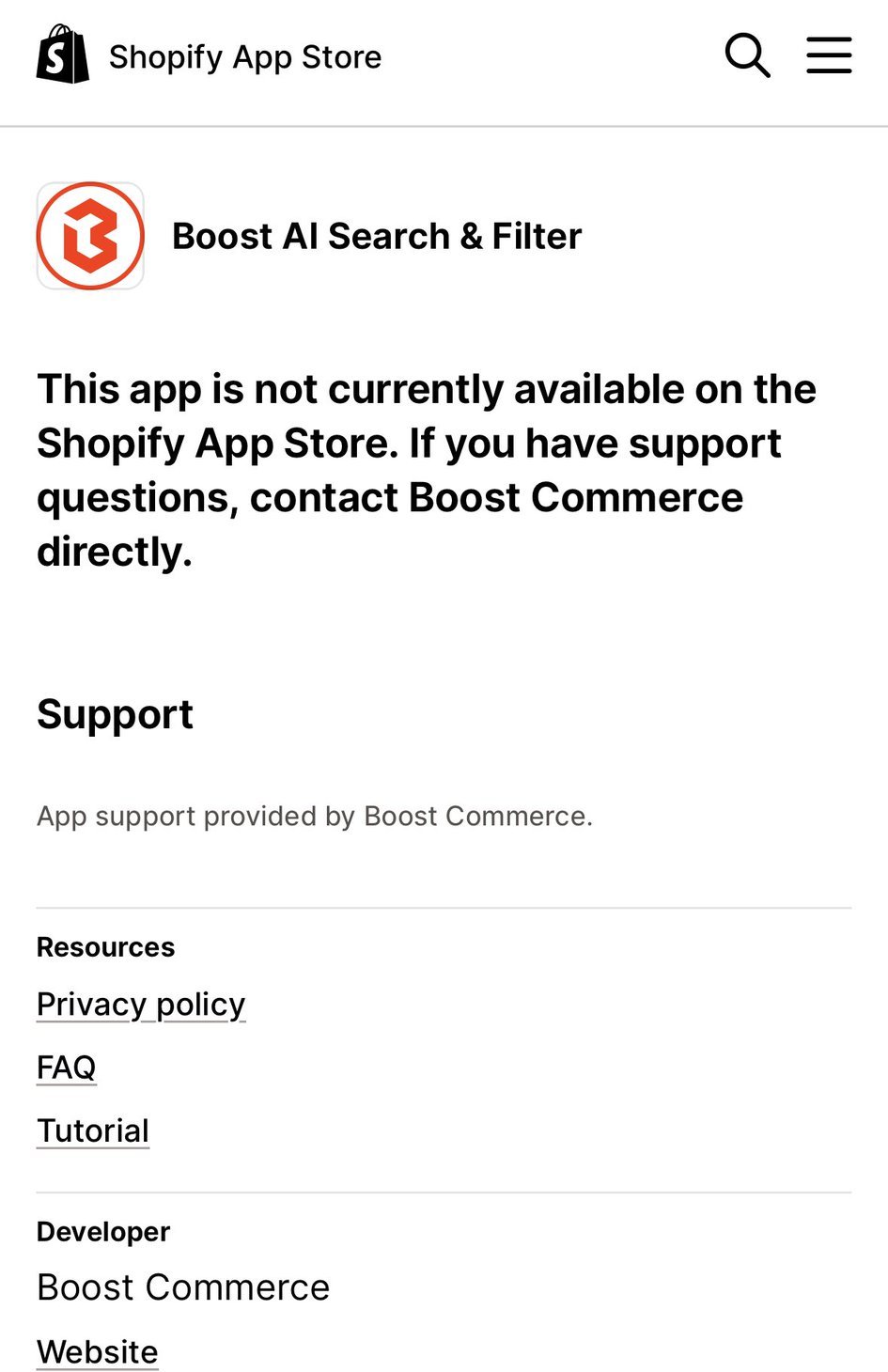
It wasn't one store. Within a few hours, the brands on Boost that had no fallback in place had lost their collection pages and their search, and on some sites the product grid sat blank under the header.
I told our team that every Boost brand without a fallback now had no PLPs (product listing pages) and no search, and that it came down to how widget-driven Boost is.
My co-founder Lukas Tanasiuk put it more bluntly: "PLPs are destroyed across many of their brands, totally dead in some instances."
What happened to Boost Commerce?
Boost's status page opened the incident at 22:38 UTC on October 17, 2026. Just after midnight UTC, Boost said it had "identified and fixed the underlying cause" and was "working with Shopify to restore the Boost Commerce app on storefronts."
By 09:25 UTC on Sunday, its case was still "with the appropriate Shopify team for review." Neither company has said why the app was pulled, so I won't guess.
Why did Boost stores lose their collection pages and search?
Boost's storefront is widget-driven, and that is why it broke. Its status page kept the Search & Filter API "Operational" while Storefront UIs sat at "Partial Outage," so the engine was fine while shoppers on affected stores lost their filters and search.
Boost's own help center describes its Boost Core app embed as the piece that will "Define UI displayed in your storefront," so when the app's standing with Shopify changed, the storefront went with it.
To be fair to Boost, its newest version ships a fallback that shows your theme's own product list during a disruption. Stores without it are the ones that went blank.
Could the same thing happen on a Layers store?
Not to your collection pages or your search. We don't depend on app embeds or app blocks for our core service: your search and collection pages are your own theme templates calling our API, with Shopify fallbacks behind them.
If our app were pulled from the App Store tomorrow, some automatic tracking might degrade. Your collection pages and search would keep working, because we implement every brand ourselves and nothing of ours is slapped over your theme.
Here is where each piece lives:
- Your theme draws the storefront. Search and collection templates call our API through the SDK or plain fetch from Liquid.
- Your settings live in Shopify. Sort orders, facets, and recommendation blocks sync to your store as metaobjects that your theme reads directly.
- The app embed handles plumbing. Our app embed covers tracking, identity, cart context, and redirects, which is the part that would degrade.
We also publish our incident targets: we aim to restore the storefront APIs within one hour of a SEV1, and you can watch live status at status.uselayers.com.
If you want to see how that setup would look on your own store, email me at jake@uselayers.com and I'll walk you through it.
How does Boost compare with Layers?
Boost trails us on more than architecture. Our row-by-row Layers vs Boost Commerce page, last verified on July 9, 2026, found gaps in languages, sync speed, visual search, merchandising, and pricing for a Shopify Plus store, all well before anything breaks.
- Languages. Our comparison found Boost's AI search covers five languages, while our multilingual model handles 100+ languages from a single index. That matters the moment you add a Shopify Market.
- Sync speed. Boost's pricing page lists catalog sync at three times a day on Launch and seven on Convert. We sync through Shopify webhooks as products change.
- Visual search. Our comparison found no camera or image search in Boost. Ours is part of Visual Discovery, with no add-on to buy.
- Merchandising depth. Boost caps active campaigns at 10, 40, or 100 by plan, and our comparison found no UTM-based sorting or return rate in ranking. Our merchandising rules rank on your own business metrics.
- Pricing. Boost prices on GMV: Accelerate starts at $699 a month, and every plan adds $2 for each $1,000 of GMV over its limit. We price on traffic with no overage.
Boost started as a filter app and added its AI search layer later, which our Boost alternatives guide covers in detail. It has also been part of AppHub, an app roll-up, since June 2024.
For a wider view, we've also written head-to-heads on Searchspring vs Boost Commerce and Fast Simon vs Boost Commerce.
What should you do if your store runs on Boost?
Check what shoppers see right now, put Shopify's native filters in place as a stopgap, and export your Boost settings before you uninstall anything. Leave Boost's code alone until you have picked where you are moving. Here is the order we recommend:
- Open your collection and search pages on desktop and mobile, so you see exactly what shoppers get right now.
- Turn on Shopify's native filters as a stopgap through the free Search & Discovery app, if your theme supports storefront filtering.
- Export what you can before you uninstall. If your Boost admin loads, export your synonyms, redirects, and analytics as files. Boost deletes your data 7 to 10 days after removal.
- Leave Boost's code in place until you know where you're moving, so you only clean your theme once.
How are we helping Boost stores move?
Lukas called it "24 hour saviour mode." We're running rapid migrations around the clock this weekend, and brands have been booking calls with us through the night. Our team does the build, the catalog sync, and the cutover.
If you're on Boost's Accelerate plan or higher, we'll honor or beat what you pay today. I posted that offer on X as soon as I saw what was happening, and it stands.
Our Boost Commerce to Layers migration guide walks through what maps across, what you retire, and how the cutover works, step by step.
FAQs
Is Boost Commerce coming back? Boost says it fixed the underlying cause and that its case is "with the appropriate Shopify team for review." Neither company has said when, or whether, the app returns. If it does, your collection pages still depend on that app's standing with Shopify.
Why did my Boost collection pages go blank? Boost's storefront UI renders through its Boost Core app embed. When the app was pulled, stores without Boost's fallback lost the filters and product grid that embed draws, even though Boost's search API stayed up.
Can I export my settings from Boost? Partly. If your Boost admin loads, synonyms, stop words, redirects, the suggestion dictionary, and analytics export as files. Filter trees do not export, and Boost deletes your data 7 to 10 days after you uninstall, so export first.
What is the best Boost alternative for a Shopify Plus store? We built Layers for Shopify Plus only: search and collections in your theme, 100+ languages from one index, webhook sync, and pricing on traffic instead of GMV. Our Boost alternatives guide compares eight options if you want the wider field.
How long does it take to move from Boost to Layers? A standard theme often goes live in around a week, and a heavily customized one takes longer. We are prioritizing Boost stores right now, and our team handles the theme build, catalog sync, and cutover.
Ready to get off Boost?
Email me at jake@uselayers.com, or reach Lukas at lukas@uselayers.com, with your current Boost plan. We'll sync your catalog, build on a draft theme, and show you Layers on your real products before you decide anything.
Written by

Jake Casto
Founder, Layers
Jake Casto is the founder of Layers, the enterprise search and merchandising platform built for Shopify Plus. He previously co-founded Proton, a Shopify Plus engineering studio that shipped more than 400 storefronts, where Layers began as an internal tool for a problem that kept repeating. He writes about search infrastructure, performance, and the engineering behind discovery at scale.
View all articlesRelated articles
More reading on search, merchandising, and product discovery.
Switching from Boost Commerce to Layers: A Shopify Plus Migration Guide
Moving from Boost Commerce to Layers on Shopify Plus: what you run today, what maps across, what you retire, and how we run the switch with Shopify fallbacks.
Jake Casto
Oct 18, 2026 · 11 min read
Switching from Algolia to Layers: A Shopify Plus Migration Guide
Moving from Algolia to Layers on Shopify Plus: what the 2026 Commerce Pipeline changed, what config ports, what you rebuild, and how we run the switch.
Jake Casto
Sep 4, 2026 · 11 min read
Switching from Coveo to Layers: A Shopify Plus Migration Guide
Moving from Coveo to Layers on Shopify Plus: why enterprise fit and cost force the question, what ports, what you rebuild, and how we run the switch.
Jake Casto
Sep 4, 2026 · 11 min read