Malachyte vs Algolia: Top Differences and Similarities (2026)
Malachyte brings real-time, cold-start personalization. Algolia is a developer-first search API with AI gated to its top tier. See how the two compare for Shopify.
Key takeaways
Overview
Malachyte is a real-time individualization platform built by an ex-Spotify team. Its Vector AI engine builds a live behavioral profile for 100% of traffic, including anonymous visitors, and uses it to rank recommendations and search.
It runs on Shopify and headless stacks, reached Shopify general availability in June 2026, and raised a $10M seed co-led by Bessemer and Gradient Ventures.
Algolia has run as a hosted, developer-first search API since 2012. It pairs fast keyword search with optional AI layers: NeuralSearch for vector results, Dynamic Re-Ranking for behavioral promotion, and a Merchandising Studio.
It deploys on Shopify through a first-party app, and its 2026 Commerce Pipeline rebuild added native taxonomy indexing and cut update latency to about two minutes.
Top differences between Malachyte and Algolia
Verified September 2026 against each vendor's public documentation. Verdicts: Yes ✅, Partial or gated ⚠️, No ❌.
Platform and Shopify fit
| Capability | Malachyte | Algolia |
|---|---|---|
| Native ingestion of Shopify taxonomy | ⚠️ Synced copy | ✅ Yes |
| Combined listings and bundles | ❌ Not documented | ⚠️ Not in indexed objects |
| Native Shopify Markets (per-region) | ❌ Not documented | ✅ Yes, on request |
| Built only for Shopify | ❌ Shopify + headless | ❌ General-purpose API |
Search
| Capability | Malachyte | Algolia |
|---|---|---|
| Keyword search (prefix, fuzzy, typo) | ✅ Yes | ✅ Yes |
| Semantic / natural-language understanding | ✅ Built in | ⚠️ NeuralSearch, Elevate only |
| Meaning without maintained synonyms | ⚠️ Synonyms are manual | ⚠️ Synonym workflow; NeuralSearch gated |
| Autocomplete / type-ahead | ✅ Yes | ✅ Yes |
| Shopper camera / image search | ❌ Text-only API | ⚠️ Similar-item recs; no native camera |
AI and personalization
| Capability | Malachyte | Algolia |
|---|---|---|
| Personalize for anonymous / first-time visitors | ✅ Cold start, core | ⚠️ Needs events; re-ranking is aggregate |
| Per-visitor real-time profile | ✅ Vector AI | ⚠️ Re-ranking refreshes every 24h |
| Behavioral re-ranking from clicks and adds | ✅ In-session | ⚠️ Dynamic Re-Ranking, Elevate |
Merchandising
| Capability | Malachyte | Algolia |
|---|---|---|
| Rules engine to boost or demote | ✅ Yes | ✅ Yes (capped by tier) |
| Visual merchandising preview | ✅ Playground | ⚠️ Merchandising Studio, Grow Plus+ |
| Margin and inventory in ranking | ⚠️ Via rules | ⚠️ Precomputed numeric attribute |
| Scheduled, time-based merchandising | ❌ Not documented | ✅ Rule validity windows |
Pricing, delivery, and reviews
| Capability | Malachyte | Algolia |
|---|---|---|
| Published pricing | ❌ Quote-only | ✅ Usage-based, public |
| Runs without developers | ✅ No-code portal | ❌ Needs a dev front end |
| Independent review corpus | ❌ Too new | ✅ G2, Capterra, TrustRadius |
How does each understand a search query?
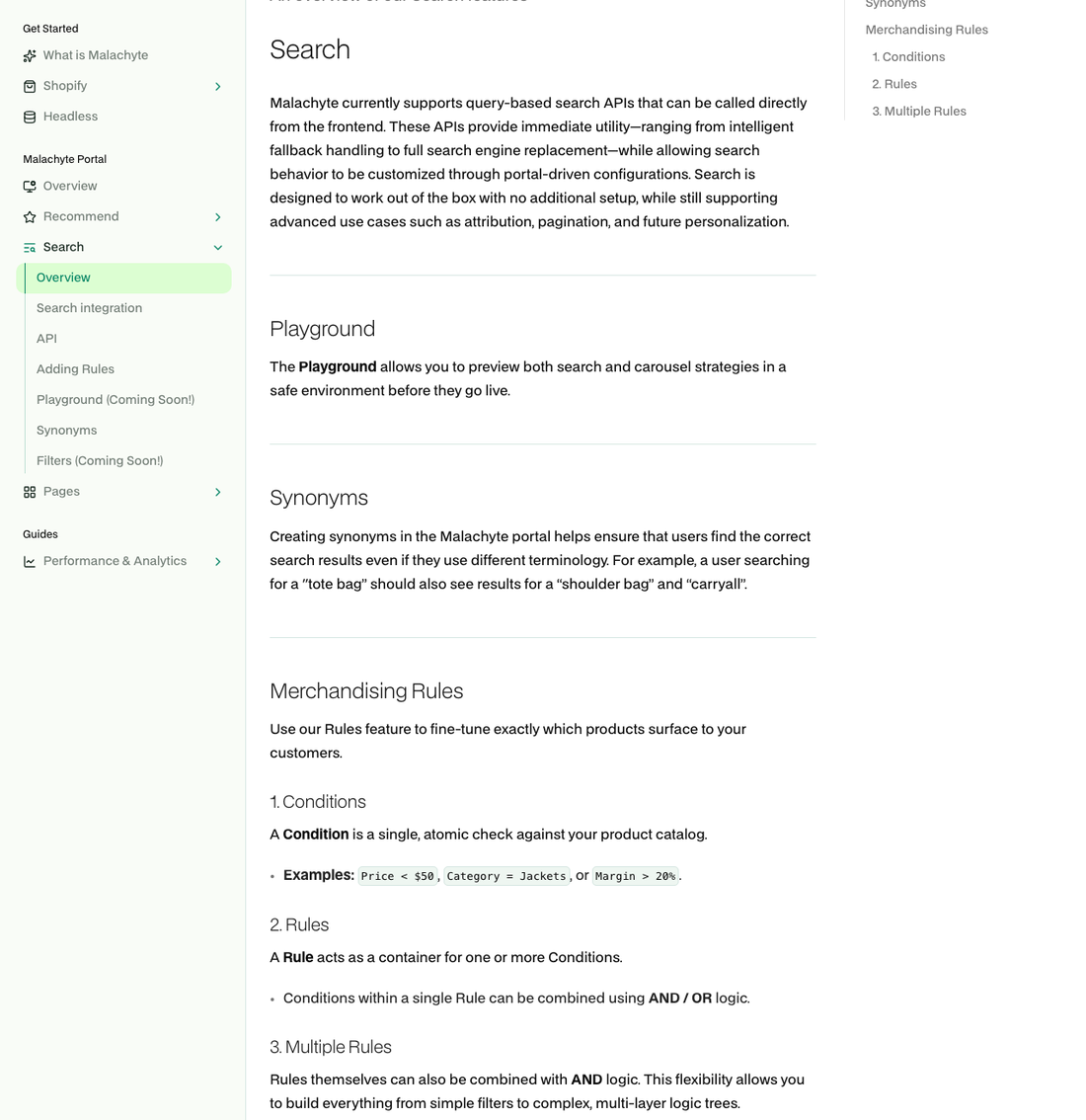
Malachyte reads meaning semantically, but synonyms are still created by hand in the portal. Source.
Malachyte reads meaning out of the box. Its docs describe semantic understanding that recognizes synonyms and context, so "crimson parka" surfaces "red winter jackets." It still relies on synonyms you create by hand in the portal for terms it does not infer.
Algolia starts as a keyword engine. Semantic matching comes from NeuralSearch, which "adds vector search to your keyword search, then merges and ranks the results."
The catch is the tier. NeuralSearch carries the callout "this feature isn't available on every plan," and the pricing matrix places it on Elevate, Algolia's top tier. On Grow, you get keyword search plus a synonym workflow.
- Malachyte: semantic understanding included, synonyms still manual.
- Algolia: excellent keyword search; true semantic matching is an Elevate upgrade.
How does each personalize for an anonymous, first-time visitor?
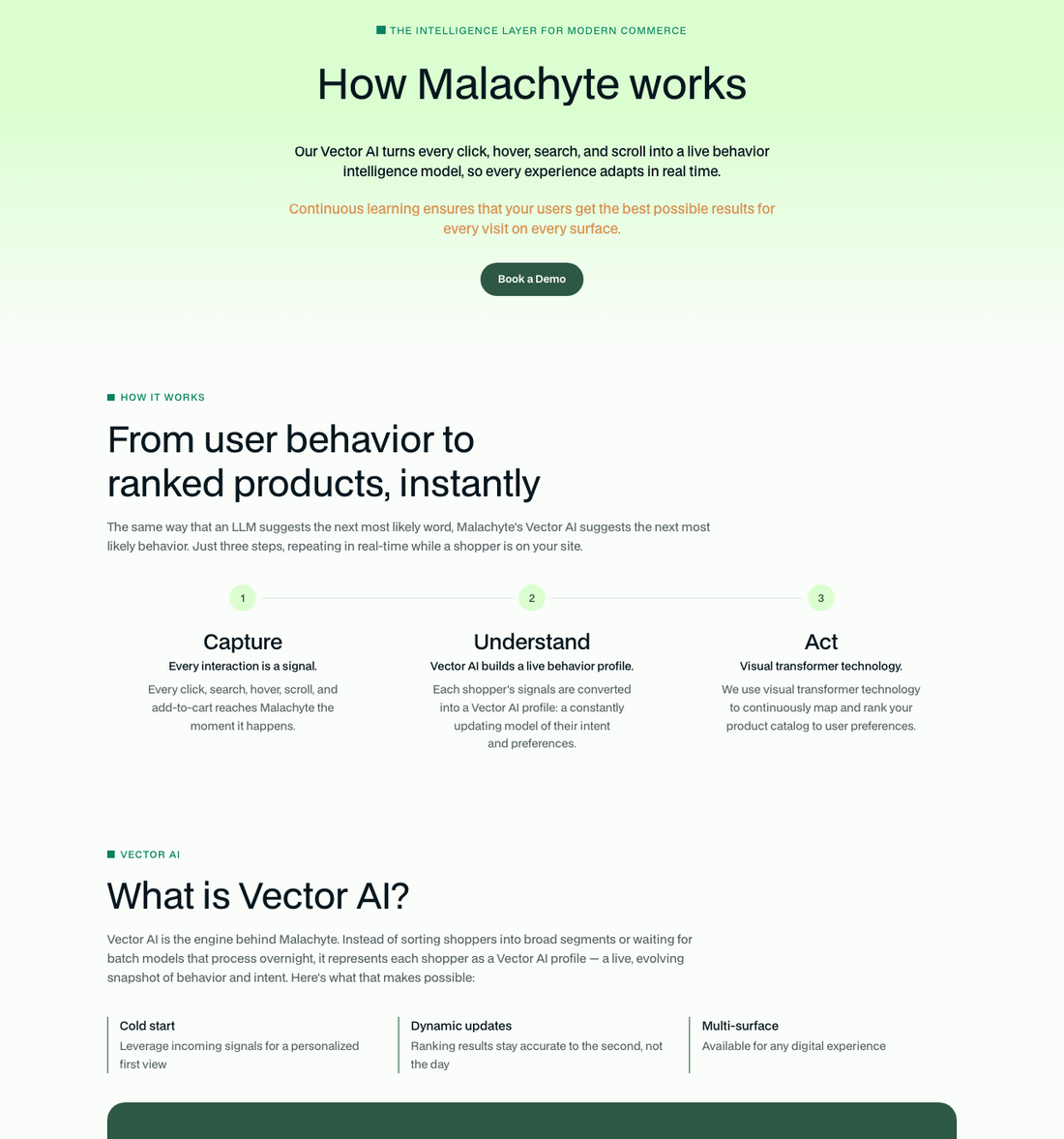
Malachyte's Vector AI builds a live behavior profile from the first click, with no login required. Source.
This is the sharpest difference. Malachyte builds Adaptive User Profiles for 100% of traffic, with no login, cookie, or prior history required to start. Personalizing the first-time visitor is the problem it was built to solve.
Algolia personalizes too, but its behavioral layer leans on aggregate signals. Dynamic Re-Ranking "uses AI to detect trends in user behavior" and refreshes each query's order every 24 hours over a 30-day window.
That is trend-following across users, not a live profile of the individual in front of you, and it sits on the Elevate tier. Per-visitor profile personalization is a separate Algolia capability that depends on captured user events.
- Malachyte: live per-visitor profile from the first click, for anonymous traffic.
- Algolia: aggregate behavioral re-ranking on a 24-hour refresh, gated to Elevate.
How does each rank and re-rank results?
Malachyte ranks with its Vector AI engine, which continuously maps and ranks the catalog to each shopper's preferences and adjusts in-session as behavior changes.
Algolia ranks with a configurable formula whose tiebreaker is custom ranking over a numeric attribute. Any boolean or numeric attribute works, but it sorts by one attribute at a time, and a blended score has to be precomputed upstream and written into each record.
Both let a merchandiser layer rules on top. Malachyte uses Rules and Conditions; Algolia uses Rules that are capped per index by tier.
- Malachyte: real-time, per-visitor ranking with rule overrides.
- Algolia: deterministic custom ranking, plus gated behavioral re-ranking.
Can merchandisers run it without developers?
Malachyte is built for the merchandising team. The Portal is a no-code interface for building experiences, previewing them, and setting rules "without requiring engineers."
Algolia is built for developers. A Shopify merchant review notes the app "does not provide a frontend framework... your developer team will need to implement" the storefront experience. The business-user Merchandising Studio exists, but it is absent on the entry Grow plan.
That split is the practical one. One team ships changes from a dashboard; the other files a ticket, then waits.
- Malachyte: no-code portal for merchandisers.
- Algolia: developer implementation, with the merchandiser UI gated above Grow.
How does each handle Shopify specifically?
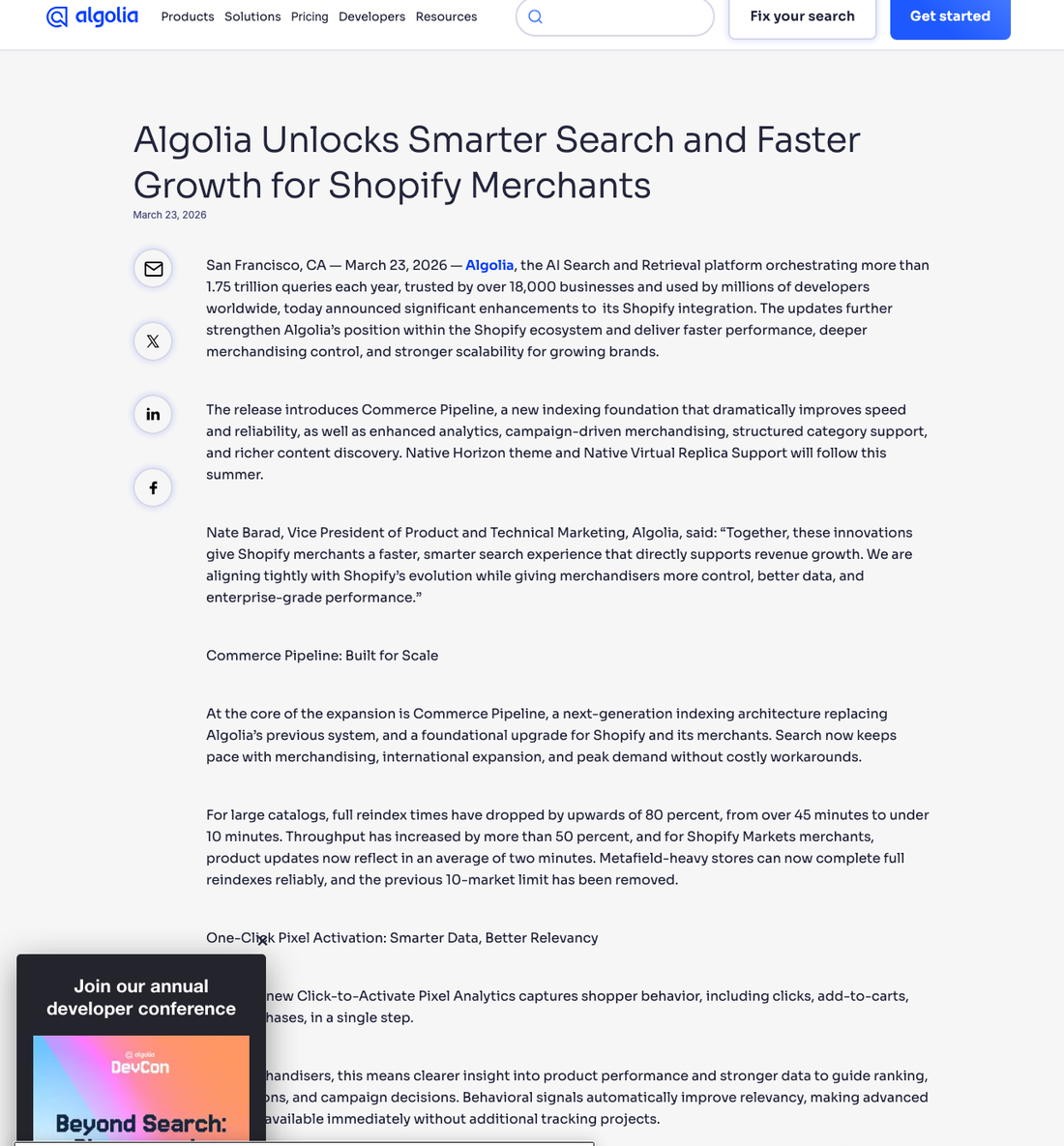
Algolia's 2026 Commerce Pipeline added native Shopify taxonomy indexing and about two-minute update latency. Source.
Algolia has invested in Shopify depth. Its 2026 Commerce Pipeline now "indexes Shopify's Standard Product Taxonomy," and Markets support creates one index per market and language, enabled on request.
Malachyte integrates through a custom Shopify app that syncs product fields (title, price, availability, tags, collections) daily, with real-time webhook updates. Its docs do not detail Shopify Markets, combined listings, or metafields as native objects.
Neither is Shopify-exclusive. Algolia is a general-purpose API with many platform integrations; Malachyte supports both Shopify and custom-built sites.
- Malachyte: syncs core product fields; native Plus objects undocumented.
- Algolia: native taxonomy and Markets, one index per market.
Does either offer visual or image search?
Neither ships shopper-facing camera search in the way a visual-first tool does. Malachyte's Search API is text-query only; its "visual transformer" maps the catalog to preferences for ranking, not a shopper photo query.
Algolia's native capability is LookingSimilar, which recommends visually similar items. For an image-query search bar, its docs direct you to a third-party image-recognition service.
So a shopper cannot upload a photo and search either catalog without extra work.
- Malachyte: no image query; visual AI is for ranking.
- Algolia: visually-similar recommendations, no native camera search.
What does each cost?
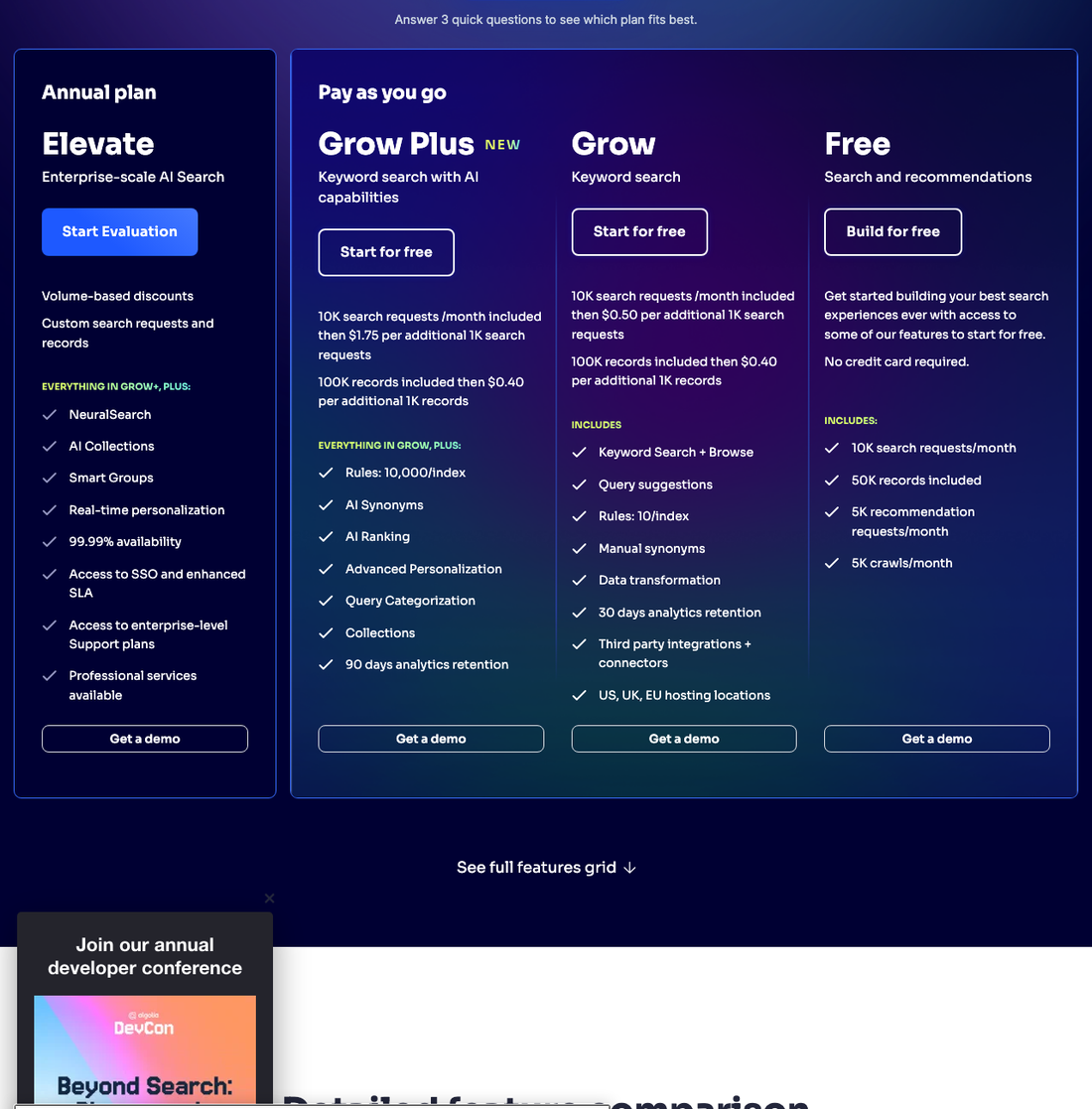
Algolia's pricing: NeuralSearch and real-time personalization sit on the top Elevate tier; Grow includes manual synonyms. Source.
Algolia publishes its pricing. It is usage-based, billed on search requests and records, with Grow at $0.50 per 1,000 extra searches and Grow Plus at $1.75 per 1,000, the tier where more AI turns on. Elevate is custom.
The recurring complaint is predictability. One developer summed it up: "It's basically impossible for me to know whether... Algolia will cost $100/month or $1,000/month or $10,000/month."
Malachyte does not publish pricing. There is no public price list or tier table as of September 2026, so cost requires a sales conversation.
- Malachyte: quote-only, no published tiers.
- Algolia: public usage-based pricing that is hard to forecast.
How mature and proven is each?
Algolia is the established option. It has operated since 2012, serves thousands of businesses, and carries a deep independent review base across G2, Capterra, and TrustRadius.
Malachyte is new. It was in testing since 2024 and reached Shopify general availability in June 2026. Its team built the personalization systems behind Spotify, but the commerce product is early and has no independent review corpus yet.
The tradeoff is proven scale against a newer, more real-time approach. Both are defensible, depending on your risk appetite.
- Malachyte: novel technology, early product, no third-party reviews yet.
- Algolia: proven at scale, large review base, thirteen years in market.
What are customers saying?
Algolia has a large, mixed review base: ~4.5/5 on G2 (450+), 4.7/5 on Capterra (74), and 4.4/5 on TrustRadius (134).
On the Shopify App Store it drops to 3.5/5 across 35 reviews, split between strong praise and cost complaints.
The praise centers on speed and developer experience. The gripes center on cost and the need for developers: support "requires... min $12,000 USD a year", per one merchant.
Malachyte has no independent review corpus yet, expected for a platform that reached GA in June 2026. Its evidence is press coverage and vendor case studies. Gradient's note cites early results, but those are vendor-reported, not third-party audited.
Top similarities between Malachyte and Algolia
Both are AI-era discovery layers, not native Shopify search
Each replaces Shopify's built-in search and merchandising with a more capable engine. Neither is a simple filter app; both aim to own the discovery experience end to end.
Both use behavioral signals to rank
Malachyte reads clicks, hovers, and scrolls in real time. Algolia's Dynamic Re-Ranking learns from click and conversion events. The difference is per-visitor versus aggregate, and real-time versus a 24-hour refresh.
Both give merchandisers rule-based control
Each offers a rules layer to boost, bury, or pin products on top of the algorithm. Malachyte uses Conditions and Rules; Algolia uses Rules capped per tier.
Both run beyond Shopify
Neither is Shopify-exclusive. Algolia is a general-purpose API, and Malachyte supports Shopify and custom-built sites. If you run multiple platforms, either can follow you.
Both keep the catalog in near real-time sync
Algolia reflects updates in about two minutes. Malachyte uses real-time Shopify webhooks for create, update, and delete events, alongside a daily full sync.
Both are credible, capable engines
This is not a strong-versus-weak matchup. Algolia is a proven search platform, and Malachyte's personalization technology has a real pedigree. The right pick depends on which half of discovery you are solving for.
How to choose
Choose Malachyte if your priority is real-time personalization for anonymous visitors and you want a no-code tool your merchandising team runs without developers. Be ready to adopt a new platform whose search is still maturing, with pricing by quote.
Choose Algolia if you have developers, want a proven, high-performance search API, and can manage usage-based billing. You should be prepared to reach its top tier for semantic search and behavioral re-ranking, and to build the storefront experience yourself.
Is there an option built only for Shopify Plus?
If you are on Shopify Plus, both of these ask you to accept a compromise.
Malachyte leads with personalization and treats Shopify as one of several platforms. Algolia is a general-purpose API that prices its AI as an upgrade. Neither was built only for Shopify Plus.
That is the gap we built Layers for. We are the AI search and merchandising platform made exclusively for Shopify Plus, so we do not have to assume a generic storefront or bolt on Shopify support.
Where we work differently:
- Semantic search on every query with no synonym lists to maintain, included rather than gated to a top tier.
- Shopper camera and image search, shipped, so a photo becomes a query.
- Ranking that blends margin and return rate into one sort score, run by merchandisers.
- Shopify Markets, combined listings, and metafields as native objects across a single index.
- Metafields as searchable attributes, so a wholesale or support search for a style number returns the exact product.
On the calls we run with Shopify Plus brands, the same theme comes up: teams want search and merchandising to lead, owned by their merchandising team.
David Cost, VP of eCommerce at Rainbow Shops, told us Layers "was the first time we were able to create the kind of sort orders we were used to having in Salesforce," with "a pretty immediate impact on conversion rate."
Where we are the wrong fit: if you sell on Magento, BigCommerce, or Salesforce Commerce Cloud, we are not your tool.
If your single goal is 1:1 real-time personalization for anonymous shoppers, Malachyte's approach may fit better. If you want a raw, developer-owned search API, Layers vs Algolia shows where Algolia wins.
FAQ
Is Malachyte a search engine or a personalization tool? Primarily a personalization engine. It has search, but the core is real-time individualization, and its search personalization is labeled a future capability.
Does Algolia include semantic search on every plan? No. Algolia's semantic layer, NeuralSearch, is gated to the Elevate tier. Entry plans get keyword search and a synonym workflow.
Which is better for a first-time, anonymous visitor? Malachyte is built for exactly that case, personalizing from the first click without a login or cookie. Algolia's behavioral re-ranking is aggregate and refreshes every 24 hours.
Do either require developers? Algolia does; a merchant review notes it does not provide a frontend framework. Malachyte offers a no-code portal for merchandisers.
How much do they cost? Algolia publishes usage-based pricing that many find hard to forecast. Malachyte is quote-only with no published tiers.
If you are on Shopify Plus and want search, merchandising, and personalization as one native platform, run both against your own catalog, and put Layers in the same test.
Written by

Lukas Tanasiuk
Co-Founder & CRO, Layers
Lukas Tanasiuk is Co-Founder and CRO of Layers, the enterprise search and merchandising platform built exclusively for Shopify Plus. He has spent over a decade in Shopify ecommerce and CRO, and speaks with enterprise merchants about search and merchandising every week.
View all articlesRelated articles
More reading on search, merchandising, and product discovery.
Malachyte vs Constructor: Top Differences and Similarities (2026)
Malachyte brings real-time, anonymous-first personalization. Constructor is a proven enterprise discovery engine. Compare the two on search, merchandising, pricing, and fit.
Lukas Tanasiuk
Sep 23, 2026 · 10 min read
Malachyte vs Nosto: Top Differences and Similarities (2026)
Malachyte reads intent in real time for anonymous shoppers. Nosto is a proven personalization platform with a full search module. Here is how the two compare in 2026.
Lukas Tanasiuk
Sep 23, 2026 · 10 min read
8 Best Malachyte Alternatives for Shopify Plus (2026)
Malachyte brings real-time, Spotify-style personalization to anonymous shoppers, but it is new, personalization-first, and quote-only. Compare the 8 best Malachyte alternatives for Shopify Plus.
Lukas Tanasiuk
Sep 23, 2026 · 15 min read