Malachyte vs Nosto: Top Differences and Similarities (2026)
Malachyte reads intent in real time for anonymous shoppers. Nosto is a proven personalization platform with a full search module. Here is how the two compare in 2026.
Key takeaways
Malachyte and Nosto both promise to personalize the store for each shopper. They arrive at it from opposite ends.
Nosto has spent more than a decade building personalization and recommendations, then added search by acquisition. Malachyte is a 2026 entrant built by an ex-Spotify team, starting from real-time behavioral intent and adding merchandising and search around it.
This piece compares the two on the features that decide the buy, then covers where they overlap and who each one fits.
Overview
Malachyte is a real-time individualization platform founded by ex-Spotify engineers, generally available on Shopify since June 2026. It raised a $10M seed co-led by Bessemer and Gradient in August 2026.
It builds a live behavioral profile for every visitor, including logged-out ones, and uses it to rank recommendations and search.
Nosto is a Commerce Experience Platform rooted in personalization and recommendations. Its search product, Nosto Search and Categories, runs on the Findologic engine it acquired in December 2022. It added native Shopify Markets support in 2024 and agentic AI in 2025.
Top differences between Malachyte and Nosto
Platform and Shopify fit
| Capability | Malachyte | Nosto |
|---|---|---|
| Built only for Shopify | No | No |
| Native Shopify Markets (regions, currencies) | Not documented | Yes |
| Shopify combined listings ingested natively | Not documented | Partial |
| Catalog updates in near real time | Yes | Partial |
Search
| Capability | Malachyte | Nosto |
|---|---|---|
| Dedicated search product | Partial, newer surface | Yes, full module |
| Semantic understanding | Yes | Gated to search module |
| Works without hand-built synonym lists | Partial | Partial |
| Shopper-facing image or camera search | No | No |
| Multilingual search | Not documented | Partial, 28 languages |
Merchandising
| Capability | Malachyte | Nosto |
|---|---|---|
| Rules to boost, bury, and pin | Yes | Yes |
| Multiple saved sort orders per collection | Not documented | Yes |
| Margin and inventory in ranking | Yes | Yes |
| Return rate in ranking | No | Partial, custom tag |
| Scheduled and Market or UTM-varying sort | Not documented | Yes |
AI and personalization
| Capability | Malachyte | Nosto |
|---|---|---|
| 1:1 personalization | Yes | Yes |
| Real-time intent from the first click | Yes | Partial |
| Personalizes anonymous, cold-start visitors | Yes | Partial |
| ML reranking from behavior | Yes | Yes |
Pricing and reviews
| Malachyte | Nosto | |
|---|---|---|
| Pricing model | Quote-only, none published | Quote-only, revenue-indexed |
| Independent reviews | None yet | G2 4.4/5 |
Verified September 2026 from each vendor's product documentation and independent review sites. Features and pricing change; confirm before you buy.
How does each one personalize a shopper?
Both platforms personalize for the individual, not just a segment. The difference is what they start from and how quickly they act.
Malachyte builds an Adaptive User Profile for 100% of traffic, updating it in-session from clicks, hovers, and scrolls. It is designed to act on the first click, before any login or purchase history exists.
Nosto personalizes 1:1 from affinities and preferences it has learned about a visitor. It is mature and proven, and it leans on signals that accumulate as Nosto sees more of a shopper.
Which one handles the anonymous, first-time visitor?
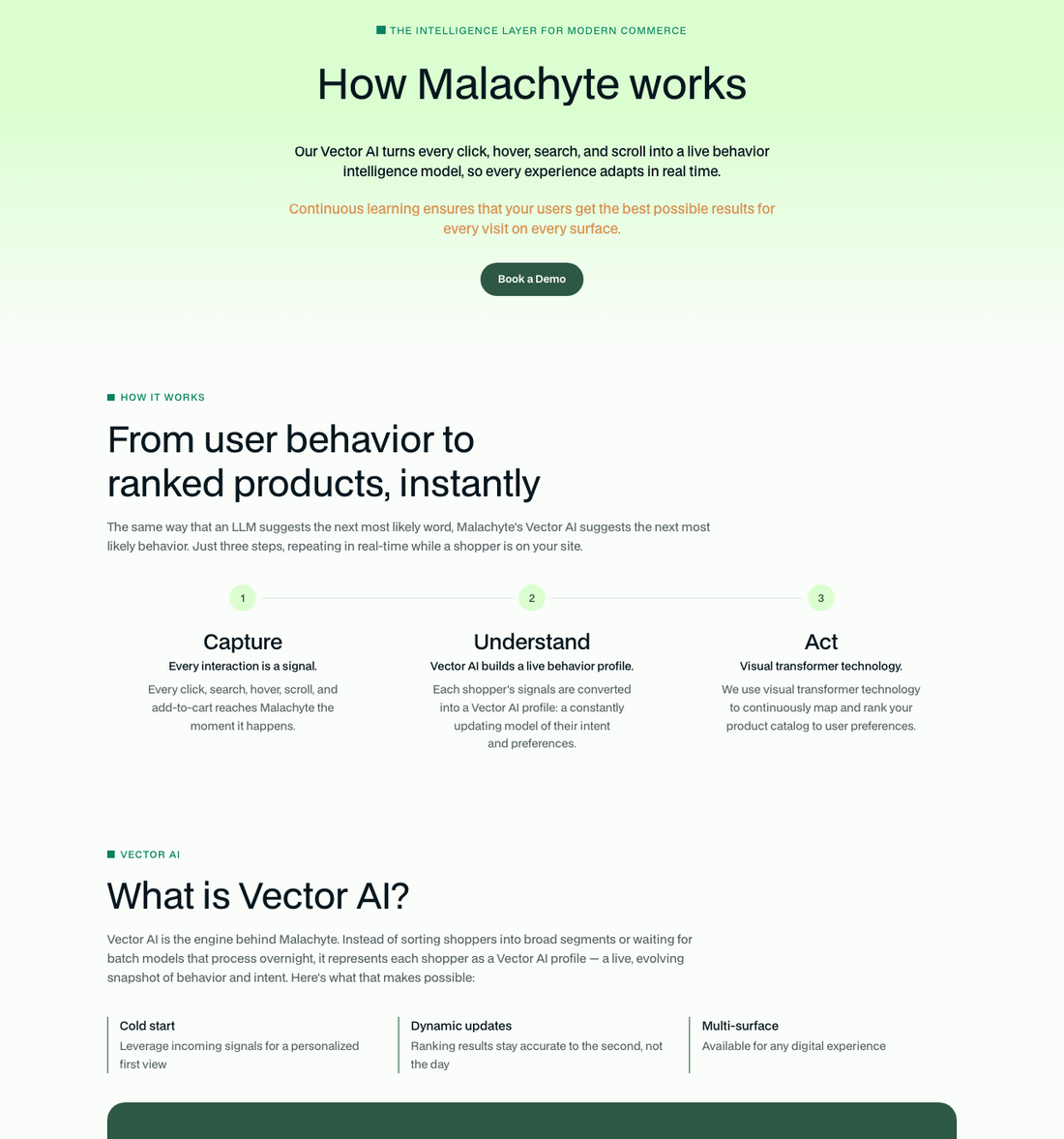
Malachyte's Vector AI builds a live behavior profile from the first click, with no login or cookies required. Source.
This is Malachyte's sharpest claim. It is built to read intent for a shopper with no login, cookie, or history, which is most of the traffic on a typical store.
Malachyte's cold-start activation starts personalizing the moment a visitor arrives. Its investors cite this anonymous-visitor gap as the reason they funded it.
Nosto personalizes anonymous sessions too, but its documented model centers on learned affinities, so the strongest experiences build as it gathers signal. For a store where most visitors are new, that difference matters.
How mature is each one's search?
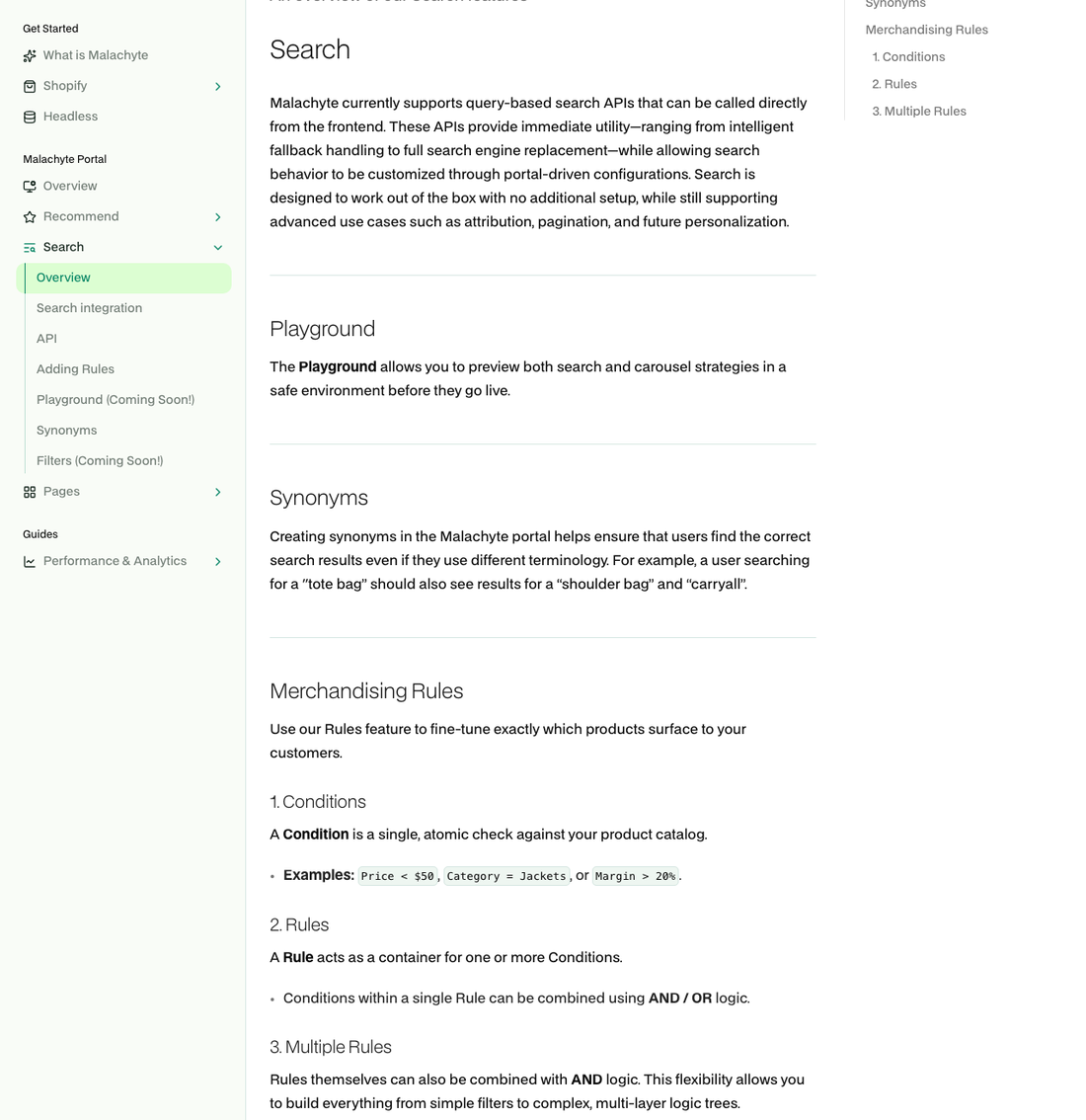
Malachyte's search docs: synonyms are created by hand in the portal, and the Playground is marked coming soon. Source.
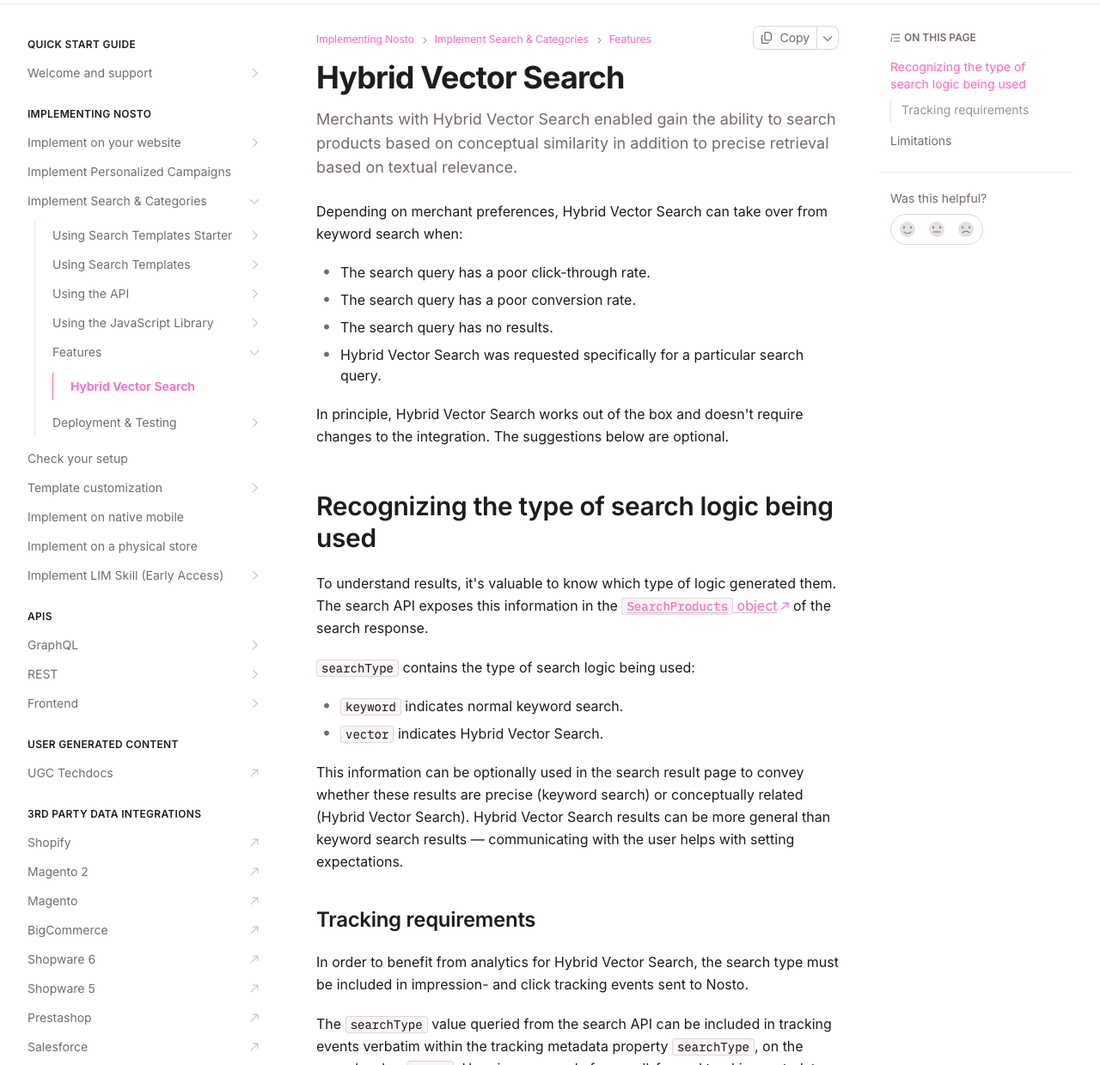
Nosto's Hybrid Vector Search takes over from keyword search only on poor click-through, poor conversion, or zero results. Source.
Nosto has the more established search product. Malachyte's search works, but it is the newer of its two surfaces.
Nosto's Search and Categories module runs on the Findologic engine and includes NLP query understanding, typo tolerance, facets, and Hybrid Vector Search.
The catch: semantic matching engages conditionally, on poor click-through or zero results, rather than on every query. Search is also sold as a separate module.
Malachyte's search offers typo tolerance, semantic understanding, and autocomplete, but synonyms are created by hand and full search personalization is labeled a future capability.
Can shoppers search by photo?
Neither one lets a shopper search with an image. Both search APIs take text queries only.
Malachyte's Search API accepts a text query and returns ranked results. Its "visual transformer" maps the catalog to preferences for ranking; it is not a shopper-facing image input.
Nosto's Search API also accepts a text query only. Its "VisualAI" branding refers to recommendation-side visual similarity, not an image search box for shoppers.
How strong is each one's merchandising?
Nosto has the deeper documented merchandising toolkit today. Malachyte's is capable but younger.
Nosto documents multiple sort orders, weighted multi-metric ranking, sequencing, scheduling, and Market or UTM-based rules, with margin and inventory as native metrics. Return rate is available only through a custom tag.
Malachyte offers a Rules and Conditions engine with pinning, boosting, and margin conditions, plus dynamic collection sorting. Saved sort orders, scheduling, and Market or UTM logic are not documented.
How does each fit Shopify?
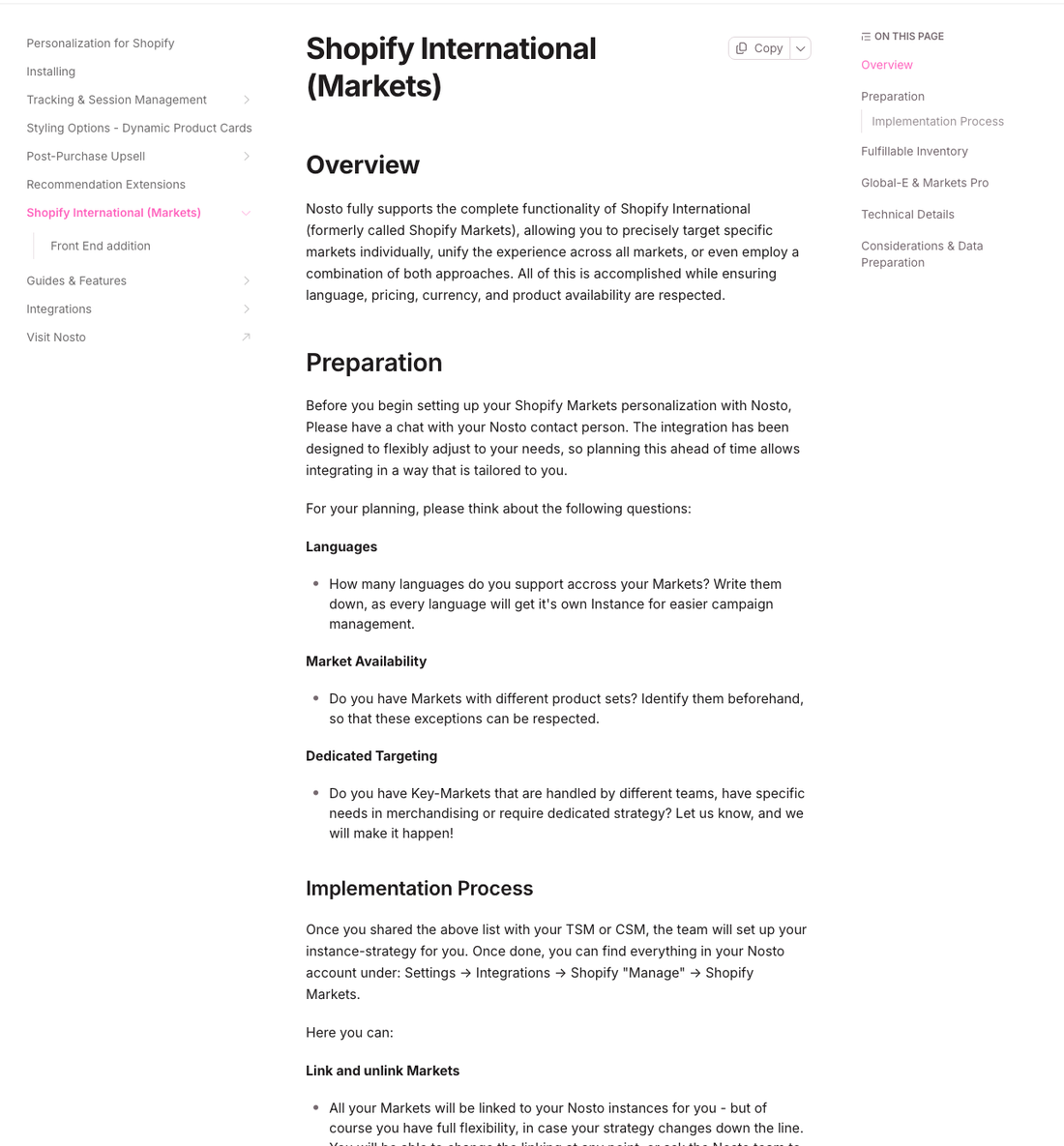
Nosto supports Shopify Markets with one Nosto account per market and language. Source.
Both run on Shopify, but neither is Shopify-only, and Nosto's native Shopify support is more documented.
Nosto fully supports Shopify Markets, respecting language, currency, and availability, and ships Theme App Extensions. Its architecture uses one account per market and language.
Malachyte integrates today through a custom Shopify app, with a Theme App Extension model planned for a future version. It also runs on headless and custom sites. Native Shopify Markets support is not documented.
What does each one cost?
Both are quote-only, so you cannot price either without a sales conversation. The pricing shapes differ.
Nosto's license is indexed to your revenue, so the bill climbs with GMV. Vendr lists an average contract around $47,591, and the loudest reviews concern annual lock-in and billing after cancellation.
Malachyte publishes no pricing, tiers, or model as of September 2026. There is no public reference point at all, which is common for a vendor this early.
How proven is each one at scale?
Nosto is the proven platform; Malachyte is the promising newcomer. That is the plainest difference between them.
Nosto has years of merchants, a large customer base, and an independent review record you can check. Its personalization and merchandising are its most-praised work.
Malachyte reached general availability on Shopify in June 2026. The team's Spotify pedigree is real and its early results are cited by investors, but there is no independent review base yet, and its track record at retail scale is short.
What are customers saying?
Nosto holds a G2 rating of 4.4/5, where reviewers rate recommendations and merchandising as its strongest work and frequently name their CSM.
On the upside, one Shopify merchant calls it a "robust platform with tons of features and opportunity to get really granular".
The recurring gripe is commercial, not technical: annual lock-in and billing after cancellation, plus "some slowness with technical support in recent years" as the company scales.
Malachyte has no independent review base yet. It is too new for a G2, Capterra, or Shopify App Store corpus.
Its public evidence is press coverage of its seed round and vendor case studies, which are vendor-reported rather than independently verified.
Top similarities between Malachyte and Nosto
For all their differences, these two overlap more than the marketing suggests.
Both are personalization-first
Neither started as a search company. Both center on individualizing the experience, with search and merchandising built around a personalization core.
Both personalize 1:1, beyond segments
Malachyte builds a per-visitor profile; Nosto personalizes 1:1 from learned affinities. Both go beyond broad audience buckets.
Both use ML to rank results and recommendations
Both apply machine learning to reranking and recommendations rather than static rules alone, and both let merchandisers layer rules on top.
Both are quote-only
Neither publishes standard pricing. Expect a sales conversation and a custom quote from either one.
Both search by text, not image
Both search APIs accept text queries only. If shopper-facing image search matters, neither is the answer.
Both run on more than Shopify
Nosto integrates with several platforms; Malachyte runs on Shopify and on headless or custom stacks. Neither is a Shopify-exclusive tool.
How to choose between Malachyte and Nosto
Choose Malachyte if real-time personalization for anonymous visitors is your priority and you can adopt a young platform. Its cold-start approach is novel, and new-visitor traffic is where it aims to win. Test it against your stack first.
Choose Nosto if you want proven, mature personalization with a real search module, and can accept revenue-indexed, quote-only pricing on annual terms. It is the lower-risk pick if you need personalization working now.
Is there an option built only for Shopify Plus?
Both Malachyte and Nosto run on more than Shopify, and both treat search as the surface built around personalization rather than the main event.
If you are on Shopify Plus and want search and merchandising to lead, natively, that gap is the reason we built Layers.
Where we work differently:
- We build only for Shopify Plus, reading combined listings, metafields, B2B, and Markets as native objects.
- We serve every Market, currency, and language from one index, not one account per locale.
- Your shoppers can search by photo, which neither text-only engine here offers.
- You blend margin and return rate into ranking, and a merchandiser runs it without developer tickets.
- Read metafields as searchable attributes, so a wholesale or support search for a style number returns the exact product.
David Cost, VP of eCommerce at the 9-figure apparel brand Rainbow Shops, said Layers "was the first time we were able to create the kind of sort orders we were used to having in Salesforce," with "a pretty immediate impact on conversion rate."
Where we are the wrong fit: if you are not on Shopify Plus, if a general-purpose 1:1 personalization engine for anonymous traffic is your single goal, or if you run a very small catalog.
In those cases, one of the tools above serves you better. We compare ourselves directly in Layers vs Malachyte and Layers vs Nosto.
FAQ
Is Malachyte better than Nosto? Neither is universally better. Malachyte is stronger on real-time, cold-start personalization for anonymous visitors. Nosto is more proven, with a fuller search module and a longer track record.
Does Malachyte have search like Nosto? Both have search. Nosto's is a full module built on the acquired Findologic engine. Malachyte's is newer, with hand-built synonyms and a text-only API, and full search personalization is still on its roadmap.
How much do Malachyte and Nosto cost? Both are quote-only. Nosto is revenue-indexed, averaging around $47,591 a year on Vendr. Malachyte publishes no pricing at all as of September 2026.
Do either support Shopify Markets? Nosto fully supports Shopify Markets. Malachyte does not document native Shopify Markets support as of September 2026.
Which is better for a Shopify Plus brand? If personalization is your single priority, test either. If you want native Shopify Plus search and merchandising as the lead, a Shopify-exclusive platform like Layers is worth comparing against both.
Written by

Lukas Tanasiuk
Co-Founder & CRO, Layers
Lukas Tanasiuk is Co-Founder and CRO of Layers, the enterprise search and merchandising platform built exclusively for Shopify Plus. He has spent over a decade in Shopify ecommerce and CRO, and speaks with enterprise merchants about search and merchandising every week.
View all articlesRelated articles
More reading on search, merchandising, and product discovery.
Malachyte vs Algolia: Top Differences and Similarities (2026)
Malachyte brings real-time, cold-start personalization. Algolia is a developer-first search API with AI gated to its top tier. See how the two compare for Shopify.
Lukas Tanasiuk
Sep 23, 2026 · 12 min read
Malachyte vs Constructor: Top Differences and Similarities (2026)
Malachyte brings real-time, anonymous-first personalization. Constructor is a proven enterprise discovery engine. Compare the two on search, merchandising, pricing, and fit.
Lukas Tanasiuk
Sep 23, 2026 · 10 min read
8 Best Malachyte Alternatives for Shopify Plus (2026)
Malachyte brings real-time, Spotify-style personalization to anonymous shoppers, but it is new, personalization-first, and quote-only. Compare the 8 best Malachyte alternatives for Shopify Plus.
Lukas Tanasiuk
Sep 23, 2026 · 15 min read