Malachyte vs Constructor: Top Differences and Similarities (2026)
Malachyte brings real-time, anonymous-first personalization. Constructor is a proven enterprise discovery engine. Compare the two on search, merchandising, pricing, and fit.
Key takeaways
Overview
Malachyte launched publicly in 2026. Its founders built the user-vector systems behind more than 90% of Spotify's recommendations, and the company raised a $10M seed co-led by Bessemer and Gradient.
It builds a live behavioral profile for 100% of traffic, including anonymous visitors, then ranks recommendations and search from that profile. It runs on Shopify and headless stacks.
Constructor has sold enterprise product discovery for years. Its retrieval pairs an in-house inverted index with Cognitive Embeddings Search, and a multi-signal model ranks toward configurable KPIs.
It is platform-agnostic, with connectors for Shopify, BigCommerce, Salesforce Commerce Cloud, and others. Its $25M Series B in 2024 valued it at $550M.
Top differences between Malachyte and Constructor
Verdict ladder: Yes, Gated, Partial, No. Verified September 2026 from each vendor's public documentation.
Platform and Shopify fit
| Capability | Malachyte | Constructor |
|---|---|---|
| Near real-time catalog sync | Yes | Partial (5-minute delta batches) |
| Native Shopify combined listings | Not documented | Partial (listings, not bundles) |
| Native Shopify Markets (per-region catalogs) | Not documented | Partial (separate index per market) |
| One index across every language | Not documented | No (separate index per locale) |
Search
| Capability | Malachyte | Constructor |
|---|---|---|
| Semantic understanding | Yes | Yes |
| Typo tolerance and autocomplete | Yes | Yes |
| Semantic without manual synonym lists | Partial (synonyms still manual) | Yes |
| Shopper-facing camera or image search | No (text queries only) | Yes (Image Search v2) |
Merchandising
| Capability | Malachyte | Constructor |
|---|---|---|
| Rules engine to boost or bury | Yes | Yes |
| Scheduled, time-based merchandising | Not documented | Yes |
| Margin and inventory in ranking | Partial (no return rate) | Yes |
| Visual preview before publishing | Yes (Playground) | Partial (live diagnostic only) |
AI and personalization
| Capability | Malachyte | Constructor |
|---|---|---|
| ML reranking toward business KPIs | Yes | Yes |
| Real-time, in-session learning | Yes | Partial (model retrains several times a day) |
| Cold-start personalization for anonymous visitors | Yes | Partial (segment and context based) |
| Generative AI shopping agent | Not documented | Yes |
Pricing and reviews
| Capability | Malachyte | Constructor |
|---|---|---|
| Public pricing | No (quote-only) | No (quote-only, ~$150K/yr avg) |
| Self-serve or fast entry path | Partial (native Shopify app) | No (enterprise contracts only) |
| Independent review corpus | No (GA June 2026) | Yes (Gartner, G2) |
How does each rank products?
Both rank on behavior rather than keyword position, which is the real dividing line from legacy search. Where they differ is the cadence of learning and the breadth of signals.
Constructor blends eight signal categories into one score, including personalization, popularity, and item metadata, and retrains its models several times a day. You can optimize toward revenue, conversion, or profit.
Malachyte represents each shopper as a live Vector AI profile and updates ranking within the session as the shopper clicks and scrolls. Its edge is speed and recency; Constructor's edge is the number of signals and the years of tuning behind them.
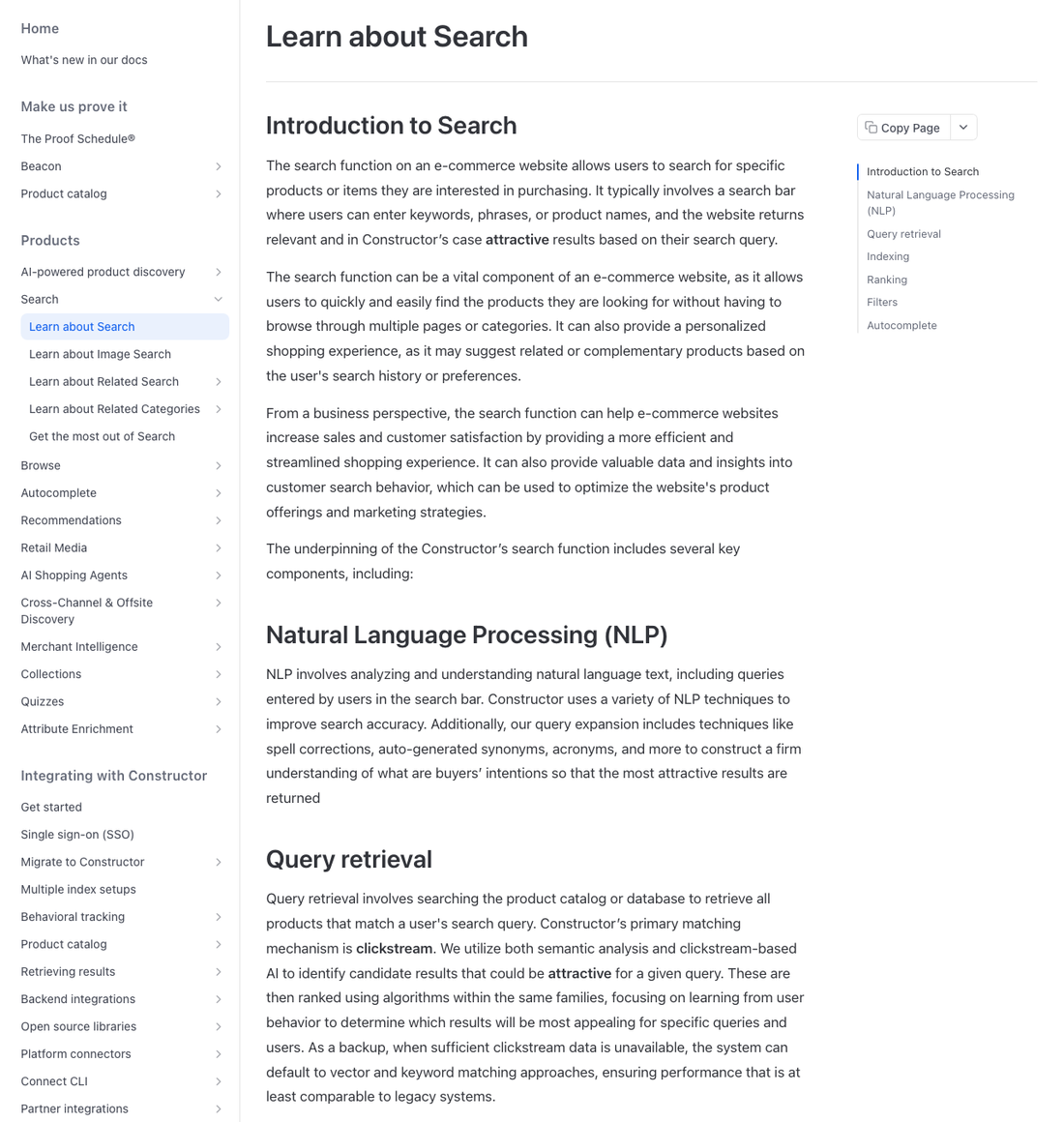
Constructor's search combines NLP and clickstream-based ranking, with vector and keyword matching as a backup. Source.
- Constructor: broad multi-signal ranking, retrained several times daily.
- Malachyte: live per-shopper vector, updated inside the session.
How good is each at search?
Both go well beyond keyword matching. The gap is breadth: Constructor's search is older and wider, and Malachyte's is newer.
Constructor ships semantic retrieval, typo tolerance, price detection in queries, acronym expansion, and camera-based Image Search v2. Malachyte ships semantic understanding, typo tolerance, and predictive autocomplete, with redirect logic for poor queries.
Two gaps stand out on the Malachyte side. Its synonyms are created by hand in the portal, and its search API is text-query only, so shoppers cannot search by photo. Malachyte also labels full search personalization a future capability.
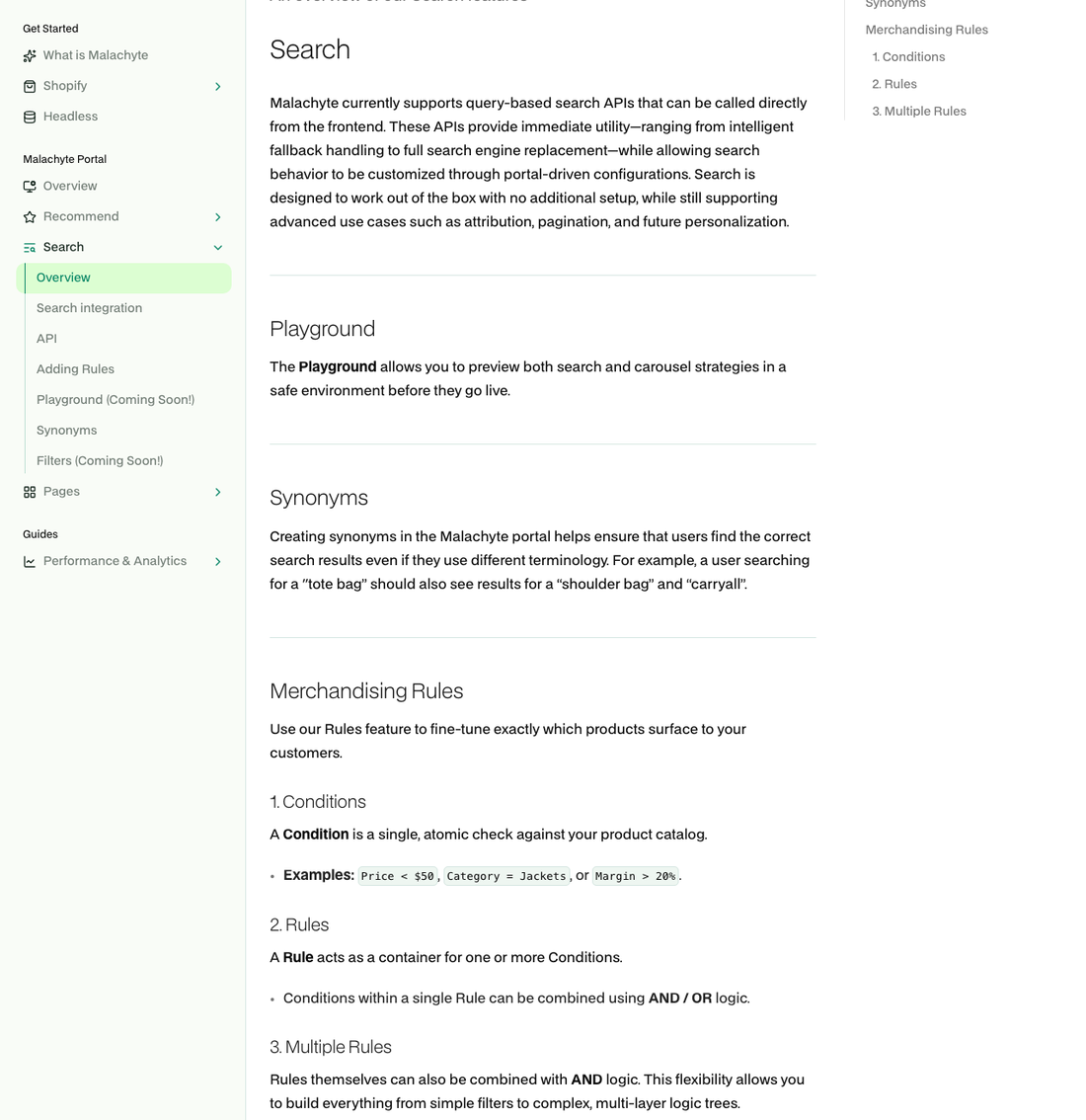
Malachyte's search docs: synonyms are created by hand in the portal, and the Playground is marked coming soon. Source.
- Constructor: broader search, native visual search, auto synonym handling.
- Malachyte: solid semantic search, but manual synonyms and text-only queries.
Can each personalize for anonymous, first-time visitors?
This is Malachyte's headline claim, and where it is sharpest. It builds an adaptive profile for every visitor with no login, cookie, or history, and its investors highlighted a head-to-head gain that was largest on brand-new visitors.
Constructor personalizes too, but the documented mechanism leans on the clickstream and audience segments rather than a per-individual profile from the first click. That is powerful for a known shopper. For a first-time anonymous visitor, Malachyte's is the more specific bet.
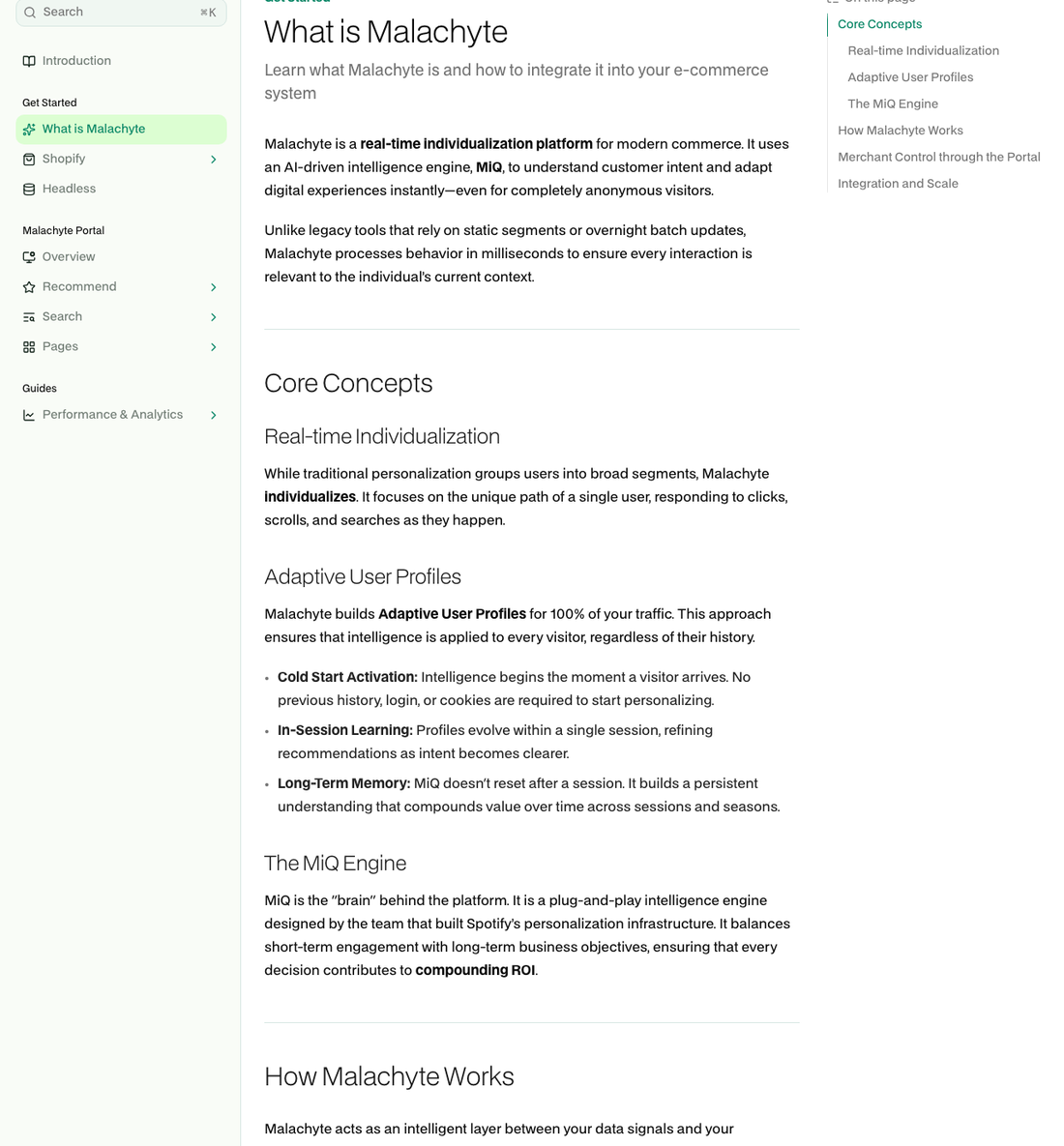
Malachyte builds Adaptive User Profiles for every visitor, including anonymous ones, with no login or cookies required. Source.
- Malachyte: individual profile from the first click, no login required.
- Constructor: strong personalization, weighted toward clickstream and segments.
How does each handle merchandising control?
Both give operators control without code. Constructor's toolkit is deeper and more mature; Malachyte's is simpler and newer.
Constructor's rules engine covers boost, bury, slot, blocklist, and allowlist, with start and end dates for scheduled campaigns and segment targeting. Malachyte uses a Rules and Conditions model with margin and inventory conditions, plus pinning and boosting.
Two practical differences. Malachyte previews strategies in a Playground before they go live, while Constructor's Interact tool inspects live results rather than staging changes. Scheduled, time-based merchandising is documented for Constructor and not for Malachyte.
- Constructor: deeper rules, scheduling, and segment targeting.
- Malachyte: simpler rules, with a live preview Playground.
What does each cost?
Neither vendor publishes pricing, so both require a sales conversation. The difference is the shape of the commitment.
Constructor sells enterprise contracts with no self-serve path, and third-party data puts the average contract around $150,000 a year.
Malachyte is also quote-only, with no published tiers as of September 2026. But it lists a native Shopify app and a fast pilot path rather than a pure enterprise motion.
- Constructor: enterprise contracts, roughly six figures a year.
- Malachyte: quote-only, but with a lighter Shopify entry point.
How fast is each to launch on Shopify?
Speed is a Malachyte selling point and a real difference here. It reports a Golden Path Pilot in days and onboarding in about a week via a native Shopify app.
Constructor is an enterprise deployment. Its Shopify connector is capable, but the platform is built for large, involved rollouts, and the Shopify Connect app launched in September 2024 with no App Store reviews yet. Expect a longer, more hands-on implementation.
- Malachyte: native app, pilot in days.
- Constructor: enterprise rollout, longer implementation.
How does each keep the catalog in sync?
Both maintain a synced copy of your catalog. The freshness differs.
Malachyte pairs a daily full sync with instant webhook updates for create, update, and delete events, so price and availability changes propagate quickly. Constructor recommends a daily full sync with delta updates, and advises against sending updates more than once every five minutes.
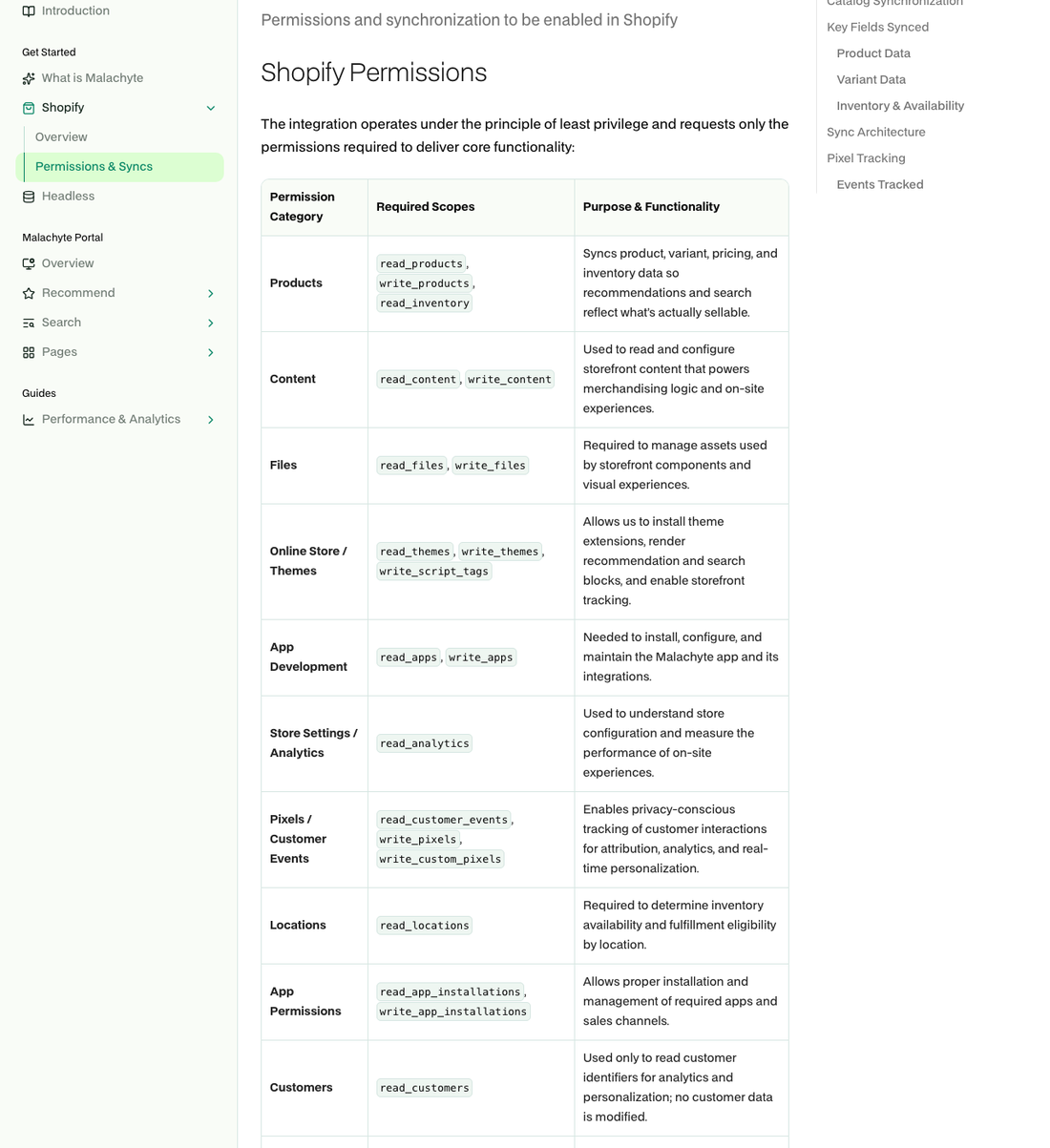
Malachyte runs a daily full catalog sync plus real-time Shopify webhooks for create, update, and delete events. Source.
- Malachyte: instant webhook sync for catalog changes.
- Constructor: batch delta updates, five-minute minimum interval.
Which is proven at scale?
Constructor, clearly. It has years of enterprise deployments, public Gartner Peer Insights and G2 reviews, and security certifications. If a long, checkable track record matters to your risk tolerance, that is a real advantage.
Malachyte is early. It has production results its investors vouch for and named customers, but it reached general availability in June 2026 and has no independent review corpus yet. Strong pedigree, short public history.
- Constructor: proven, reviewed, certified.
- Malachyte: promising and well-backed, but new to GA.
What are customers saying?
Only one of these vendors has an independent review base to read, which is itself worth knowing.
Constructor holds a Gartner Peer Insights rating of 4.9/5 across dozens of reviews and 4.8/5 on G2. Support scores highly. The recurring honest gripe is implementation effort; one Gartner reviewer called the rollout "time-heavy but support was provided."
Malachyte has no meaningful third-party review presence yet, since it reached GA in June 2026. Its investor cites a 17% new-visitor RPV lift at Jordan Craig, but treat that as a vendor case study, not an independent review.
Top similarities between Malachyte and Constructor
For all their differences, these two agree on the core thesis of modern discovery.
Both are AI-native, not keyword engines with ML bolted on
Constructor's dual retrieval and Malachyte's Vector AI both start from learned representations of shoppers and products, not from a keyword index with rules layered over it.
Both rank on behavior toward business outcomes
Constructor optimizes toward revenue, conversion, and profit. Malachyte ranks from a live behavioral profile and lets operators steer toward goals like high-margin prioritization.
Both use semantic understanding
Each interprets meaning and intent rather than exact strings, so a query like "summer outfit" returns useful results rather than a near-empty page.
Both give merchandisers no-code control
Constructor's searchandizing rules and Malachyte's Portal both let merchandisers set rules and overrides without engineering tickets.
Both are quote-only
Neither publishes pricing. Budget and terms come from a sales conversation in both cases, which makes side-by-side cost comparison harder than with published-price tools.
Both run beyond Shopify
Constructor is platform-agnostic by design, and Malachyte supports Shopify and headless stacks. Neither is built exclusively for Shopify.
How to choose
Choose Constructor if you are an enterprise retailer that wants the broadest, most proven discovery platform, with native visual search, deep scheduled merchandising, and a checkable track record, and you have the budget and team for an enterprise rollout.
Choose Malachyte if your priority is real-time, in-session personalization for anonymous visitors, you want a fast Shopify launch, and you are comfortable betting on a newer vendor for that specific edge.
Is there an option built only for Shopify Plus?
On the evaluations we run with Shopify Plus brands, both tools above come up constantly.
Both also run across multiple platforms, so neither is tuned to the specifics of a Shopify Plus catalog. That is the gap we built Layers for.
We are not a general discovery engine and not a 1:1 personalization engine. We are AI search and merchandising built only for Shopify Plus, where the depth is native rather than synced.
Where we work differently:
- Semantic search across 100+ languages in a single index, so one index covers every Market.
- Shopper-facing camera and image search, shipped.
- Ranking that blends margin and return rate into one sort score.
- Near real-time webhook sync and native metafields, combined listings, and Shopify Markets.
- Metafields as searchable attributes, so a wholesale or support search for a style number returns the exact product.
David Cost, VP of eCommerce at a 9-figure apparel brand (Rainbow Shops), said Layers "was the first time we were able to create the kind of sort orders we were used to having in Salesforce," with "a pretty immediate impact on conversion rate."
Where we are the wrong fit: you are not on Shopify Plus, you want a general-purpose engine for many platforms, or your single goal is anonymous-visitor personalization, where Malachyte may fit better.
The full breakdowns are in Layers vs Malachyte and Layers vs Constructor.
FAQ
Is Malachyte better than Constructor? Neither is better across the board. Constructor is broader and proven, with visual search, scheduled merchandising, and a public review base. Malachyte is newer and sharper on real-time, anonymous personalization and fast Shopify launch.
Do Malachyte and Constructor both have search? Yes. Both offer semantic search beyond keywords. Constructor adds native camera-based visual search; Malachyte's search API is text-query only and its synonyms are created manually.
How much do Malachyte and Constructor cost? Both are quote-only. Third-party data puts Constructor's average contract around $150,000 a year; Malachyte does not publish tiers.
Which is faster to launch on Shopify? Malachyte, which offers a native Shopify app and a pilot in days. Constructor is an enterprise deployment with a longer implementation.
Are Malachyte or Constructor built for Shopify Plus specifically? No. Both run on multiple platforms. For a Shopify Plus-only option with native combined listings and Markets, see Layers.
Written by

Lukas Tanasiuk
Co-Founder & CRO, Layers
Lukas Tanasiuk is Co-Founder and CRO of Layers, the enterprise search and merchandising platform built exclusively for Shopify Plus. He has spent over a decade in Shopify ecommerce and CRO, and speaks with enterprise merchants about search and merchandising every week.
View all articlesRelated articles
More reading on search, merchandising, and product discovery.
Malachyte vs Algolia: Top Differences and Similarities (2026)
Malachyte brings real-time, cold-start personalization. Algolia is a developer-first search API with AI gated to its top tier. See how the two compare for Shopify.
Lukas Tanasiuk
Sep 23, 2026 · 12 min read
Malachyte vs Nosto: Top Differences and Similarities (2026)
Malachyte reads intent in real time for anonymous shoppers. Nosto is a proven personalization platform with a full search module. Here is how the two compare in 2026.
Lukas Tanasiuk
Sep 23, 2026 · 10 min read
8 Best Malachyte Alternatives for Shopify Plus (2026)
Malachyte brings real-time, Spotify-style personalization to anonymous shoppers, but it is new, personalization-first, and quote-only. Compare the 8 best Malachyte alternatives for Shopify Plus.
Lukas Tanasiuk
Sep 23, 2026 · 15 min read