Algolia vs Constructor.io: Top Differences and Similarities (2026)
A fact-by-fact comparison of Algolia and Constructor.io for Shopify Plus: search, ranking, merchandising, Shopify Markets, catalog sync, AI agents, pricing, and reviews. Every claim cited, verified August 2026.
Key takeaways
Overview
Both tools do ecommerce search and product discovery well. They are built for different buyers.
Algolia is a hosted search-and-retrieval API founded in 2012. It powers about 18,000 businesses across web, mobile, and docs, not just ecommerce. You get a keyword engine, extensive documentation, and AI relevance as a paid layer on top. You also own the storefront front end, which is where much of the work lives.
Constructor.io is an enterprise product-discovery platform founded in 2015. It does one thing: rank ecommerce search and browse results toward a business goal. Its published customer list includes Sephora, Petco, and Birkenstock. It sells through a hands-on sales and solutions-engineering process, not self-serve, so it fits companies that want a vendor relationship rather than a signup form.
The rest of this guide compares them fact by fact, then shows which one fits which team.
Top differences between Algolia and Constructor.io
Four verdicts below: Yes works as stated, Gated needs a higher tier, Partial works with limits, No. Each is sourced in the sections that follow. Verified August 2026.
Platform and Shopify fit
| Capability | Algolia | Constructor.io |
|---|---|---|
| Built only for Shopify | No | No |
| Native Shopify taxonomy ingestion | Yes (Commerce Pipeline) | No (custom field mapping) |
| Native Shopify Markets | Yes, one index per market and language | Partial, separate index key per market |
| One index across locales | Partial | No, separate index per locale |
| Catalog sync latency | ~2 minutes | Batch, 5-minute minimum |
| Shopify App Store rating | 3.5 / 5 (35 reviews) | 0 / 5 (0 reviews) |
Search
| Capability | Algolia | Constructor.io |
|---|---|---|
| Keyword search, prefix, typo tolerance | Yes | Yes |
| Semantic / vector search | Gated (NeuralSearch, Elevate) | Yes (included) |
| Behavioral re-ranking | Gated (Dynamic Re-Ranking) | Yes (retrains several times daily) |
| Query intent to auto-filters | Partial (hand-authored rules) | Yes (NLP + regex) |
| Camera / image-to-search | Partial (recs only) | Yes (Image Search v2) |
| Autocomplete and faceting | Yes | Yes |
Merchandising
| Capability | Algolia | Constructor.io |
|---|---|---|
| No-code merchandiser UI | Gated (Merchandising Studio, Elevate) | Yes (algorithm-first) |
| Rules engine, boost / bury / pin | Yes (10 per index on Grow) | Yes (six rule types) |
| Blend metrics into one ranking score | Partial (one attribute at a time) | Yes (eight-signal model) |
| Margin / inventory / returns in ranking | Partial (precomputed) | Yes |
| Drag-and-drop merchandising | Gated | Partial (recommendations only) |
| Scheduling and segment targeting | Yes | Yes |
AI, pricing, and reviews
| Capability | Algolia | Constructor.io |
|---|---|---|
| AI included without a tier upgrade | No (NeuralSearch is Elevate) | Yes (one platform, one contract) |
| Built-in AI shopping agent | Yes (Agent Studio, Elevate) | Yes (AI Shopping Agent) |
| MCP server for outside assistants | Yes (read-only) | No public MCP |
| Free tier / self-serve start | Yes | No |
| Pricing transparency | Public usage rates | Quote only |
| Public review base | Hundreds of reviews, ~4.5 stars | Dozens of reviews, higher scores |
How does each engine find products?
The two engines start from different places. Algolia is a keyword engine with vector search added on top as a paid feature. Constructor runs keyword and vector retrieval together on every query.
Constructor uses two retrieval systems at once. An in-house Inverted Index handles keyword matching, and Cognitive Embeddings Search matches on meaning. That is what helps a vague query like "office" or "summer outfit" still return something useful, and its API even labels each result as a token match or an embeddings match.
On top of that, a natural-language layer reads "shirts under $50" and applies the price filter on its own. It also ships native Image Search v2, where a shopper uploads a scene photo and gets results for each detected item.
Algolia's core is a keyword engine with typo tolerance and prefix matching. Its vector layer, NeuralSearch, merges keyword and vector results, but it runs on the Elevate tier only. Below Elevate, you approximate semantic behavior with hand-authored rules and synonym lists, which is more maintenance for the merchandising team.
Algolia's own image feature is LookingSimilar, which returns visually similar recommendations rather than upload-to-search. A true image query routes to a third-party recognition service.
This matters most on long or fuzzy queries, which is where keyword-only search returns a zero-result page. Semantic retrieval is the difference between "no results" and a relevant grid.
- Keyword search: included on every tier for both.
- Semantic search: included on Constructor; Elevate tier on Algolia.
- Image-to-search: native on Constructor; recommendations only on Algolia.
How does each rank results?
Ranking is where the two philosophies split hardest. Algolia gives you a ranking formula to control. Constructor gives you a model that optimizes toward an outcome.
Constructor's ranking model scores each item across eight signal groups, including item popularity, personalization, segment behavior, query relevance, and newness. It blends them into one score tuned to a KPI you set: revenue per visitor, average order value, profit, or conversions.
It retrains from shopper clickstream several times a day, so the ranking shifts as demand shifts without anyone editing a rule.
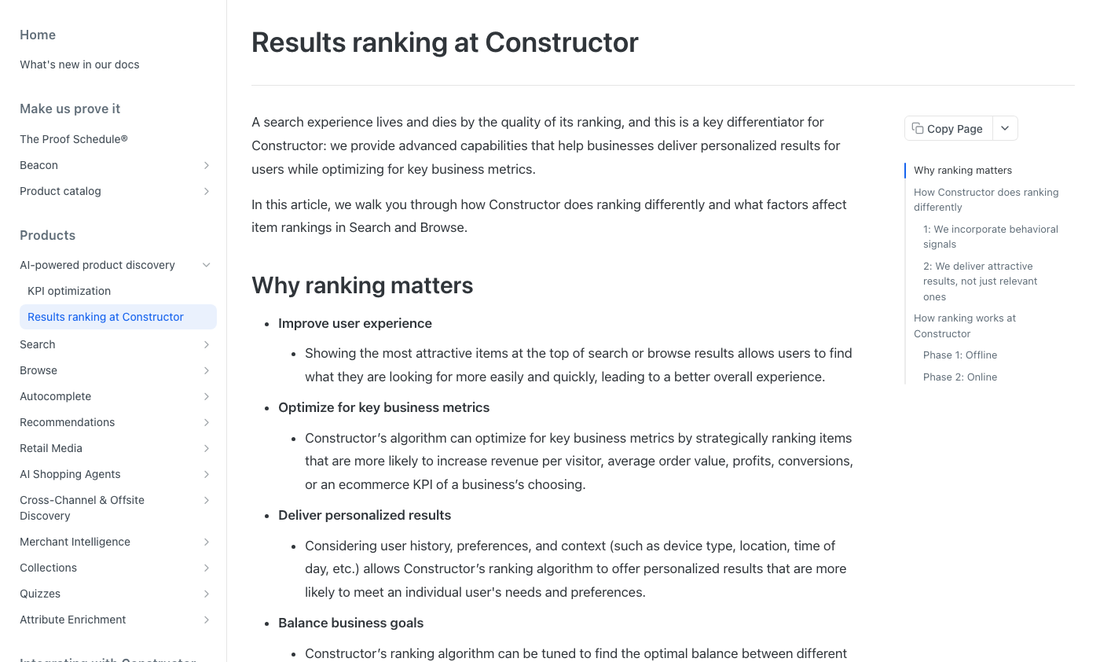
Constructor's ranking documentation. The left menu also shows its wider feature set. Source.
Algolia ranks with a configurable formula whose tiebreaker is custom ranking over a numeric attribute. The catch is that it sorts by one attribute at a time.
If you want a blended score, say 60% relevance, 30% margin, 10% newness, you compute that score upstream, write it into every product record, and keep it fresh as prices and inventory change. That is a data-pipeline job, not a merchandiser setting.
- Constructor: blends eight signals automatically and optimizes to a KPI.
- Algolia: sorts by one numeric attribute; a blended score is precomputed and maintained by you.
Can merchandisers run each one without developers?
Both tools give merchandisers real controls, and both still expect a technical partner for the deep work. The difference is where each draws that line.
Constructor ships a full rules engine with six rule types (boost, bury, slotting, blocklist, allowlist, content), scheduling, and segment targeting through its Audience Hub.
The limit is philosophy rather than feature count. Because the model owns the base ranking, merchant overrides sit on top of it. One reviewer on Gartner Peer Insights notes that "reliance on automated algorithms can limit a merchant's ability to override results" (Gartner).
Drag-and-drop exists for recommendation carousels. The core search and browse merchandising is form-based.
Algolia's no-code surface is the Merchandising Studio for pinning, boosting, and previews, but it is on the Elevate tier. The rest of the setup, the ranking formula, synonyms, and rules logic, is developer territory.
One merchant put the front-end reality plainly: the app "does not provide a frontend framework, so this is something your developer team will need to implement" (Shopify App Store).
- Algolia: no-code Merchandising Studio, Elevate tier; deeper config is developer work.
- Constructor: broad no-code rules included, but the AI model owns the base ranking.
How well does each fit Shopify Plus?
Neither is a Shopify-native tool. Both are multi-platform engines that connect to Shopify through an app, so the real question is how mature and proven that connector is.
Algolia ships a first-party Shopify app, and its March 2026 Commerce Pipeline rebuild closed a lot of the gap: native Shopify taxonomy and Metaobject indexing, and update latency down to about two minutes.
Its App Store rating is 3.5 from 35 reviews, and the reviews split cleanly. Enterprise accounts with a technical account manager are happy; self-serve accounts report support they cannot reach without a paid commitment.
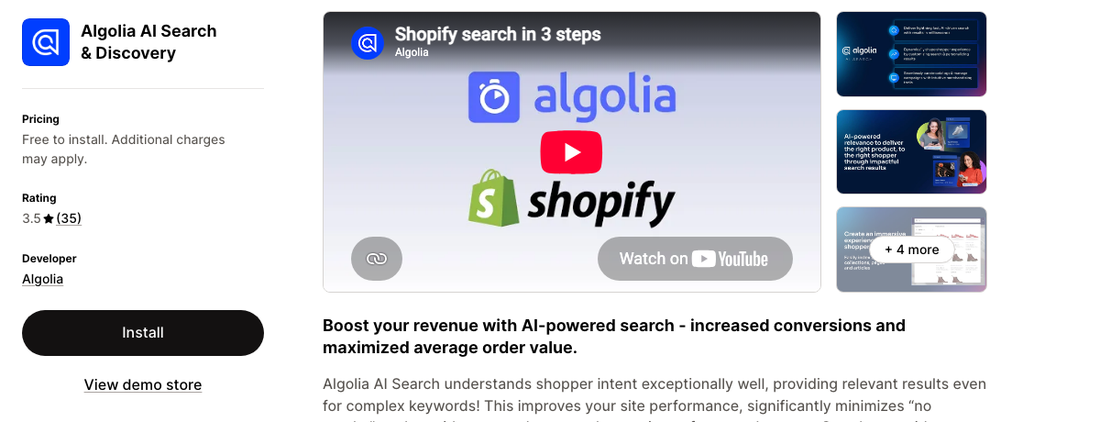
Algolia on the Shopify App Store: 3.5 stars, 35 reviews. Source.
Constructor's Connect app launched in September 2024 and has 0 reviews, so there is no independent Shopify-merchant signal yet. It is one of 8 or more platform connectors, and it does not natively ingest Shopify's Standard Product Taxonomy; extra attributes need custom mapping through its Connect CLI.
None of that means the engine is weak. It means the Shopify surface is new and unproven in public.
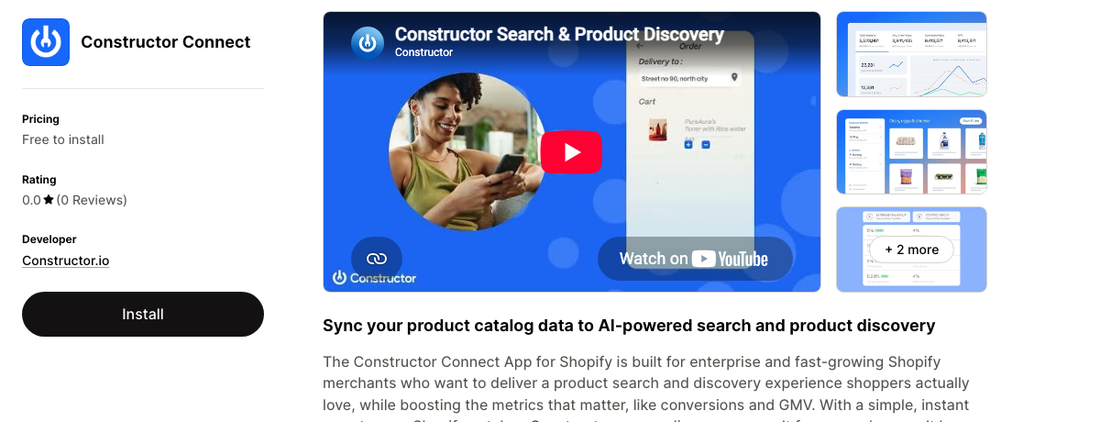
Constructor Connect on the Shopify App Store: 0 reviews as of August 2026. Source.
How do they handle Shopify Markets?
If you run more than one storefront, this is where cost and complexity compound. Both platforms split a multi-market catalog into separate indexes rather than serving one.
Algolia creates one index per market and language, and Commerce Pipeline removed the old 10-market cap. Each locale still adds another index to configure and keep in sync.
Constructor needs a separate index key per market and locale, each with its own synonyms and merchandising rules. There is no single index across markets, so a brand running US, UK, CA, and AU storefronts is maintaining and merchandising several parallel indexes at once.
For teams that want a single index across Shopify Markets, the per-region model is real operational drag on both. It is the kind of thing that looks minor in a demo and turns into weekly overhead once you are live in four regions.
How fresh is the catalog on each?
Catalog freshness decides whether a shopper sees a sold-out product or a stale price. The two take different approaches, and the gap is measured in minutes.
Algolia reports catalog updates reflected in about two minutes on average after Commerce Pipeline. Constructor recommends a daily full sync plus intraday deltas, and its docs state that updates more frequently than every five minutes are not recommended.
For a flash sale, a price drop, or fast-moving inventory, that five-minute floor is a fixed limit of the batch model, not a setting you can turn up.
Which is readier for AI shopping agents?
As shoppers start arriving through AI assistants, the two vendors are betting in opposite directions. Algolia opens its data to outside assistants. Constructor builds its own agent inside the storefront.
Algolia runs an MCP server that lets assistants like ChatGPT and Claude query its search and recommendations through the open Model Context Protocol. Both of its offerings are read-only, so an assistant can read your catalog but not change it. Its broader agent layer, Agent Studio, is an Elevate feature.
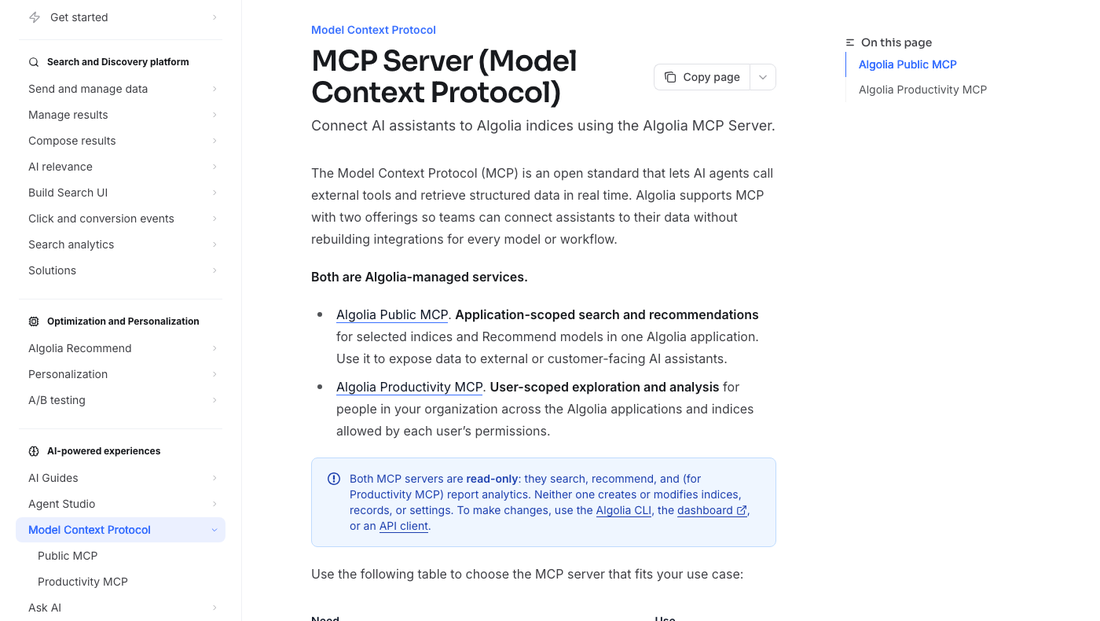
Algolia's MCP server documentation. Both offerings are read-only. Source.
Constructor does not publish an MCP server. Instead it ships its own AI Shopping Agent that runs conversational search inside the storefront, plus a Merchant Intelligence Agent in beta for the merchandising team. It is a self-contained approach: strong inside Constructor, closed to outside models.
The deeper question for a Shopify Plus brand is what the agent actually sees. An MCP that exposes raw search is not the same as one that exposes your merchandising rules and curation, which is what decides whether an agent recommends the products you want to sell.
- Algolia: open, read-only MCP for outside assistants, plus Agent Studio on Elevate.
- Constructor: a proprietary on-site shopping agent, no public MCP.
What does each actually cost?
Both reach five to six figures a year at scale, but they get there in opposite ways. Algolia is transparent and hard to forecast. Constructor is opaque and fixed once you sign.
Algolia publishes four tiers: Free, Grow, Grow Plus, and Elevate. It bills on two axes at once, search requests and records, plus tier for features.
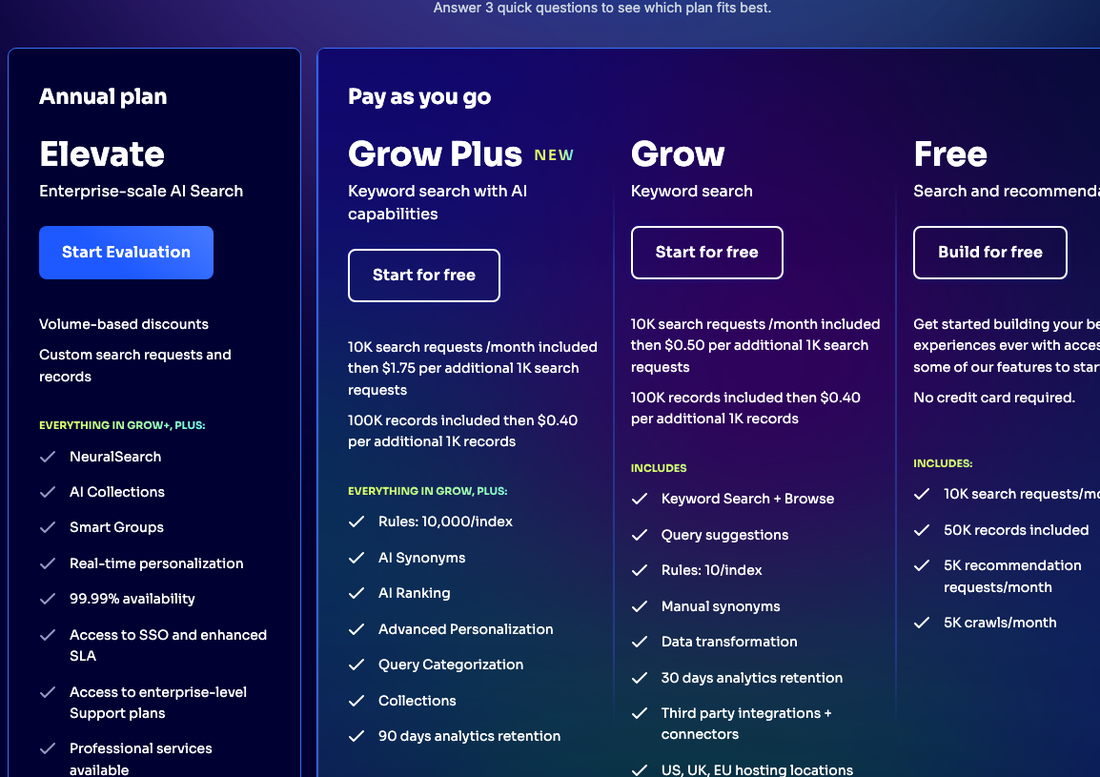
Algolia's pricing tiers. NeuralSearch, Smart Groups, and real-time personalization sit under Elevate. Source.
- Grow overage: $0.50 per extra 1,000 search requests.
- Grow Plus overage: $1.75 per extra 1,000 search requests, 3.5 times higher, and the tier where AI Synonyms and AI Ranking live.
- NeuralSearch and Merchandising Studio: Elevate tier.
- The recurring complaint: bills are hard to predict, because an as-you-type search box can fire a request per keystroke and there is no bot protection, so scraper traffic is billable too. One reviewer described not knowing "whether Algolia will cost $100/month or $1,000/month or $10,000/month" (Hacker News).
Constructor has no public pricing, no free tier, and no self-serve path. Every customer signs a custom annual enterprise contract.
- Average contract: around $150,000 per year, with a negotiation redline near $200,000, per Vendr.
- Query-based estimate: roughly $24K to $120K per year depending on volume.
- Trade-off: you get one predictable annual number, but no way to start small or test cheaply first.
Treat every Constructor figure as a third-party estimate, not a vendor number.
What are customers saying?
The two read differently depending on which review site you weight. Algolia has hundreds of reviews across the major sites. Constructor has far fewer, mostly from enterprise buyers, but its scores are high.
Algolia rates roughly 4.5 on G2 across hundreds of reviews, 4.7 on Capterra, 4.4 on TrustRadius, and a split 3.5 on the Shopify App Store. Praise clusters on speed, developer experience, and documentation. Gripes cluster on price at scale, complexity, and paywalled features.
"Would 100% recommend Algolia to other enterprise level users, the tool has everything you need to make a success of your search strategy." Oh Polly, Shopify App Store
"It is definitely not a straight forward implementation which requires support and that is pretty much none-existent unless you commit to min $12,000 USD a year." TripleClamp Moto, Shopify App Store
Constructor rates 4.9 on Gartner Peer Insights across 59 ratings and 4.8 on G2 across about 57, with no Shopify App Store reviews yet. Praise clusters on ranking quality and the support relationship. Gripes cluster on implementation effort and limited override of the model.
"Constructor's support and communication provided during the sales, contract and implementation phases have been second to none." Head of Ecommerce, Retail, Gartner Peer Insights
"Reliance on automated algorithms can limit a merchant's ability to override results, though manipulation of search and merchandising results exists, this does reduce flexibility in specific use cases." Verified reviewer, Gartner Peer Insights
Read them for what they are. Algolia's reviews are broad but tell you more about its API than its Shopify app. Constructor's are strong but come from a small, enterprise-heavy sample with no mid-market Shopify signal in it yet.
Top similarities between Algolia and Constructor.io
Knowing the differences is only half the decision. Here is where the two are genuinely alike, which matters just as much for a Shopify Plus buyer.
Neither is built for Shopify
Both are multi-platform engines with a Shopify adapter, not Shopify-native tools. Constructor lists Shopify as one of 8 or more platform connectors, and Algolia documents Shopify as one integration among many. That general-purpose design is what drives most of the differences above: taxonomy handling, Markets, and catalog sync all inherit it.
Both expect developers or a solutions team
Algolia gives you APIs and libraries but you build and own the storefront front end. Constructor is API-first with a services-led rollout that reviewers call time-heavy. Neither is a tool a lean merchandising team runs alone, so budget for engineering or a partner on either.
Both are enterprise-priced at scale
Algolia's real AI lives on the Elevate enterprise tier, and Constructor is enterprise-contract-only. A serious deployment on either lands in five to six figures a year, so the true cost gap is smaller at the top of the market than it looks at the entry point.
Both ship their own AI shopping agent
Constructor has its AI Shopping Agent, and Algolia has Agent Studio. Both are vendor-owned surfaces sold on the top tier. If your plan depends on a specific agent experience, you are buying into that vendor's walled garden either way.
Both reward scale and steady traffic
Constructor's behavioral models need meaningful volume to train, so smaller stores see smaller lifts. Algolia's per-request billing rewards steady, predictable traffic and punishes spiky loads. Under a certain size, neither one pays for itself.
Both are capable, proven search engines
This is the honest one. Both do keyword search, faceting, autocomplete, synonyms, rules-based merchandising, and analytics well, and both hold strong independent review scores. The decision is about fit and delivery on Shopify Plus, not about whether the core search works.
How to choose
Choose Algolia if you are engineering-led or headless, you want a fast, well-documented search API, you are fine owning the storefront UI, and you need one engine across web, app, and docs. Budget for the Elevate tier if you want the AI in the box.
Choose Constructor.io if you are a large retailer with high traffic and a big catalog, you want AI ranking tuned to revenue without configuring a formula, you value a hands-on CSM, and a six-figure annual contract fits your budget.
Is there an option built only for Shopify Plus?
Algolia and Constructor are both multi-platform engines. If you sell only on Shopify Plus, a native tool drops the parts of both that add overhead. That is the gap we built Layers for.
Where we work differently from both:
- Shopify-native catalog. We index Shopify's Standard Product Taxonomy, combined listings, and bundles natively, so there is no field mapping to maintain.
- One index across Markets. 100+ languages in a single index, not a separate index per region, which removes the multi-index overhead both other tools carry.
- Near-real-time sync. Webhook-driven catalog updates, not a five-minute batch floor.
- Merchandiser-owned. Drag-and-drop control and ranking by margin or return rate, no developer ticket and no tier upgrade to unlock it.
- Native MCP. Assistants like ChatGPT and Claude read your merchandising rules, not just raw search results.
One example. 9-figure apparel brand Rainbow Shops moved to Layers from Algolia. Their VP of eCommerce and Digital, David Cost, on the switch:
"Layers was the first time we were able to create some customization and essentially create the same kind of sort-orders that we were used to having in Salesforce. And we could see a pretty immediate impact on the conversion rate."
After the move, Rainbow Shops reported a 30% increase in conversion rate and now re-orders every collection page daily based on the last seven days of demand.
A 9-figure haircare brand made the same move off the other side of this comparison, from Constructor.io to Layers.
On Constructor.io, catalog changes took 30 to 40 minutes to sync, and hand-configured recommendations took up to two days to appear. Both are immediate on Layers.
Where we are the wrong fit:
- You are not on Shopify, or you run a multi-platform or headless stack. Algolia or Constructor fits better.
- You want a general-purpose search API for web, app, and internal docs. Algolia fits better.
- Your catalog is small enough that Shopify's native search still does the job.
FAQ
Is Constructor.io better than Algolia for ecommerce? Constructor is the more specialized ecommerce ranking product. Algolia is the stronger general-purpose search API and easier to start with. The right pick depends on whether you want an opinionated discovery platform or a fast, controllable engine.
Which is more expensive, Algolia or Constructor.io? Constructor has a higher floor because it is enterprise-contract-only, around $150K per year. Algolia can start free and scale with usage, but its bills are harder to predict, and its AI needs the Elevate tier. At scale both reach five to six figures a year.
Do Algolia or Constructor.io work natively with Shopify Plus? Neither is Shopify-native. Both are multi-platform engines with a Shopify connector. Algolia's connector is more mature after its March 2026 update. Constructor's is newer, from September 2024, with no public App Store reviews yet.
Does Algolia include AI or semantic search? Its semantic engine, NeuralSearch, is on the Elevate tier only. Lower tiers use keyword search with typo tolerance plus rules you configure by hand.
Can ChatGPT or Claude connect to these platforms? Algolia runs a read-only MCP server that lets assistants like ChatGPT and Claude query its search and recommendations. Constructor ships its own on-site AI shopping agent and does not publish an MCP server.
Which is easier for a merchandising team to run without developers? Neither is built for that. Algolia's no-code studio is an enterprise-tier feature, and its deep setup is developer work. Constructor's rules are broad, but the AI model owns the base ranking and its rollout is services-led.
Written by

Jake Casto
Founder, Layers
Jake Casto is the founder of Layers, the enterprise search and merchandising platform built for Shopify Plus. He previously co-founded Proton, a Shopify Plus engineering studio that shipped more than 400 storefronts, where Layers began as an internal tool for a problem that kept repeating. He writes about search infrastructure, performance, and the engineering behind discovery at scale.
View all articlesRelated articles
More reading on search, merchandising, and product discovery.
Coveo vs Algolia: Top Differences and Similarities (2026)
A fact-by-fact comparison of Coveo and Algolia for Shopify Plus: search, ranking, merchandising, Shopify Markets, catalog sync, AI agents, pricing, and reviews. Every claim cited, verified August 2026.
Jake Casto
Aug 24, 2026 · 18 min read
Coveo vs Bloomreach: Top Differences and Similarities (2026)
A fact-by-fact comparison of Coveo and Bloomreach for Shopify Plus: search, ranking, merchandising, Shopify Markets, catalog sync, AI agents, pricing, and reviews. Every claim cited, verified August 2026.
Jake Casto
Aug 24, 2026 · 18 min read
Coveo vs Constructor.io: Top Differences and Similarities (2026)
A fact-by-fact comparison of Coveo and Constructor.io for Shopify Plus: search, ranking, merchandising, Shopify Markets, catalog sync, AI agents, pricing, and reviews. Every claim cited, verified August 2026.
Jake Casto
Aug 24, 2026 · 17 min read