Fast Simon vs Boost Commerce: Top Differences and Similarities (2026)
A fact-by-fact comparison of Fast Simon and Boost Commerce for Shopify Plus: search, ranking, merchandising, Shopify Markets, catalog sync, AI agents, pricing, and reviews. Every claim cited, verified August 2026.
Key takeaways
Overview
Both apps handle Shopify search and merchandising well. They start from opposite corners: Fast Simon as a search box, Boost as a filter sidebar.
Fast Simon started as InstantSearch+ and is a multi-platform search, merchandising, and visual-discovery app. It runs on Shopify, BigCommerce, Magento, WooCommerce, and headless Hydrogen. It is billed by monthly sessions and aimed at SMB to mid-market brands that want a no-code tool.
Boost Commerce is the Shopify-only Boost AI Search & Discovery app. Deep faceted filtering has always been its core, with a semantic and merchandising layer added on top.
It is billed on online GMV and is now owned by app roll-up AppHub, which took a $95M strategic investment from PSG alongside the acquisition.
Below, every capability gets a verdict and a source. The last two sections say which store each app actually suits.
Top differences between Fast Simon and Boost Commerce
Five states below: Yes works as stated, Gated needs a higher tier, Partial works with limits, No, and Unverified where no public source confirms it either way. Each is sourced in the sections that follow. Verified August 2026.
Platform and Shopify fit
| Capability | Fast Simon | Boost Commerce |
|---|---|---|
| Built only for Shopify | No, multi-platform | Yes, all Shopify tiers |
| Native Shopify Markets | Yes | Yes |
| Combined listings and bundles | Unverified | Yes |
| Catalog sync latency | Gated, realtime at Essential | Partial, 5 to 10 minute polling |
| Headless or composable path | Yes, Hydrogen 2 SSR | No |
Search
| Capability | Fast Simon | Boost Commerce |
|---|---|---|
| Semantic vector embeddings | Yes, BERT hybrid | Partial, NLP layer |
| Query intent to auto-filters | Yes | Yes |
| Typo tolerance and autocomplete | Yes | Yes |
| Camera or image visual search | Yes | No |
| Many languages in one index | Unverified | No, starts with 5 |
| ML query re-ranking | Gated, Top Pro | Yes, all tiers |
Merchandising
| Capability | Fast Simon | Boost Commerce |
|---|---|---|
| Boost, demote, and pin rules | Gated, Top Pro | Yes, all tiers |
| Drag-and-drop pin UI | Gated, Top Pro | Yes |
| Keep paired items together | Partial | No |
| Margin or inventory in ranking | Partial, no return rate | Partial, no return rate |
| Visual preview before publish | Unverified | Yes |
AI, pricing, and reviews
| Capability | Fast Simon | Boost Commerce |
|---|---|---|
| AI ranking without a tier upgrade | No, Top Pro | Yes, all GMV tiers |
| AI shopping agent or MCP | Partial, marketed | No |
| Recommendations and bundles | Yes | Yes |
| Pricing model | Session-metered | GMV-scaling |
| Shopify App Store rating | 4.8 / 5 (289) | 4.8 / 5 (1,496) |
How does each engine find products?
Fast Simon and Boost read a query through opposite lenses. Fast Simon is a search engine with a visual-discovery layer beside it. Boost is a filter engine that grew a semantic layer on top.
Fast Simon runs what it calls Gen AI Hybrid Search, which combines keyword matching with BERT-based vector embeddings. Its docs describe queries being transformed into intent-aware vectors using models like BERT.
Its clearest differentiator is Visual Discovery: camera search, photo upload, Instagram feed links, and Shop the Look. Boost ships no camera or image-based search on any surface.
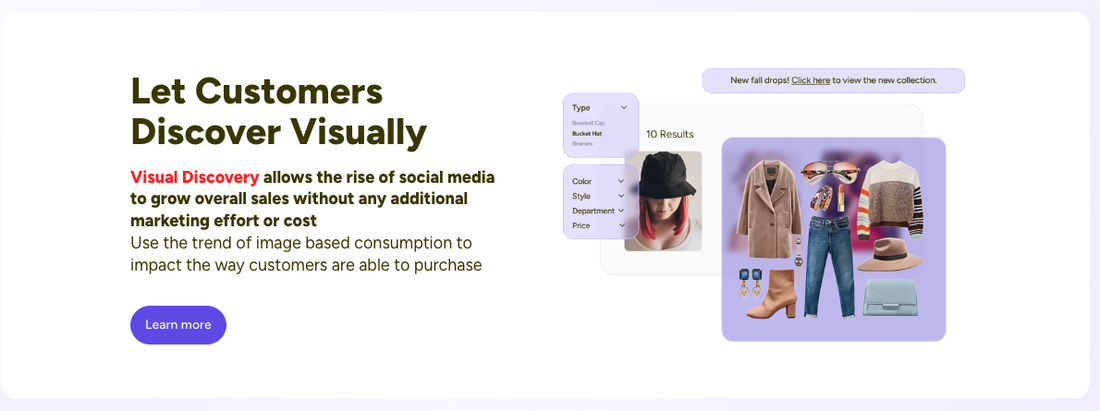
Fast Simon's Visual Discovery surface: photo and camera search into a shoppable grid. Source.
Boost describes its relevance as NLP with Named Entity Recognition, not vectors. Its own semantic-search docs never mention embeddings, and its impact is a configurable 0 to 100% slider.
One independent teardown calls Boost's approach relevance features layered onto the filter engine rather than a from-scratch vector core. That framing fits its history as a filtering app first.
- Keyword, typo, and autocomplete: included on every tier for both.
- Vector embeddings: documented on Fast Simon; unconfirmed on Boost.
- Image-to-search: native on Fast Simon; absent on Boost.
How does each rank results?
Both apps watch shopper behavior and re-order results from it. What separates them is which tier turns it on, and how far each model reaches.
Fast Simon runs an implicit-feedback model that reads clicks, scrolls, add-to-cart, and purchases to re-rank per shopper. Its docs note the model needs roughly 30 to 90 days of data to be effective.
The catch is the gating: Fast Simon's Custom Ranking Controls sit on the Top Pro tier at $299.99, so the deepest ranking levers cost $300 a month to reach.
Boost runs Product Performance Ranking, which re-orders on click-through, add-to-cart, and conversion with recency weighting. It runs per query and is configurable to re-rank 10 to 100 products per term.
Boost includes that behavioral ranking on all GMV tiers. Individual personalization is the part it reserves for its top tier, so the base ranking is available lower down.
- Fast Simon: strong per-shopper ranking, best controls on Top Pro.
- Boost: behavioral ranking on every tier, personalization gated to the top tier.
Can merchandisers run each one without developers?
Both give merchandisers real controls. The split is where each puts the paywall and whether the UI can hold paired products together.
Boost ships six merchandising strategies (Pin, Boost, Demote, Hide, Filter, Banner) with conditions, drag-and-drop, and a preview before publish. Those merchandising rules are available on all tiers, with the campaign count rising from 10 to unlimited.
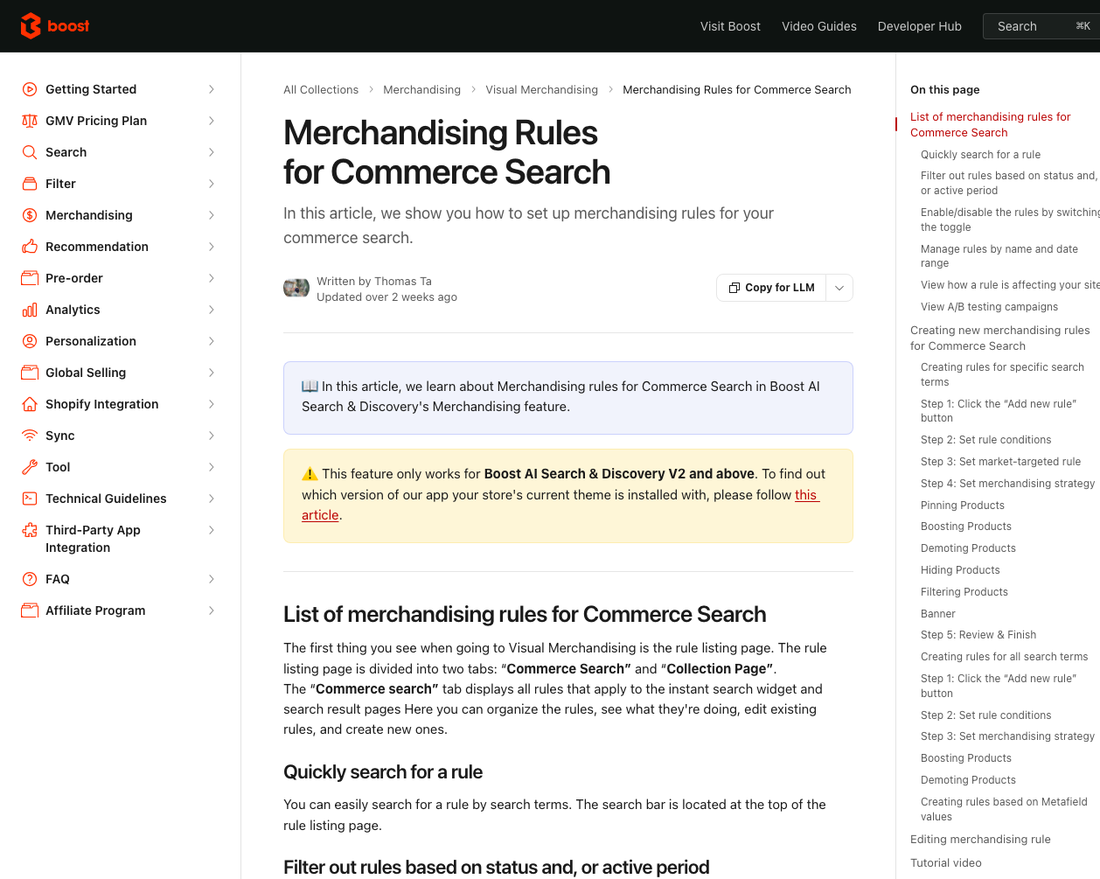
Boost's merchandising rules docs. The six strategies are listed in the right-hand menu. Source.
Boost's group-ranking feature carries one explicit limit: it cannot maintain specific product sequences or pair individual items together. Full-look sequencing, where a shirt and its matching trousers stay side by side, is out.
Fast Simon offers promote, pin, bury, and hide rules, a visual drag-and-drop editor, and Curated Sets. The trade is tier: its merchandising rules, visual merchandising, and A/B testing are all gated to Top Pro.
Reviewers also flag a change-management cost on Boost: some changes are theme-specific and need a developer to ship (Shopify App Store).
- Fast Simon: deep merchandising, gated to Top Pro.
- Boost: broad rules on all tiers, but no paired sequencing.
How well does each fit Shopify Plus?
Neither is built only for Shopify Plus, but they miss in opposite directions. Fast Simon is multi-platform. Boost is Shopify-only across every tier.
Boost is built exclusively for Shopify, with deep theme, Admin, metafield, and Markets integration. Its historic strength is the filter tree, which builds filter options from Shopify product attributes and metafields, each option supporting up to 1,500 values.
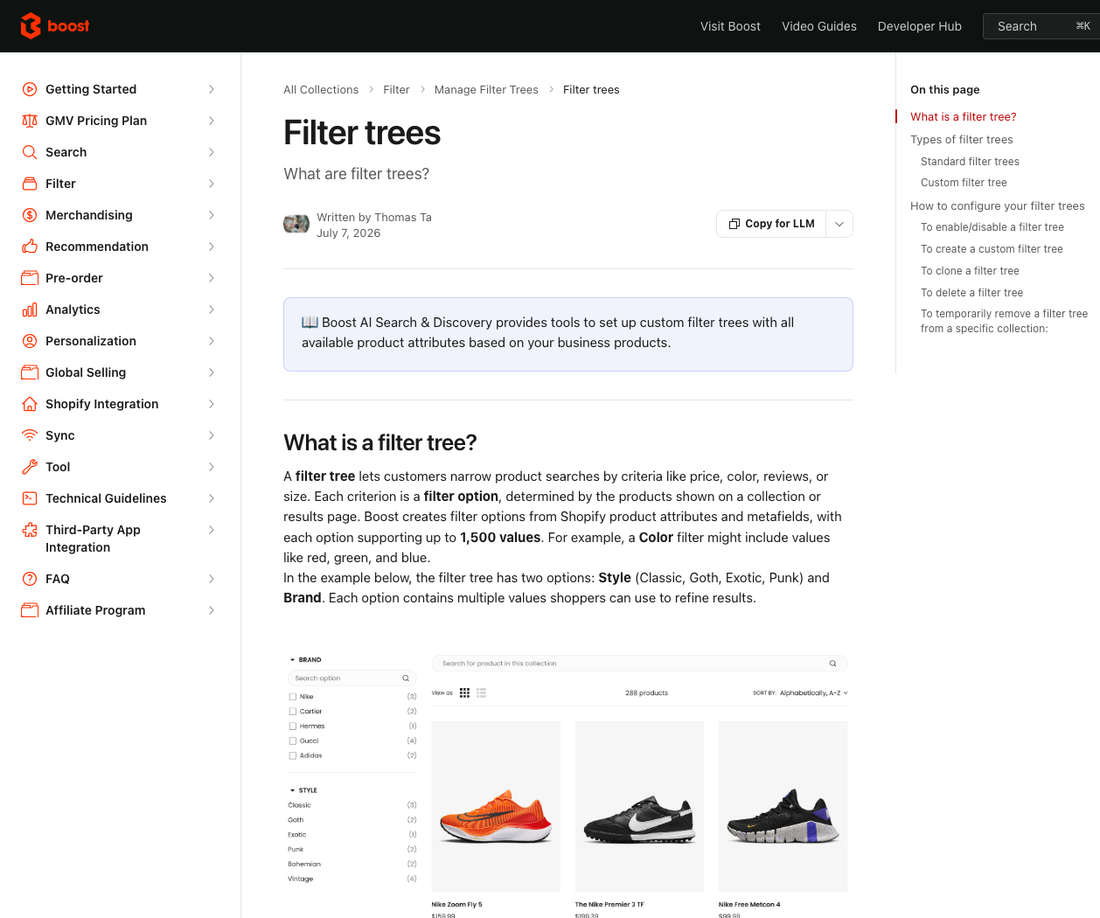
Boost's filter-tree docs. Faceted filtering is its deepest, longest-proven feature. Source.
The cost of that focus is reach. Shopify-only means no headless or cross-platform path the day your stack moves beyond Shopify.
Fast Simon is Shopify-certified and a Plus tech partner, but it is one connector among many. It also runs on Microsoft Dynamics 365 Commerce and added Hydrogen 2 server-side rendering for headless in May 2025.
Both carry uninstall gripes. Fast Simon reviewers report code left behind on the site after removal, and Boost had an indexing incident that prevented Google from indexing collection pages.
How do they handle Shopify Markets?
Run a US, UK, and EU storefront and the Markets question turns practical fast. Both apps plug into Shopify Markets. The real split is how many languages the search index speaks on its own.
Fast Simon shipped an integrated Markets solution in October 2024 that offers different products and prices per market. Its multilingual query depth is undocumented, and reviewers point multilingual buyers elsewhere.
Boost handles global selling with per-market visibility, correct currency and pricing, and stock by shipping location. It also supports market-level merchandising rules where a specific rule beats a global one.
The limit on Boost is language. Its AI semantic search is native in only five languages, and other languages need Weglot or Langify to translate.
For teams that want a single index across Shopify Markets, both tools ask you to manage per-region configuration rather than one shared setup.
How fresh is the catalog on each?
Sync lag is the gap between a shopper adding a sold-out SKU to cart and never seeing it in the first place. Both apps park realtime sync on a higher tier, and neither pushes webhook-instant updates on an entry plan.
Fast Simon tiers its sync from daily on Free, to hourly and on-demand on Starter, to realtime only on Essential at $99.99. One reviewer reports inconsistencies in automatic syncing, with paid plans not always outperforming the free trial.
Boost runs three syncs per day on Launch, seven on Convert, and "real-time" on Accelerate. Its docs describe that top tier as 5 to 10 minute polling, not webhook-instant.
On large catalogs, Boost warns that collection and search pages may be slow to update after bulk changes. For a flash sale or fast-moving inventory, both floors are real limits, not settings you can turn up.
Which is readier for AI shopping agents?
As shoppers start arriving through AI assistants, this is the newest and least proven area for both. Fast Simon markets an agent; Boost shows no public evidence of one.
Fast Simon lists an AI Shopping Agent as part of its core offering. There is no independent verification of its agent depth, and Shopify's own MCP endpoint is a platform-level feature, not uniquely Fast Simon's.
Boost publishes no MCP server, no agentic-commerce endpoints, and no LLM-agent readiness across its docs, changelog, or marketing. Its recent shipping was GA4 integration and combined-listings support, not agent work.
The deeper question for a Shopify Plus brand is what an agent actually sees. An agent that reads raw search is not the same as one that reads your merchandising rules and curation, which decides whether it recommends the products you want to sell.
- Fast Simon: markets an AI shopping agent, depth unverified.
- Boost: no public MCP or agent readiness.
What does each actually cost?
Both meter on a growth variable, so neither gives you a flat number. Fast Simon bills on sessions; Boost bills on GMV. Both climb as the store scales.
Fast Simon charges by monthly sessions and gates features by tier: Free, Starter $39.99, Essential $99.99, and Top Pro $299.99, then Growth and Enterprise above that.
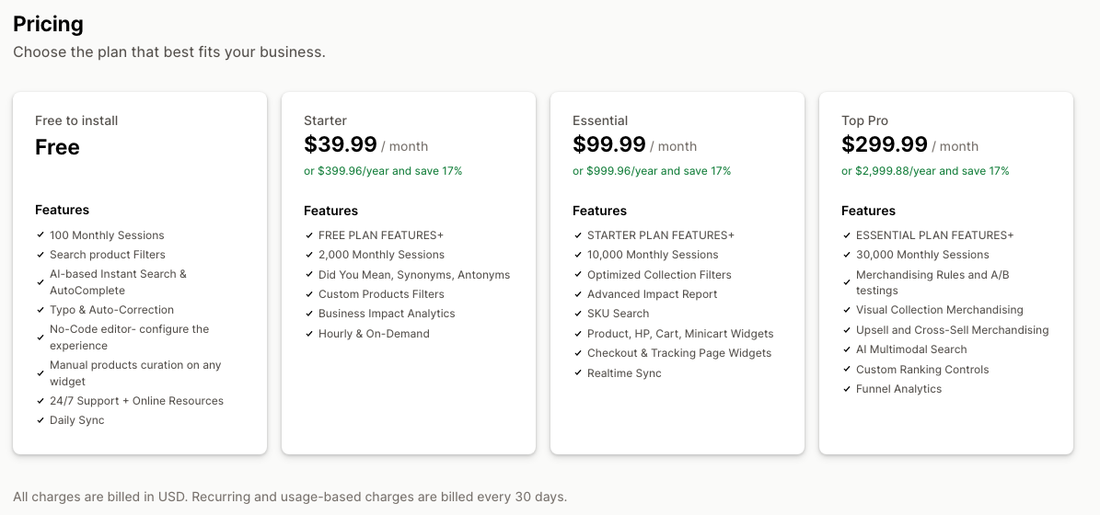
Fast Simon's App Store pricing. Each tier caps monthly sessions; multimodal search and custom ranking sit on Top Pro. Source.
Because sessions count bot traffic, you pay for crawlers too. One merchant notes that "as you grow, especially if you have a large number of pages, the Google bots will utilize many of the visits" (Shopify App Store).
Merchants also report mid-cycle re-pricing of existing plans.
Boost charges on online GMV, and each tier is a climbing range rather than a flat fee.
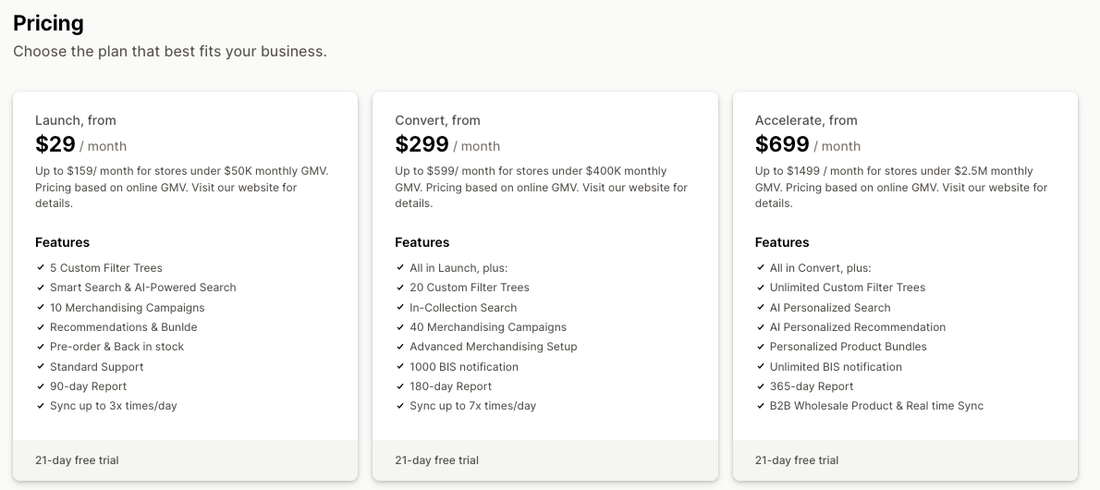
Boost's App Store pricing. Launch runs $29 to $159, Convert $299 to $599, Accelerate $699 to $1,499 by GMV band. Source.
Boost's own numbers do not always agree. Its App Store and vendor pricing pages show different figures, and aggregators report roughly $2 in overage per additional $1,000 of GMV, so a strong sales month raises the bill.
The honest answer on which is cheaper depends on your traffic-to-revenue ratio, so treat both vendors' scale numbers as estimates to check against a contract.
What are customers saying?
Both hold high Shopify App Store scores off large review counts. The catch: almost all of that signal comes from one channel, with thin third-party validation either way.
Fast Simon rates 4.8 from 289 reviews on the Shopify App Store and 4.0 from 13 reviews on G2, with no meaningful Capterra or TrustRadius presence.
Praise clusters on fast core search, ease of use, and responsive support. Gripes cluster on price escalation, session-metered billing, and bugs deflected to an enterprise tier.
"I've worked with Fast Simon for years and it is very user friendly! They are constantly making improvements and updates to the app. Our CS Manager and their dev team respond so quickly to any issues that arise." St. John Knits, Shopify App Store
"It is (apart from the speed) quite unsophisticated. The entire model is geared to get you to pay more, more, more. Bug reports are countered with 'we can only fix that on an enterprise server' (which is $1500+ per month)." Verified reviewer, G2
Boost Commerce rates 4.8 from about 1,496 reviews on the Shopify App Store and 4.8 on G2 from a much thinner count, with zero Capterra reviews.
Praise clusters on deep filtering, support, and a long-tenured base. Gripes cluster on shallow AI, sync lag on large catalogs, and developer dependency for changes.
"I recommend boost for it's ease of use, and features that covers every Merchandizer's need, they have a great support team and very collaborative. The tool is handy, reliable and provides accurate Analytics." Ted Baker.ae, Shopify App Store
"ANY CHANGE you want to make is THEME specific and you have to get a developer involved or their team." Ooze, Shopify App Store
Weigh those stars accordingly. Both counts come almost entirely from the Shopify App Store, and neither has a deep G2, Capterra, or TrustRadius base to cross-check against.
Top similarities between Fast Simon and Boost Commerce
The overlap matters as much as the gaps. On six counts, Fast Simon and Boost look almost interchangeable, and a Shopify Plus buyer should weigh those too.
Both are app-tier tools, not enterprise search pure-plays
Both are sold in the Shopify App Store and installed no-code. Independent teardowns place both among app-tier discovery tools layered on an older core rather than from-scratch, semantic-first search engines. They are strong app-store tools, not search platforms built vector-first.
Both bolted AI onto an older core
Fast Simon added vector search and personalization onto a session-based engine, and Boost added a semantic layer onto a filter-first engine. In both cases the AI story is newer than the product underneath it.
Both gate their best AI behind the top tier
Fast Simon reserves semantic multimodal search and custom ranking for Top Pro. Boost reserves AI-personalized search and personalized bundles for Accelerate. On either tool, the headline AI is a top-tier feature.
Both meter on a growth variable
Fast Simon meters on sessions and Boost meters on GMV, so neither offers a flat, predictable price. Cost rises with traffic or revenue, and a spike in either raises the bill without adding a feature.
Both carry SEO and reliability complaints from real merchants
Fast Simon reviewers report indexing issues and residual code on uninstall. Boost merchants report an incident that blocked Google from indexing collection pages and slowdowns during peak traffic. Neither is complaint-free at scale.
Both are capable, proven discovery apps
Give both their due here. Keyword search, faceting, autocomplete, rules-based merchandising, analytics: both apps do all of it well, and both hold high App Store scores. Your decision is about fit on Shopify Plus, not about whether either core product works.
How to choose
Choose Fast Simon if you sell on more than one platform or run headless, you want camera and visual discovery out of the box, and you are comfortable moving to Top Pro to unlock semantic search and merchandising. Its session pricing suits stores where traffic is steady and predictable.
Choose Boost Commerce if you are Shopify-only, you want the deepest faceted filtering with a decade of tenure, and you want behavioral ranking and merchandising rules available on lower tiers. Its GMV pricing suits stores that would rather scale cost with revenue than with traffic.
Is there an option built only for Shopify Plus?
Fast Simon is multi-platform and Boost runs on every Shopify tier. If you sell only on Shopify Plus, a Plus-native tool drops the overhead both carry. We built Layers to close that gap.
How we differ from both:
- Shopify-native catalog. We ingest Shopify's Standard Product Taxonomy, combined listings, and bundles natively, so there is no field mapping to keep in sync.
- One index across Markets. 100+ languages in a single index, not five native languages plus a translation app.
- Near-real-time sync. Webhook-driven catalog updates, not a realtime tier or a 5 to 10 minute poll.
- Merchandiser-owned ranking. Drag-and-drop control and ranking by margin or return rate, where return rate is not a ranking metric on either competitor.
- Native MCP. Assistants like ChatGPT and Claude read your merchandising rules, not just raw search results.
One example. 9-figure apparel brand Rainbow Shops rebuilt Salesforce-level merchandising on Shopify with Layers. Their VP of eCommerce and Digital, David Cost, on the switch:
"Layers was the first time we were able to create some customization and essentially create the same kind of sort-orders that we were used to having in Salesforce. And we could see a pretty immediate impact on the conversion rate."
After the move, Rainbow Shops reported a 30% increase in conversion rate and now re-orders every collection page daily based on recent demand.
When we are the wrong call:
- You are not on Shopify, or you run a multi-platform or headless stack. Fast Simon fits better.
- You want a $29 to $40 entry point. Boost's Launch tier or Fast Simon's Free plan fits better.
- Camera-led visual discovery is your primary need out of the box. Fast Simon's Visual Discovery is a more mature marketed surface for that.
- You want a decade-proven filter tree today. Boost's faceted filtering is its deepest, longest-tenured strength.
FAQ
Is Fast Simon or Boost Commerce better for ecommerce? Fast Simon is the broader search and visual-discovery tool and runs on multiple platforms. Boost is the deeper Shopify-only filtering tool. The right pick depends on whether you value image search and multi-platform reach or filter depth and Shopify-native fit.
Which is more expensive, Fast Simon or Boost Commerce? Neither publishes a flat price. Fast Simon meters on monthly sessions, and Boost meters on online GMV. A large Shopify Plus store lands on Fast Simon's Growth or Enterprise plan, or Boost's Accelerate plan. Both reach four figures a month at scale.
Do Fast Simon or Boost Commerce work natively with Shopify Plus? Boost is built exclusively for Shopify, though not only for Plus. Fast Simon is Shopify-certified but also runs on BigCommerce, Magento, and WooCommerce. Neither is a Plus-only tool.
Does Fast Simon or Boost Commerce include AI search without an upgrade? Boost includes semantic search and behavioral ranking on all GMV tiers. Fast Simon reserves semantic multimodal search and custom ranking for its Top Pro tier at $299.99 per month.
Can ChatGPT or Claude connect to these platforms? Fast Simon markets an AI Shopping Agent, but its agent and MCP depth is unverified. Boost publishes no MCP server or agentic-commerce endpoints. Shopify's own MCP endpoint is platform-level, not specific to either app.
Which is easier for a merchandising team to run without developers? Boost includes merchandising rules and drag-and-drop on all tiers, but changes can be theme-specific and need a developer. Fast Simon has deep controls, but rules, visual merchandising, and A/B testing are gated to Top Pro.
Written by

Deb Mukherjee
Ecom Growth Advisor
Deb Mukherjee is an Ecom Growth Advisor who writes about ecommerce search and merchandising for Layers, the enterprise search and merchandising platform built for Shopify Plus. He works with Plus brands on search relevance, merchandising, and the catalog-data work behind product discovery at scale.
View all articlesRelated articles
More reading on search, merchandising, and product discovery.
Coveo vs Algolia: Top Differences and Similarities (2026)
A fact-by-fact comparison of Coveo and Algolia for Shopify Plus: search, ranking, merchandising, Shopify Markets, catalog sync, AI agents, pricing, and reviews. Every claim cited, verified August 2026.

Jake Casto
Aug 24, 2026 · 18 min read
Coveo vs Bloomreach: Top Differences and Similarities (2026)
A fact-by-fact comparison of Coveo and Bloomreach for Shopify Plus: search, ranking, merchandising, Shopify Markets, catalog sync, AI agents, pricing, and reviews. Every claim cited, verified August 2026.
Jake Casto
Aug 24, 2026 · 18 min read
Coveo vs Constructor.io: Top Differences and Similarities (2026)
A fact-by-fact comparison of Coveo and Constructor.io for Shopify Plus: search, ranking, merchandising, Shopify Markets, catalog sync, AI agents, pricing, and reviews. Every claim cited, verified August 2026.
Jake Casto
Aug 24, 2026 · 17 min read