Searchspring vs Boost Commerce: Top Differences and Similarities (2026)
A fact-by-fact comparison of Searchspring and Boost Commerce for Shopify Plus: search, ranking, merchandising, Shopify Markets, catalog sync, AI agents, pricing, and reviews. Every claim cited, verified August 2026.
Key takeaways
Overview
Both handle ecommerce search, merchandising, and recommendations. Where they differ is origin. Searchspring was built to run on any platform; Boost was built to run only on Shopify.
Searchspring is a hosted, platform-agnostic search and merchandising suite. Its heritage strength is deep, merchandiser-owned control of search results and category pages. In January 2025 it merged with Klevu and Intelligent Reach to form Athos Commerce.
Today Searchspring is a legacy product folded into that group. Athos reached general availability in Q1 2026, and legacy platforms retire from 2027, so existing customers face a migration.
Boost Commerce is one of the longest-running, most-installed Shopify-native discovery apps. Its depth is in faceted filtering and Shopify plumbing. An NLP-based semantic layer was added in 2023, and its strongest AI features sit on the top GMV tier.
Below, every capability gets a verdict and a source, from semantic search to catalog sync to what Boost actually charges once your GMV climbs.
Top differences between Searchspring and Boost Commerce
Four verdicts below: Yes works as stated, Gated needs a higher tier or add-on, Partial works with limits, No. Each is sourced in the sections that follow. Verified August 2026.
Platform and Shopify fit
| Capability | Searchspring | Boost Commerce |
|---|---|---|
| Built only for Shopify | No | No |
| Native Shopify taxonomy ingestion | Partial | No |
| Combined listings and bundles | Gated (add-on) | Yes |
| Native Shopify Markets | Partial | Yes |
| Catalog sync latency | Partial (daily default) | Partial (5 to 10 min polling) |
| Shopify App Store rating | 3.7 / 5 (18 reviews) | 4.8 / 5 (1,496 reviews) |
Search
| Capability | Searchspring | Boost Commerce |
|---|---|---|
| Keyword, prefix, typo tolerance | Yes | Yes |
| Semantic search / NLU | Yes (tier unpublished) | Yes (all GMV tiers) |
| Query intent to auto-filters | Yes | Yes |
| Behavioral re-ranking | Yes | Yes |
| Camera / image search | No (undocumented) | No |
Merchandising
| Capability | Searchspring | Boost Commerce |
|---|---|---|
| No-code merchandiser UI | Yes | Yes |
| Rules engine, boost / bury / pin | Yes | Yes (six strategies) |
| Blend metrics into one ranking score | Partial | Partial |
| Margin / inventory / return rate in ranking | Partial (no return rate) | Partial (no return rate) |
| Product sequences that keep pairs together | Yes | No |
| Scheduling and segment targeting | Yes | Partial |
AI, pricing, and reviews
| Capability | Searchspring | Boost Commerce |
|---|---|---|
| AI and semantic included without an upgrade | Partial (tier unpublished) | Yes |
| MCP server for outside assistants | No | No |
| Public, self-serve pricing | No | Partial |
| Pricing transparency | Quote only | Public tiers, two sheets |
| Public docs for merchandisers | Yes | Yes |
How does each engine find products?
Both started as keyword and filter engines and bolted AI on later. What matters is how deep that AI goes, and which tier you have to reach before it turns on.
Searchspring's core is the IntelliSuggest relevancy engine, historically keyword and behavioral rather than vector-native. Semantic search arrived with the Klevu merger. Its site-search page now says the model "goes beyond keywords to understand shopper intent."
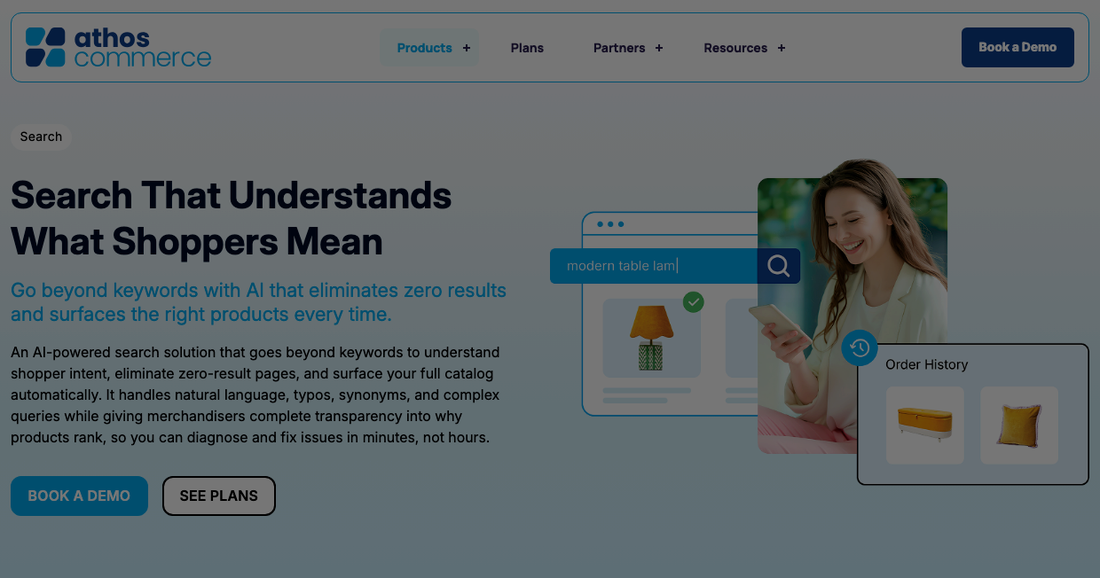
Searchspring's semantic search claim lives on a marketing page, not developer docs. Source.
The catch is that this evidence sits on a product page, and the tier where semantic search unlocks is not published. You confirm availability in a sales conversation, not a pricing table.
Boost added an NLP semantic layer in 2023 that reads "the deeper context and intent" of a query. Its docs never mention embeddings or vectors, so the architecture reads as NLP rather than dense-vector.
Boost does include semantic search on every GMV tier, so a smaller store gets the same engine as a larger one.
- Keyword search: included on every tier for both.
- Semantic search: included on all Boost tiers; unpublished tier on Searchspring.
- Visual or image search: neither documents an upload-to-search feature.
How does each rank results?
Both re-rank on shopper behavior. Neither lets you write a free-form weighted formula. The real gap is narrow, and it comes down to how each one handles a single custom attribute like margin.
Searchspring's IntelliSuggest re-ranks results on clicks, add-to-cart, and purchase for your top search terms. It is rule-based, not a blended score. One merchant was asked to "add additional facets such as stock quantity, margin" to shape ranking.
Margin feeds Searchspring ranking as a custom attribute, not a first-class input.
Boost's Product Performance Ranking re-orders on click-through, add-to-cart, and conversion for every search term. Custom sort works with simple alphanumeric values, so there is no blended weighted formula here either.
Boost supports margin and inventory-threshold rules. Like Searchspring, it does not document return-rate-aware ranking, so both share the same blind spot.
- Searchspring: behavioral re-ranking plus rules and priority, no free-form formula.
- Boost: behavioral re-ranking plus single-attribute sort, no free-form formula.
- Both: margin can feed ranking; return rate cannot.
Can merchandisers run each one without developers?
Both give merchandisers real, no-code controls. The split shows up the moment you want to touch the storefront layout, not just the order of results.
Searchspring's heritage is visual, no-code merchandising: drag-and-drop pin, boost, and bury, up to 15 custom sorts, scheduling, and previews. It is the most-praised part of the product.
One merchant said it "gives us so much more control over search results" and lets the team "easily merchandise pages" without a developer.
Boost ships six merchandising strategies, Pin, Boost, Demote, Hide, Filter, and Banner, with drag-and-drop pinning and a preview. The console is broad and capable.
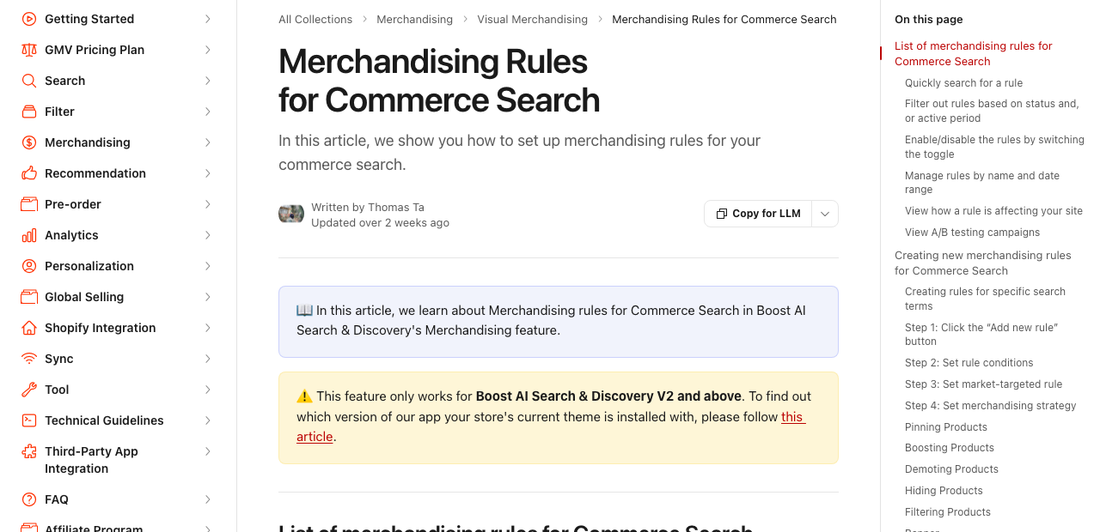
Boost documents six merchandising strategies for commerce search. Source.
The limit shows up at the theme. One reviewer wrote that "ANY CHANGE you want to make is THEME specific and you have to get a developer involved". Result-level rules are self-serve; layout changes are not.
- Searchspring: deep no-code merchandising console, no developer for day-to-day changes.
- Boost: deep no-code rules, but theme changes pull in a developer.
How well does each fit Shopify Plus?
This is the widest gap between them. Searchspring serves five commerce platforms; Boost serves one.
Searchspring equally targets BigCommerce, Magento, and Salesforce Commerce Cloud. It ingests a copy of your catalog and serves results through its own JavaScript layer. Deep front-end customization needs the vendor's team.
Its rebranded Shopify listing, "Athos: Unified Discovery," carries a thin public footprint of 3.7 stars from 18 reviews.
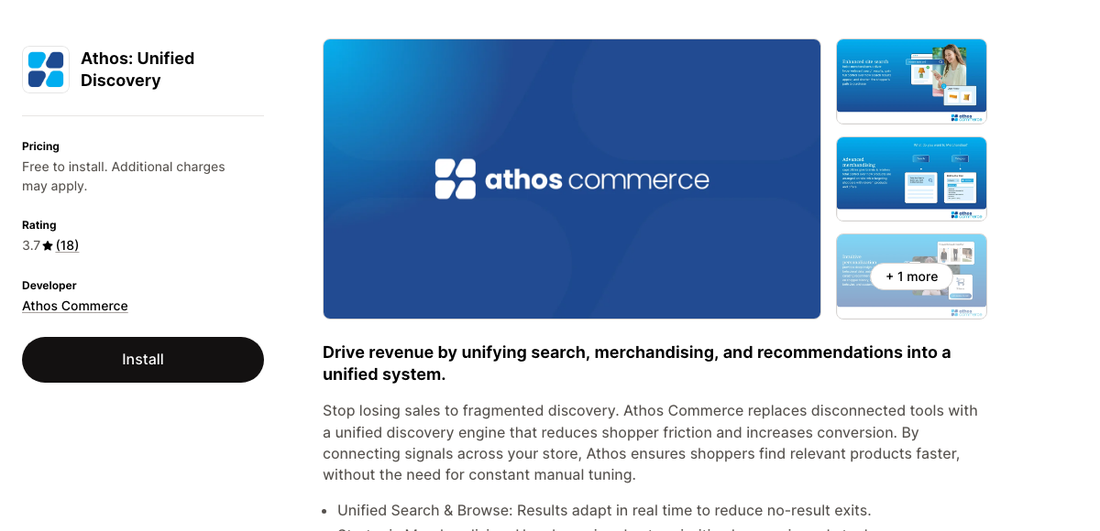
Searchspring now lists as Athos: Unified Discovery, 3.7 stars from 18 reviews. Source.
Boost is theme-aware, integrates with the Online Store editor, and uses deep Shopify scopes across products, metafields, metaobjects, Markets, and themes. It carries a large App Store footprint and the "Built for Shopify" badge.
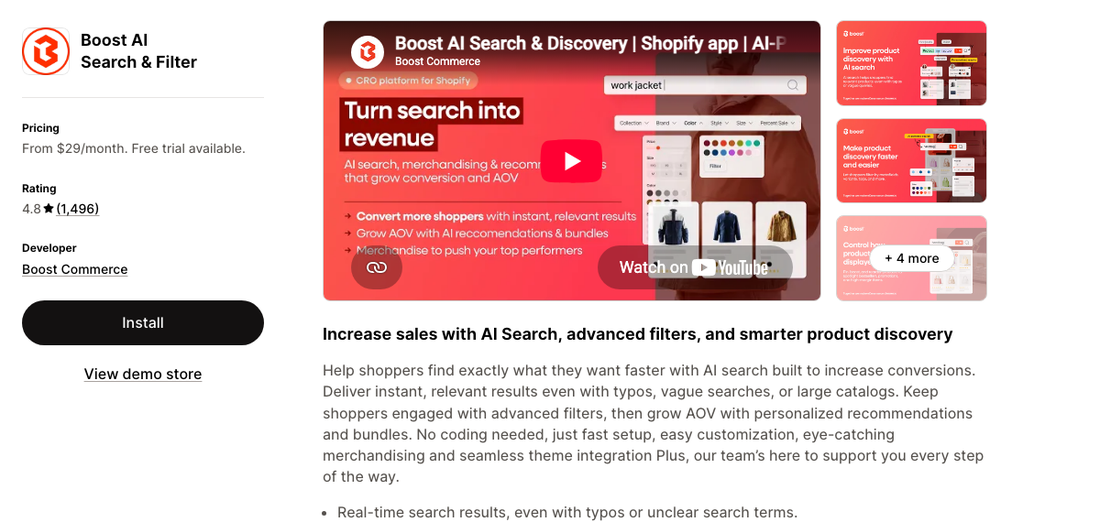
Boost on the Shopify App Store: 4.8 stars from 1,496 reviews. Source.
The trade-off is reach. Searchspring travels across platforms; Boost is Shopify-only, with no headless or cross-platform option.
How do they handle Shopify Markets?
Run US, UK, and AU storefronts off one catalog and this section becomes your maintenance bill. Boost reads Shopify Markets directly. Searchspring rebuilds the same behavior out of domains, pricing groups, and geo segments.
Searchspring achieves multi-market behavior through multi-domain configs, pricing groups, and geo-merchandising. There is no native Shopify Markets integration documented; region is passed in as a segment.
Boost is native. Shoppers "only see products available in their selected market" with the correct currency and pricing. It also supports market-specific merchandising rules with a "specific beats global" precedence.
For teams that want a single approach across Shopify Markets, Boost's native handling is the cleaner fit; Searchspring's segment model is more configuration to maintain.
How fresh is the catalog on each?
A stale index is how a shopper adds a sold-out hoodie to cart or sees last week's price on the PDP. Both engines sync on a clock, and both have a slowest-case floor you cannot fully turn off.
Searchspring indexes at least daily, with tiers stepping from twice a day to four times a day to live indexing. Near-real-time updates for a single product need the Express Sync API. One merchant flagged the default 24-hour index delay as friction.
Boost steps from three syncs a day up to a "real-time" tier. In practice, "real-time" is 5 to 10 minute polling, not webhook-instant, and large-catalog stores report sync lag during spikes.
How much any of this matters is honestly a function of your catalog. A 500-SKU brand that restocks weekly will never feel it. A flash-sale calendar with thousands of moving SKUs feels every minute of lag.
Searchspring closes the gap with an API call; Boost closes it with a shorter polling interval.
Which is readier for AI shopping agents?
Shoppers are starting to arrive through ChatGPT and other assistants. Today neither product answers them with an agent surface. Searchspring's parent has announced one on a different stack; Boost has said nothing public at all.
Searchspring's legacy product has no MCP server or agent tool surface. Its parent unveiled an "Intelligent Discovery Platform" for "the era of agentic commerce" in June 2026, with three AI agents.
That platform lives on the new unified stack that legacy customers must migrate onto. It is marketing for a roadmap, not a shipped feature on the product you buy today.
Boost shows no evidence of an MCP server, agentic endpoints, or LLM-agent shopping readiness. Its AI features are recommendations and personalized bundles, not agent interfaces.
The deeper question for a Shopify Plus brand is whether an agent can read your merchandising rules and curation, not just raw search. Neither tool exposes that today.
- Searchspring: none on the product; agentic push is unshipped roadmap on a separate stack.
- Boost: no documented MCP or agent surface.
What does each actually cost?
Both can reach four figures a month at scale. Searchspring is quote-only and locked to an annual term; Boost is public but scales with your revenue.
Searchspring publishes no plan matrix. Directory floors run $699, $899, and $1,099 a month, usage-based, so treat them as a lower bound. Contracts auto-renew annually, and onboarding is billed separately.
One verified merchant reports paying "2K a month", and reviewers repeatedly call it the most expensive search product on the market.
Boost bills through Shopify on GMV. App Store tiers run Launch $29, Convert $299, and Accelerate $699, each a range that climbs to $159, $599, and $1,499 as your GMV rises.
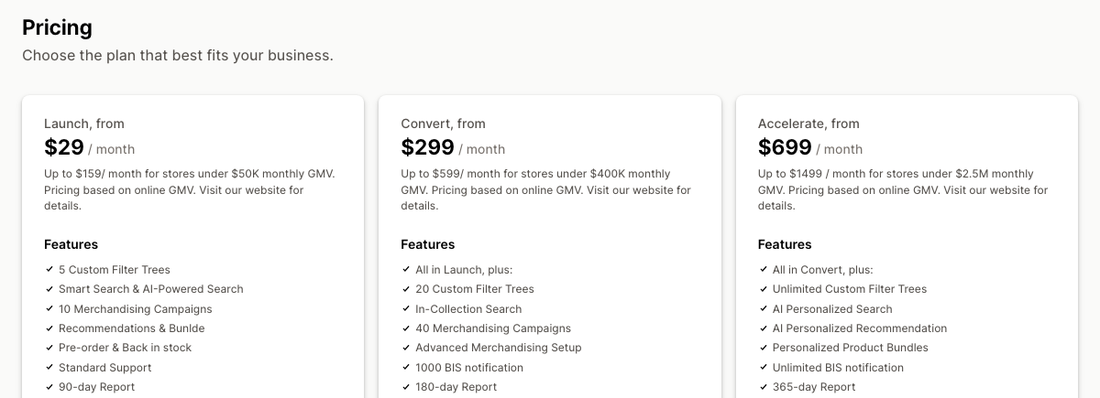
Boost's App Store pricing. Each tier is a range that climbs with GMV. Source.
Two catches sit under Boost's headline number:
- A second vendor price sheet shows different figures ($239 and $399) with different GMV bands, so the public number depends on where you look.
- Merchants report a ~$2 charge per extra $1,000 of GMV, so a strong sales month raises the bill.
Treat every Searchspring figure as a third-party estimate; it publishes no rate card.
What are customers saying?
Where you look changes what you see. Searchspring's reviews scatter across G2, TrustRadius, Gartner, and the App Store. Boost's sit almost entirely in one place, the Shopify App Store, in very large numbers.
Searchspring rates 4.5 on G2 across 222 reviews, 9.0 out of 10 on TrustRadius across 14, 5.0 on Gartner Peer Insights across 7, and 3.7 on the Shopify App Store. Praise clusters on merchandiser control; gripes cluster on post-merger support and price.
"We've been using Searchspring for about 2 years, and love the application. It works seamlessly with Shopify. We see a 20% increase in AOV and a significant increase in conversion from those who use our search feature." Hat Club, Shopify App Store
"I recently waited over 6 weeks for a response to a helpdesk ticket that was never resolved. They lock you into a 12 month automatically recurring contract, you are stuck with them. I would avoid Searchspring." Knifewear, Shopify App Store
Boost rates 4.8 on the Shopify App Store across roughly 1,496 reviews and 4.8 on G2 across a few dozen, with no Capterra reviews. Praise clusters on support and filtering depth; gripes cluster on developer-dependency and GMV billing.
"I recommend boost for it's ease of use, and features that covers every Merchandizer's need, they have a great support team and very collaborative. The tool is handy, reliable and provides accurate Analytics." Ted Baker.ae, Shopify App Store
"ANY CHANGE you want to make is THEME specific and you have to get a developer involved or their team." Ooze, Shopify App Store
Weight both accordingly. Outside G2, Searchspring's samples are small enough that one angry review moves the average, like the six-week support ticket from Knifewear above. Boost's 4.8 is real, but it is one channel deep, with little corroboration off Shopify.
Top similarities between Searchspring and Boost Commerce
The differences get the headlines. What follows is where Searchspring and Boost actually behave the same way, which matters just as much once these two are your finalists.
Both are discovery suites, not pure search
Neither is a single-purpose search box. Each bundles filtering, merchandising rules, and recommendations into one product, so you are buying a discovery suite either way, not a component you drop into your own stack.
Both re-rank on behavioral signals
Searchspring's IntelliSuggest and Boost's Product Performance Ranking both re-order results on clicks, add-to-cart, and conversion at the query level. The mechanism is the same; only the naming differs.
Both grafted AI onto an older core
Each has a keyword and filter heritage with semantic marketing added recently. Searchspring got its semantic layer through the 2025 Klevu merger; Boost added NLP in its 2023 rebrand. Neither is vector-native from the ground up.
Both are private-equity-owned
Searchspring sits under PSG through Athos Commerce. Boost sits under AppHub, backed by Silversmith and PSG. The same growth-equity firm touches both, which shapes roadmap and pricing incentives on each.
Both treat return rate as a blind spot
Margin can feed ranking on both tools, but neither documents return-rate-aware ranking. For catalogs where returns quietly erase margin, that is a shared gap, not a differentiator between them.
Both are capable, proven engines
Say the quiet part out loud: both engines are good. Keyword search, faceting, autocomplete, rules-based merchandising, analytics, all of it works, and both carry strong review scores. Your real decision is Shopify-native fit and roadmap risk, not whether search returns the right products.
How to choose
Choose Searchspring if you sell on more than one platform, or plan to, and want one search and merchandising vendor across Shopify, BigCommerce, Magento, and Salesforce Commerce Cloud.
Its heritage merchandising console is deep, and its team will run onboarding. Budget for a quote-only annual contract, and factor in the migration onto the Athos stack.
Choose Boost Commerce if you are Shopify-only, want native Markets and theme-aware install, and value a large, self-serve App Store footprint with public entry pricing.
It fits stores that want filtering depth and merchandising in one native app, as long as you can pull in a developer for theme changes and accept GMV-based billing.
Is there an option built only for Shopify Plus?
Searchspring is platform-agnostic, and Boost spans Basic through Plus. If you sell only on Shopify Plus, you end up paying for the cross-platform plumbing in Searchspring and the theme-and-developer loop in Boost without needing either one. We built Layers for exactly that store.
Five things we do differently from both Searchspring and Boost:
- Shopify-native catalog. We ingest Shopify's Standard Product Taxonomy, combined listings, and bundles natively, so there is no field mapping to maintain.
- One index across Markets. 100+ languages in a single index, not a separate index or per-region setup to maintain.
- Near-real-time sync. Webhook-driven catalog updates with a full resync every eight hours, not a daily default or a polling interval.
- Return-rate ranking. Drag-and-drop pinning plus weighted groups that blend margin and return rate into one sort score, the metric neither other tool supports.
- Native MCP. Assistants like ChatGPT and Claude read your merchandising rules, not just raw search results.
One example. Rainbow Shops, a US apparel retailer with around 1,000 stores, moved to Layers. Their VP of eCommerce and Digital, David Cost, on the switch:
"Layers was the first time we were able to create some customization and essentially create the same kind of sort-orders that we were used to having in Salesforce. And we could see a pretty immediate impact on the conversion rate."
After the move, Rainbow Shops reported a 30% increase in conversion rate and now re-orders collection pages on the last seven days of demand.
When we are not your pick:
- You run on BigCommerce, Magento, Salesforce Commerce Cloud, or a headless stack. Searchspring is the platform-agnostic pick.
- You are a sub-$1M store that wants a $29 entry price and filters first. Boost's low tier fits that better.
- You want a turnkey widget with zero developer involvement. We ship a theme app embed, an SDK, and Liquid recipes, so a developer builds the storefront UI.
FAQ
Is Searchspring or Boost Commerce better for Shopify Plus? Boost is built exclusively for Shopify, with native Markets and a theme-aware install. Searchspring is platform-agnostic and travels across platforms, but adds a migration onto the Athos stack. The right pick depends on whether you are Shopify-only or multi-platform.
Which is more expensive, Searchspring or Boost Commerce? Searchspring is quote-only with annual contracts, and one merchant reports around $2,000 a month. Boost starts at $29 a month and scales with GMV up to about $1,499. Searchspring has the higher floor; Boost's bill rises with your revenue.
Does Searchspring include AI or semantic search? Yes, semantic search arrived through its 2025 Klevu merger. The tier where it unlocks is not published, so you confirm availability in a sales conversation rather than a pricing table.
Is Boost Commerce good for Shopify Markets? Yes, Boost handles Shopify Markets natively. Shoppers see only products available in their market with the correct currency, and you can set market-specific merchandising rules.
Can ChatGPT or Claude connect to Searchspring or Boost Commerce? Neither ships an MCP server or agent surface on the product you buy today. Athos, Searchspring's parent, has announced an agentic platform on a separate stack, but it is roadmap, not a shipped feature.
Which has more reviews, Searchspring or Boost Commerce? Boost has far more, roughly 1,496 on the Shopify App Store, though almost all on that one channel. Searchspring is spread across G2, TrustRadius, Gartner, and the App Store with much smaller counts per site.
Written by

Deb Mukherjee
Ecom Growth Advisor
Deb Mukherjee is an Ecom Growth Advisor who writes about ecommerce search and merchandising for Layers, the enterprise search and merchandising platform built for Shopify Plus. He works with Plus brands on search relevance, merchandising, and the catalog-data work behind product discovery at scale.
View all articlesRelated articles
More reading on search, merchandising, and product discovery.
Coveo vs Algolia: Top Differences and Similarities (2026)
A fact-by-fact comparison of Coveo and Algolia for Shopify Plus: search, ranking, merchandising, Shopify Markets, catalog sync, AI agents, pricing, and reviews. Every claim cited, verified August 2026.

Jake Casto
Aug 24, 2026 · 18 min read
Coveo vs Bloomreach: Top Differences and Similarities (2026)
A fact-by-fact comparison of Coveo and Bloomreach for Shopify Plus: search, ranking, merchandising, Shopify Markets, catalog sync, AI agents, pricing, and reviews. Every claim cited, verified August 2026.
Jake Casto
Aug 24, 2026 · 18 min read
Coveo vs Constructor.io: Top Differences and Similarities (2026)
A fact-by-fact comparison of Coveo and Constructor.io for Shopify Plus: search, ranking, merchandising, Shopify Markets, catalog sync, AI agents, pricing, and reviews. Every claim cited, verified August 2026.
Jake Casto
Aug 24, 2026 · 17 min read