Klevu vs Constructor.io: Top Differences and Similarities (2026)
A fact-by-fact comparison of Klevu and Constructor.io for Shopify Plus: search, ranking, merchandising, Shopify Markets, catalog sync, AI agents, pricing, and reviews. Every claim cited, verified August 2026.
Key takeaways
Overview
Both are capable AI search engines with a decade behind them, Klevu since 2013 and Constructor since 2015. What separates them is who they sell to.
Klevu is an AI search, category merchandising, and recommendations suite, sold as separate Shopify App Store modules. It runs a hybrid keyword and semantic engine. In 2025 it became a brand inside Athos Commerce, the Searchspring and Intelligent Reach roll-up, with a successor platform now planned.
Constructor.io is an enterprise product-discovery platform. It does one thing: rank search and browse results toward a business goal like revenue, margin, or conversion. You reach it through a sales team, not a signup form, which suits companies that want a vendor relationship.
The sections below take each capability in turn and cite the source. The last two close with a plain read on which store each one fits.
Top differences between Klevu and Constructor.io
Four verdicts below: Yes works as stated, Gated needs a paid add-on or higher tier, Partial works with limits, No. Each is sourced in the sections that follow. Verified August 2026.
Platform and Shopify fit
| Capability | Klevu | Constructor.io |
|---|---|---|
| Built only for Shopify Plus | No | No |
| Native Shopify taxonomy ingestion | No (undocumented) | No (custom field mapping) |
| Combined listings and bundles | Partial (bundles undocumented) | Partial (combined listings only) |
| Native Shopify Markets | Partial (four documented limits) | Partial (index key per market) |
| One index across locales | No (store per locale) | No (index per locale) |
| Catalog sync latency | Partial (10-minute delta, no deletions) | Partial (5-minute batch floor) |
Search
| Capability | Klevu | Constructor.io |
|---|---|---|
| Semantic / vector search | Yes | Yes |
| Behavioral re-ranking | Yes | Yes (retrains daily) |
| Query intent to auto-filters | Yes | Yes |
| Typo tolerance, prefix, fuzzy | Yes | Yes |
| Acronym / abbreviation expansion | Partial (manual synonyms) | Yes (native) |
| Image / visual search | Partial (SDK, availability unclear) | Yes (Image Search v2) |
Merchandising
| Capability | Klevu | Constructor.io |
|---|---|---|
| No-code merchandiser dashboard | Gated (Category Merch add-on) | Yes |
| Boost / bury rules engine | Yes (scores 1 to 999) | Yes (six rule types) |
| Drag-and-drop pinning | Gated (Category Merch add-on) | Partial (recommendations only) |
| Contextual boosting by segment | Gated (Premium+ / Enterprise) | Yes (Audience Hub) |
| Scheduled / time-based merchandising | Gated (Category Merch add-on) | Yes |
| Visual preview before publish | Gated (Category Merch add-on) | Partial (live-only diagnostic) |
AI, pricing, and reviews
| Capability | Klevu | Constructor.io |
|---|---|---|
| Margin / inventory / returns in ranking | Partial (stock and conversion only) | Yes |
| Blend attributes into one ranking score | Partial (internal AI, no merchant formula) | Yes (ML-blended) |
| AI without a module or tier upgrade | Partial (modules and tier-gated) | Yes (one contract) |
| MCP server for outside assistants | No | No |
| Public / self-serve pricing | Partial (modules published, enterprise quote-only) | No (quote only) |
| Public review base | G2 4.4 to 4.5, App Store 4.9 | Gartner 4.9, G2 4.8 |
How does each engine find products?
Both engines work on meaning as well as keywords. What each tunes the retrieval toward is where they split.
Klevu runs a hybrid keyword and NLP engine trained on what it describes as billions of ecommerce queries. An independent agency review singles out its real-time synonym expansion and intent understanding (Liquify).
Constructor runs two retrieval systems at once. An in-house Inverted Index handles token matching, and Cognitive Embeddings Search matches on meaning, and its API even labels each result as a token match or an embeddings match.
Its docs are explicit that keyword matching is not the primary mechanism; behavioral ranking is. That is a deliberate bet on shopper behavior over literal query text.
Both handle typos, prefixes, and fuzzy matching. The gap shows on edge cases: one Klevu reviewer notes relevance slips on misspellings from time to time, and Constructor ships native abbreviation expansion where Klevu leans on manual synonym lists.
- Semantic retrieval: included on both.
- Abbreviation expansion: native on Constructor; manual synonyms on Klevu.
- Image-to-search: native on Constructor; an SDK function on Klevu with unclear availability.
How does each rank results?
Ranking is where the two philosophies split. Klevu learns relevance and popularity per search term. Constructor optimizes the whole result set to a business KPI you set.
Klevu computes self-learning boosting scores per search term from clicks, checkouts, and ratings, and the weights adapt on their own. Stock status is sorted first, so sold-out items fall automatically.
The limit is what those scores optimize. Klevu ranks on relevance and popularity, with stock and conversion signals, but margin and return rate are not native ranking inputs.
Constructor scores each item across eight signal categories and blends them into one score tuned to a KPI you pick: revenue per visitor, average order value, profit, or conversions. It retrains from clickstream several times a day.
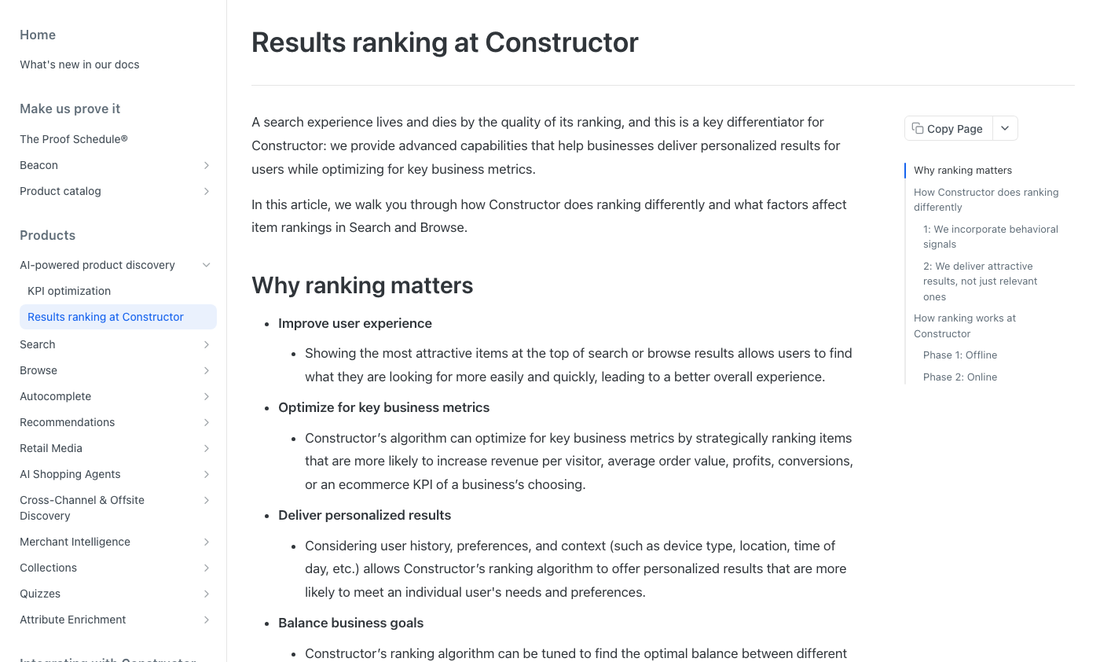
Constructor's ranking documentation lists revenue, order value, and profit as tunable objectives. Source.
The trade-off cuts both ways. A Klevu reviewer reports a 2x increase in conversion rate, while a Gartner reviewer notes that Constructor's automated model can limit a merchant's ability to override results.
- Klevu: relevance and popularity per term; margin and returns not native.
- Constructor: blends eight signals to a revenue, margin, or conversion KPI.
Can merchandisers run each one without developers?
Both hand merchandisers real levers. Klevu's run deep but sit behind a paid module; Constructor's are broad but form-based and capped by the model. Here is where each draws the line.
Klevu ships a full rules engine: boost and deboost scores from 1 to 999, pinning, exclusion, scheduling, and A/B testing. The catch is packaging. The visual dashboard, custom sorts, scheduling, and preview sit behind the paid Category Merchandising module.
One reviewer notes the admin console has a learning curve. So the control is real, but you pay for the add-on to get the no-code surface.
Constructor ships six rule types (boost, bury, slot, blocklist, allowlist, content) at single, campaign, and global scope, plus segment targeting and scheduling. Drag-and-drop, though, is only in the recommendations toolkit.
The core search and browse merchandising is form-based, and reviewers cite navigation friction: it takes a few tries to find things like pinning. Because the model owns the base ranking, overrides sit on top of it.
- Klevu: deep control, but the no-code dashboard is a paid add-on.
- Constructor: broad rules included, but form-based and the AI owns the base ranking.
How well does each fit Shopify Plus?
Both engines were built to run on any platform and reach Shopify through a connector app. So the real question is how battle-tested each connector is on a Plus store.
Klevu ships a native App Store app rated 4.9 across a small review base, plus a framework-agnostic MACH-certified SDK. Merchants call it the "easiest integration we have done with Shopify" for standard cases.
Even so, non-trivial work often requires developer involvement, and Klevu does not document support for Shopify's Standard Product Taxonomy or combined listings.
There is also corporate flux to weigh. Klevu's move into Athos Commerce comes with a defined platform transition: general availability in Q1 2026, a migration path for Klevu customers, and legacy platforms retired beginning 2027.
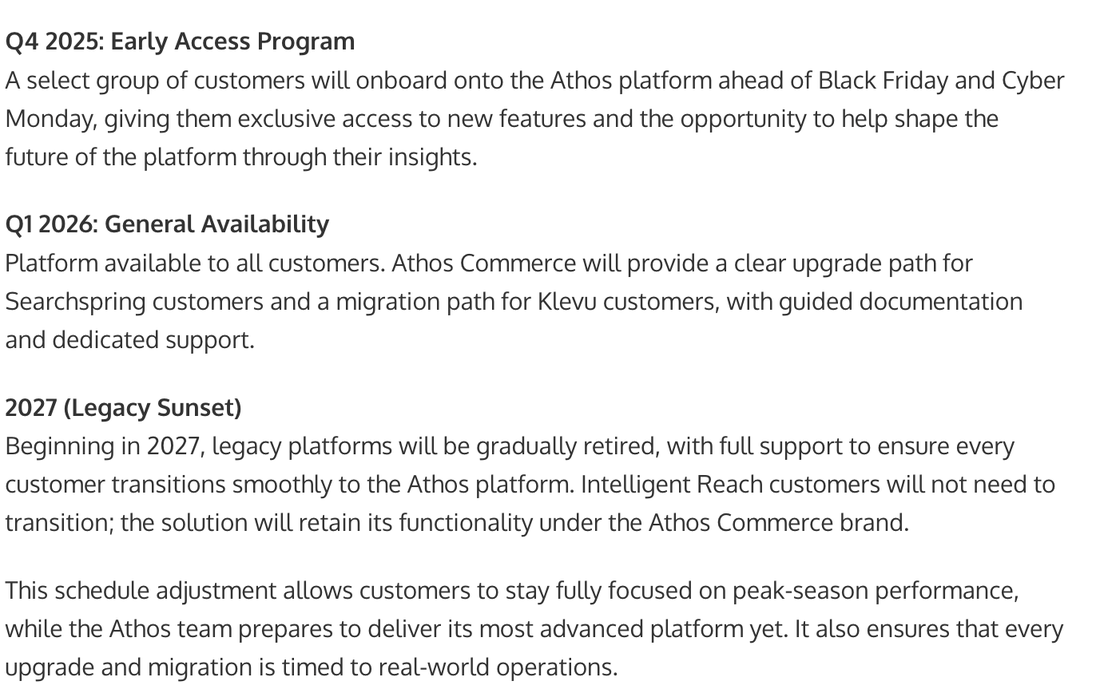
Athos Commerce's rollout notice: Q1 2026 GA, a migration path for Klevu customers, legacy retired beginning 2027. Source.
Constructor's Connect app launched in September 2024 and still has 0 reviews as of August 2026, so there is no independent Shopify-merchant signal yet. Shopify is one of eight or more platform connectors, and extra attributes need custom mapping.
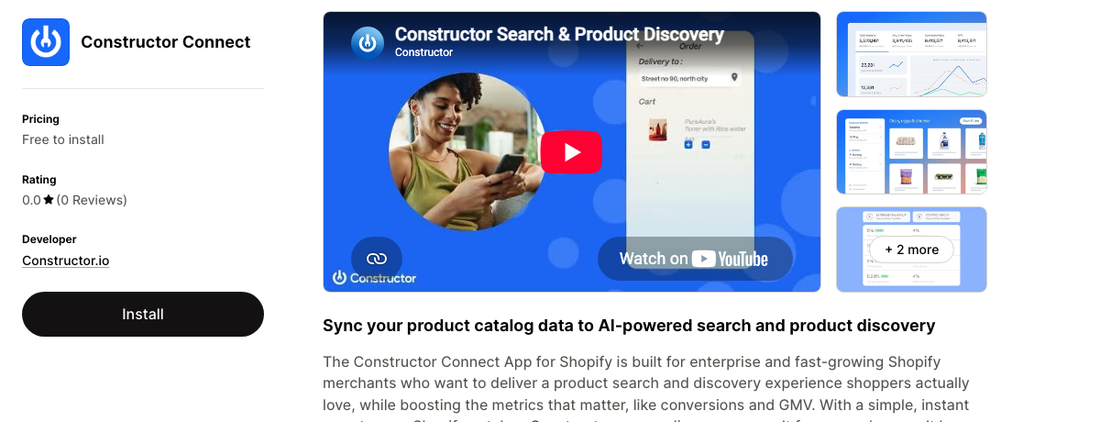
Constructor Connect on the Shopify App Store: 0 reviews as of August 2026. Source.
How do they handle Shopify Markets?
Run two or more country storefronts and this is the section that costs you time every week. Both vendors break a multi-market catalog into a separate index per market instead of serving one.
Klevu is out-of-the-box compatible with Shopify Markets, but the docs list four limits: prices sync for the primary market only, the price slider breaks on non-primary markets, fulfillable inventory is unsupported, and each market locale needs a separate KMC store.
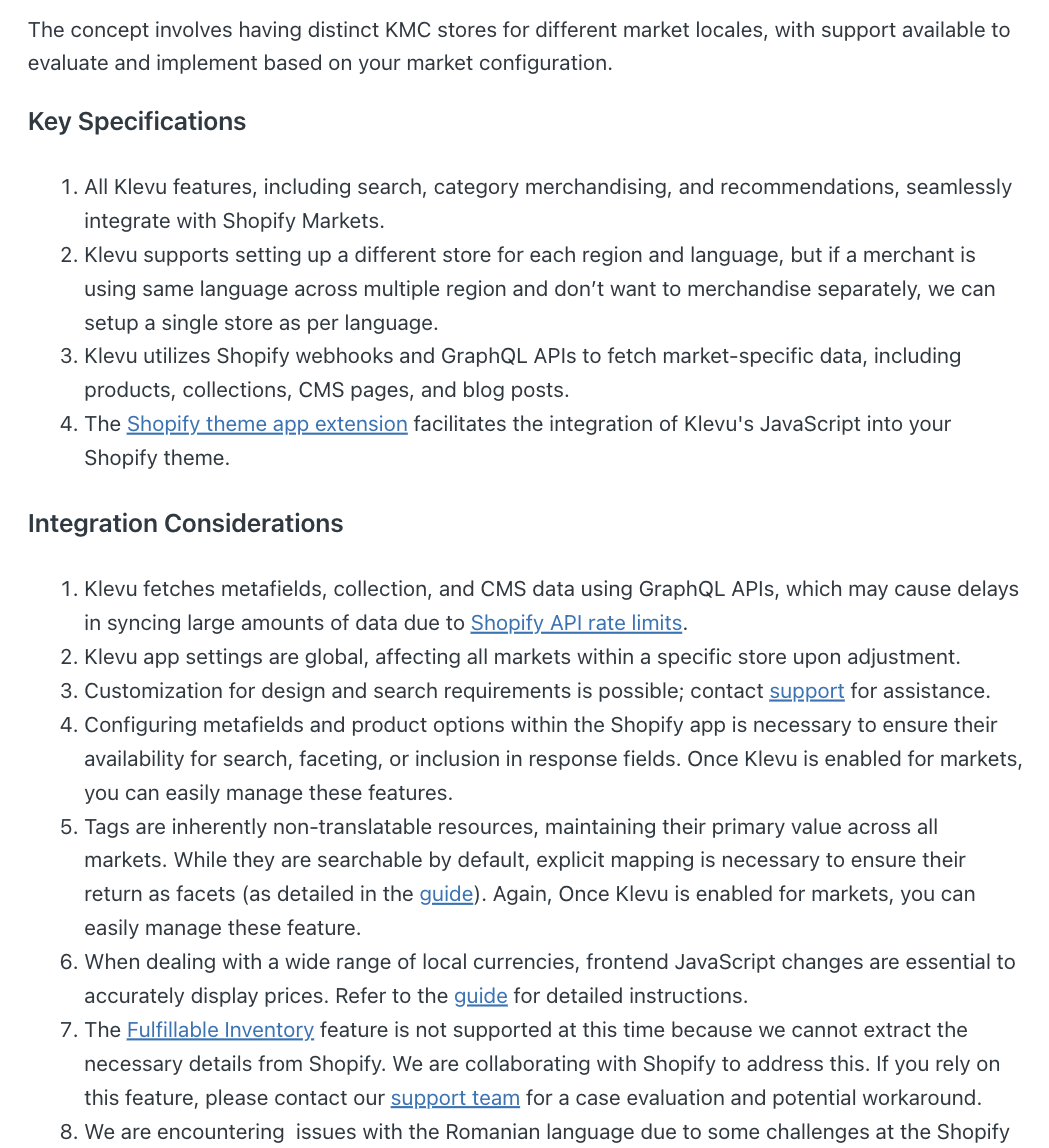
Klevu's Markets docs: distinct KMC stores per locale, plus documented integration limits. Source.
Constructor supports Markets, location-specific inventory, and localization, but each market and language is a separate index key with its own synonyms and merchandising rules. There is no single index across markets.
For a team that wants a single index across Shopify Markets, the per-region model is a standing tax on both. A one-region demo hides it. Go live across the US, UK, Germany, and Japan and you keep four sets of synonyms and rules in sync by hand.
How fresh is the catalog on each?
When a product sells out or a price drops, catalog freshness is what decides whether the shopper sees the change. Both vendors poll in batches, and the gap between them comes down to a few minutes.
Klevu runs a delta sync every 10 minutes on Shopify, keyed on updated_at with a per-batch threshold. Its delta does not handle deletions, so removed products need a separate path.
Constructor recommends a daily full sync plus intraday deltas, and its docs state that updates more frequently than every five minutes are not recommended.
For a flash sale, a price drop, or fast-moving inventory, both floors are fixed limits of the batch model, not a setting you can turn up. Neither is event-driven.
Which is readier for AI shopping agents?
As shoppers start arriving through AI assistants, both vendors are building conversational layers, and both keep them inside their own product rather than opening the catalog to outside models.
Klevu positions its generative layer, the Conversational Assistant and related tools, as paid add-ons under Athos, not part of the standalone Klevu modules. Text and image discovery live inside that assistant.
Constructor ships its own generative AI Shopping Agent that interprets conversational queries such as "something lightweight to wear hiking in summer" and runs the search inside the storefront.
Neither vendor documents a public MCP server, so neither exposes its catalog to assistants like ChatGPT or Claude over the open protocol today. The deeper question for a Shopify Plus brand is what an agent would see: raw search, or your merchandising rules and curation.
- Klevu: conversational assistant as a paid Athos add-on.
- Constructor: built-in AI Shopping Agent, no public MCP.
What does each actually cost?
Both reach five to six figures a year at scale, and they get there in different ways. Klevu publishes module prices that stack. Constructor is opaque and fixed once you sign.
The honest answer on which is cheaper depends on your query volume and how many Klevu modules you actually switch on.
Klevu lists three modules on the Shopify App Store: Site Search at $649, Category Merch at $549, and Recommendations at $449 per month. Run all three and you are at $1,647 per month before enterprise tiers.

Klevu's three modules price separately on the Shopify App Store and stack to $1,647 per month. Source.
Two more Klevu gotchas. Usage overages apply above each tier, and the listing notes that "external charges may be billed by Klevu separately from your Shopify invoice."
Athos enterprise is quote-only, reportedly starting around $699 per month. That figure comes from a motivated third-party source, so treat it as directional.
Constructor has no public pricing, no free tier, and no self-serve path. Every customer signs a custom annual contract, and cost is driven by query volume and scale.
- Average contract: around $150,000 per year, with a redline near $200,000 and one observed near $300,000, per Vendr.
- Query-based estimate: roughly $24K to $120K per year at about 5 million queries a month.
- Trade-off: one predictable annual number, but no way to start small or test cheaply.
Treat every Constructor figure as a third-party estimate, not a vendor number.
What are customers saying?
Both carry strong but thin independent review corpora, and "support" is the single most-praised attribute for each. Read the counts as carefully as the scores.
Klevu rates 4.4 to 4.5 on G2, though that page is now consolidating into a merged Athos Commerce listing that shows 4.5 across 224 reviews. That 224 count is the combined Searchspring, Klevu, and Intelligent Reach entity, not Klevu alone.
Klevu also holds 4.9 on the Shopify App Store, a stale 5.0 on Capterra, and 7 out of 10 on TrustRadius. Praise clusters on support and search relevance. Gripes cluster on premium pricing, the most recurring complaint, and Athos-migration uncertainty.
"The support team is wonderful at Klevu... they are a bit more expensive than other providers but they are well worth the price." GK Elite Sportswear, Shopify App Store
"Klevu has potential, but we faced challenges with inaccuracies in search results with spelling mistakes from time to time." Verified reviewer, G2 via Expertrec
Constructor rates 4.9 on Gartner Peer Insights across 59 ratings and 4.8 on G2 across about 57, with 7.7 out of 10 on TrustRadius and no Shopify App Store reviews yet.
Praise clusters on revenue-optimized ranking and the CSM relationship. Gripes cluster on time-heavy implementation, no self-serve, and limited override of the model.
"Constructor's support and communication provided during the sales, contract and implementation phases have been second to none. Their fast response times made our rollout smooth and frictionless." Head of Ecommerce, Retail, Gartner Peer Insights
"I wish it was a little easier to navigate the program as a whole. Sometimes it takes us a few tries to find where something is, especially when it comes to pinning specific pages." Verified reviewer, Gartner Peer Insights
Take both scores with the sample size attached. Klevu's are strong, but its standalone corpus is small and now folding into Athos. Constructor's are strong too, from a small, enterprise-heavy pool with no mid-market Shopify signal yet.
Top similarities between Klevu and Constructor.io
The differences get the attention, but for a Shopify Plus buyer the overlap decides just as much. Six things Klevu and Constructor share.
Both are genuinely AI-native engines
Both learn from clickstream rather than sitting on a static keyword index. Klevu runs self-learning relevance scores. Constructor pairs an Inverted Index with Cognitive Embeddings Search. Real semantic retrieval and behavioral ranking on each side, which is the common ground worth naming.
Neither is built for Shopify
Both are platform-agnostic engines with a Shopify adapter, not Shopify-native tools. Klevu also connects to Magento, BigCommerce, and headless stacks, and Constructor lists eight or more platform connectors. That general-purpose design drives most of the differences above: taxonomy, Markets, and catalog sync all inherit it.
Both use a separate index per locale
Neither serves a single unified multilingual index. Klevu needs a separate KMC store per market locale, and Constructor needs a separate index key per market and language. International scale multiplies index and config overhead, so a four-region brand runs several parallel indexes either way.
Both are batch-sync, not event-driven
Klevu syncs on a 10-minute delta and Constructor on a 5-minute minimum. Neither reflects a catalog change the instant it happens, so both leave a window where a shopper can see a stale price or a sold-out item during fast-moving events.
Both are enterprise-priced and reward scale
Opaque or stacking pricing is a recurring buyer complaint for each, and both need meaningful traffic to justify the spend. Constructor's behavioral models need volume to train, and Klevu's module stack adds up fast. Under a certain size, neither pays for itself.
Both are capable, proven search engines
No asterisk on this one. Both handle semantic search, faceting, autocomplete, rules-based merchandising, and analytics, and both hold strong review scores with support as the top-praised attribute. The decision comes down to fit and delivery on Shopify Plus, not whether the core search works.
How to choose
Choose Klevu if you want a mature, relevance-first search and merchandising suite, you value a support team that reviewers rate highly, and you are comfortable buying its features as separate modules.
Budget for the Category Merchandising add-on if you want the visual merchandiser surface, and weigh the Athos platform transition into your timeline.
Choose Constructor.io if you are a large retailer with high traffic and a big catalog, you want AI ranking tuned to revenue or margin without configuring a formula, you value a hands-on CSM, and a five to six-figure annual contract fits your budget.
Accept that the model owns the base ranking and that its Shopify connector is new and unproven in public.
Is there an option built only for Shopify Plus?
Klevu and Constructor are both platform-agnostic engines. If you sell only on Shopify Plus, a native tool drops the parts of both that exist to serve every other platform. That is what we built Layers to do.
Five places we take a different path from both:
- Shopify-native catalog. We index Shopify's Standard Product Taxonomy, combined listings, and bundles natively, so there is no field mapping to maintain.
- One index across Markets. 100+ languages in a single index, not a separate store or index per region, which removes the multi-index overhead both other tools carry.
- Near-real-time sync. Webhook-driven catalog updates with a full resync every eight hours, not a 10-minute or 5-minute batch floor.
- Merchandiser-owned ranking. Drag products in the grid to pin them, and blend margin, inventory, and return rate into one sort score, with no paid add-on and no developer ticket.
- Native MCP. Assistants like ChatGPT and Claude read your merchandising rules, not just raw search, which neither Klevu nor Constructor documents today.
One example. 9-figure apparel brand Rainbow Shops moved to Layers. Their VP of eCommerce and Digital, David Cost, on the switch:
"Layers was the first time we were able to create some customization and essentially create the same kind of sort-orders that we were used to having in Salesforce. And we could see a pretty immediate impact on the conversion rate."
After the move, Rainbow Shops reported a 30% increase in conversion rate and now re-orders every collection page daily based on the last seven days of demand.
And four places we are the wrong call:
- You are not on Shopify Plus, or you run a multi-platform or headless stack elsewhere. Klevu or Constructor's platform-agnostic engines fit better.
- You want drop-in, zero-dev search widgets. We ship a theme app embed, an SDK, and Liquid rendering recipes, so the markup is yours.
- You want a self-service A/B testing suite for sort configs today. That is not a shipped Layers feature yet, and all three of these tools document A/B testing.
- You are a pure enterprise team optimizing to a single revenue KPI at massive query scale. Constructor's outcome-ranking heritage may suit you better.
FAQ
Is Klevu or Constructor.io better for ecommerce search? Klevu is the more mature, relevance-first suite and is easier to start with through its Shopify modules. Constructor is the more specialized enterprise ranking product, tuned to revenue or margin. The right pick depends on whether you want packaged search modules or an outcome-ranking platform.
Which is more expensive, Klevu or Constructor.io? Klevu publishes module prices that stack to $1,647 per month for the full suite, with enterprise tiers quote-only. Constructor is enterprise-contract-only, around $150K per year per third-party data. At scale both reach five to six figures a year.
Do Klevu or Constructor.io work natively with Shopify Plus? Neither is Shopify-native. Both are platform-agnostic engines with a Shopify connector. Klevu's app is established but does not document Shopify taxonomy support. Constructor's connector launched in September 2024 and has no public App Store reviews yet.
What is Athos Commerce and how does it affect Klevu? Athos Commerce is a roll-up that owns Klevu, Searchspring, and Intelligent Reach. It plans general availability of a successor platform in Q1 2026, a migration path for Klevu customers, and retirement of legacy platforms beginning 2027.
Can ChatGPT or Claude connect to these platforms? Neither Klevu nor Constructor documents a public MCP server, so neither exposes its catalog to outside assistants over the open protocol today. Constructor ships its own on-site AI Shopping Agent, and Klevu offers a Conversational Assistant as a paid Athos add-on.
Which is easier for a merchandising team to run without developers? Neither is fully self-serve. Klevu's no-code merchandiser dashboard sits behind its paid Category Merchandising module. Constructor's rules are broad but form-based, and its AI model owns the base ranking, with a services-led rollout.
Written by

Deb Mukherjee
Ecom Growth Advisor
Deb Mukherjee is an Ecom Growth Advisor who writes about ecommerce search and merchandising for Layers, the enterprise search and merchandising platform built for Shopify Plus. He works with Plus brands on search relevance, merchandising, and the catalog-data work behind product discovery at scale.
View all articlesRelated articles
More reading on search, merchandising, and product discovery.
Coveo vs Algolia: Top Differences and Similarities (2026)
A fact-by-fact comparison of Coveo and Algolia for Shopify Plus: search, ranking, merchandising, Shopify Markets, catalog sync, AI agents, pricing, and reviews. Every claim cited, verified August 2026.

Jake Casto
Aug 24, 2026 · 18 min read
Coveo vs Bloomreach: Top Differences and Similarities (2026)
A fact-by-fact comparison of Coveo and Bloomreach for Shopify Plus: search, ranking, merchandising, Shopify Markets, catalog sync, AI agents, pricing, and reviews. Every claim cited, verified August 2026.
Jake Casto
Aug 24, 2026 · 18 min read
Coveo vs Constructor.io: Top Differences and Similarities (2026)
A fact-by-fact comparison of Coveo and Constructor.io for Shopify Plus: search, ranking, merchandising, Shopify Markets, catalog sync, AI agents, pricing, and reviews. Every claim cited, verified August 2026.
Jake Casto
Aug 24, 2026 · 17 min read