Nosto vs Klevu: Top Differences and Similarities (2026)
A fact-by-fact comparison of Nosto and Klevu for Shopify Plus: search, ranking, merchandising, Shopify Markets, catalog sync, AI agents, pricing, and reviews. Every claim cited, verified August 2026.
Key takeaways
Overview
Both engines are competent at ecommerce search and merchandising. What separates them is where each one started.
Nosto is a Commerce Experience Platform founded in Helsinki in 2011. Its mature core is AI personalization, recommendations, and a CDP.
Site search arrived through two acquisitions, SearchNode in January 2022 and Findologic in December 2022, and is sold as a separate module. Shopify is one of several platforms it supports.
Klevu is a search, merchandising, and recommendations suite founded in Helsinki in 2013. Search relevance is its flagship.
In January 2025 it became the acquired brand inside Athos Commerce, a PSG-backed platform, and now sits on a defined migration track. It is platform-agnostic and MACH-based, so Shopify is one integration among many.
The rest of this comparison goes capability by capability, from catalog sync to MCP support, and ends with which buyer each one suits.
Top differences between Nosto and Klevu
Five verdicts below: Yes works as stated, Gated needs a higher tier or add-on, Partial works with limits, No, and Undocumented means the vendor does not publish it. Each is sourced in the sections that follow. Verified August 2026.
Platform and Shopify fit
| Capability | Nosto | Klevu |
|---|---|---|
| Built only for Shopify | No | No |
| Native Shopify Standard Taxonomy ingestion | Partial (Category and CategoryIds) | Undocumented |
| Native Shopify Markets | Yes, one account per market | Partial, primary-market prices only |
| One index across locales | Partial, one account per language | No, separate store per locale |
| Catalog sync freshness | Partial, webhook plus up-to-2-hour full sync | Partial, 10-minute delta, no deletions |
| Combined listings and bundles | Partial (Dynamic Bundles) | Undocumented |
Search
| Capability | Nosto | Klevu |
|---|---|---|
| Semantic search and NLU | Gated (separate Search module) | Yes (base module) |
| Semantic without synonym lists | Partial (conditional vector fallback) | Yes |
| Query intent to auto-filters | Partial (intent detected, auto-filter undocumented) | Yes (price and measurement) |
| Keyword prefix, fuzzy, typo tolerance | Yes | Yes |
| Camera or image-based visual search | No (text query only) | Partial (SDK, add-on unclear) |
| ML reranking | Yes | Yes |
Merchandising
| Capability | Nosto | Klevu |
|---|---|---|
| Multiple custom sort orders per collection | Yes | Gated (Category Merch add-on) |
| Boost and demote rules | Yes | Yes (scores 1 to 999) |
| Drag-and-drop pinning and sequencing | Yes | Gated (Category Merch add-on) |
| Weighted multi-metric ranking score | Yes | Partial (blended internally, no formula UI) |
| Contextual boosting by segment | Yes | Gated (Premium and Enterprise) |
| Scheduled merchandising and preview | Yes | Gated (Category Merch add-on) |
AI, pricing, and reviews
| Capability | Nosto | Klevu |
|---|---|---|
| Margin and inventory in ranking | Partial (return rate is a custom tag) | Partial (stock and conversion, no margin) |
| Semantic search with no extra module | No (Search is a separate SKU) | Partial (personalized search plan-gated) |
| MCP server for outside assistants | Yes (Huginn, October 2025) | No standalone MCP |
| Published Shopify pricing | No (quote-only) | Yes (modules stack) |
| Public review base | G2 4.6, ~235 reviews | G2 4.4, 71 reviews |
How does each engine find products?
Search means something different to each company. For Nosto it is an add-on module stitched together from two 2022 acquisitions. For Klevu it is the founding product, built in-house since 2013.
Nosto's search is a separate SKU, "Nosto Search and Categories," running on the acquired Findologic and SearchNode engines. It ships a GraphQL Search API with NLP, typo tolerance, synonyms, and Hybrid Vector Search.
Buyer guides frame that search as secondary to Nosto's personalization core, or bolted on compared with pure-play vendors. The engine is credible, but it was assembled through acquisition and priced apart.
Klevu runs hybrid keyword plus semantic search in its base module, trained on ecommerce query data. Reviewers call the relevance its strongest attribute, with real-time synonym expansion and intent understanding.

Klevu's search, now sold under Athos Commerce, is pitched as intent-first and included in the base module. Source.
- Semantic search: included on Klevu's base module; a separate SKU on Nosto.
- Image-to-search: SDK-level on Klevu; not in Nosto's Search API.
How does each rank results?
The ranking logic is where Nosto and Klevu part ways. Nosto ranks by who the shopper is, plus whatever a merchandiser hand-tunes on top. Klevu ranks by what shoppers as a group have clicked and bought, scored fresh for each query.
Nosto ranks with personalization plus its Huginn "Large Intent Model," while merchandising rules and synonyms stay manually tuned. Its Hybrid Vector layer engages conditionally, on poor click-through, poor conversion, or zero results, not on every query.
Klevu computes self-learning boosting scores at the query level, per search term. The scores adapt from clicks, checkouts, and ratings, and stock-aware ranking is default behavior.
That difference shows up on the long tail. Nosto's semantic recovery is strong once triggered, but it is a fallback. Klevu's self-learning ranking runs on every term from the start.
- Nosto: personalization is strong; semantic ranking is a conditional fallback.
- Klevu: always-on, query-level self-learning trained on shopper behavior.
Can merchandisers run each one without developers?
Both hand merchandisers a real control surface. The gap is packaging: what Nosto bundles in, Klevu charges for as a separate add-on.
Nosto documents a deep, included merchandising surface: weighted multi-metric sorting rules, drag-and-drop, sequencing, scheduling, preview, pinning, and exclusion. Native metrics include gross margin, inventory level, and sales velocity, though return rate needs a custom tag.
One Shopify merchant calls it a "robust platform with tons of features and opportunity to get really granular" (Shopify App Store). The control ships with the suite.
Klevu also runs a full rules engine with boost and deboost scores from 1 to 999, pinning, and exclusion. The catch is packaging. The visual dashboard, custom sort orders, scheduling, and preview sit behind the $549 per month Category Merchandising add-on.
There is no merchant-facing weighted-formula editor, and reviewers say the console "has a learning curve" and can feel dense.
- Nosto: deep merchandiser control included with the suite.
- Klevu: deep controls too, but key ones are gated behind a paid add-on.
How well does each fit Shopify Plus?
Neither engine was built for Shopify first. Each ships a Shopify app on top of a multi-platform core, so the real question is how far past the app the integration reaches.
Nosto ships a native "Nosto | AI Search & Discovery" app with Theme App Extensions and a DynamicCard web component. One reviewer flags that the engine "works in the browser, not in your data layer," a headless-fit complaint.
Klevu ships a native Shopify app plus a MACH-certified, framework-agnostic TypeScript SDK. Reviewers call standard setup easy, but non-trivial work "often requires developer involvement" (Shopify App Store).
Neither documents support for Shopify's Standard Product Taxonomy or native combined listings. Both treat Shopify as one platform among several, not the priority.
- Nosto: native app, but multi-platform and browser-layer.
- Klevu: native app, but platform-agnostic by design.
How do they handle Shopify Markets?
Run more than one Shopify Market and this is where the overhead lives. Both vendors split a multi-market catalog into parallel setups instead of one shared index.
Nosto integrates natively with Shopify Markets and respects language, price, currency, and availability. The architecture caveat is that you run one Nosto account per market and language, not a single index.
Klevu is compatible with Shopify Markets with no data feeds, but the limits are material. Prices sync for the primary market only, the price slider breaks on non-primary markets, fulfillable inventory is unsupported, and each locale needs a separate KMC store.
So Nosto gives you full functionality at the cost of an account per market. Klevu gives you compatibility with real gaps once you leave the primary market.
How fresh is the catalog on each?
Stale index data is what puts a sold-out size or an old price in front of a shopper. Both vendors sync incrementally, but each has a floor it cannot drop below.
Nosto updates incrementally by webhook in near-real-time. A full product sync, however, can take up to two hours, which matters on a large first index or a full rebuild.
Klevu runs a delta sync roughly every ten minutes on Shopify. It depends on the updated_at field, has a per-batch threshold, and does not handle deletions in the delta.
For a flash sale or fast-moving inventory, Nosto's slow full re-sync and Klevu's ten-minute floor are both fixed limits, not settings you can turn up.
Which is readier for AI shopping agents?
More shoppers now start inside an AI assistant instead of a search box, and the two vendors have placed opposite bets. Nosto has already shipped an agent surface. Klevu has folded its agent roadmap into Athos.
Nosto launched Huginn in October 2025, an agentic layer with a proprietary "Large Intent Model." It ships an MCP server that integrates with Klaviyo and Shopify Sidekick and lets developers connect external models.
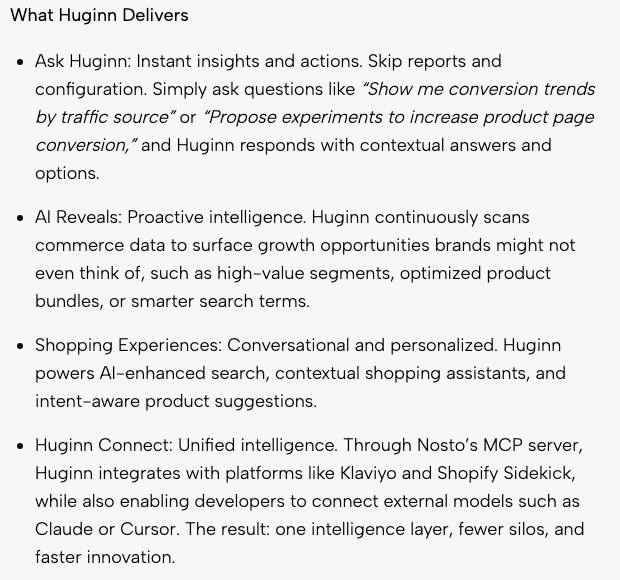
Nosto's Huginn announcement describes a shipped MCP server for outside assistants. Source.
Klevu does not document an MCP or agent-shopping endpoint for the standalone product. Its generative direction, the Conversational, Channel, and GEO Assistants, is being routed into Athos and sold as paid add-ons.
So on the agent-readiness dimension, Nosto is ahead today. Klevu's agent story depends on the Athos platform, not on Klevu as you buy it now.
- Nosto: a live MCP server shipped in October 2025.
- Klevu: no standalone MCP; agents deferred to Athos add-ons.
What does each actually cost?
At real scale both land in the five figures a year, by different routes. Nosto never publishes a number. Klevu publishes its Shopify tiers up front, then stacks modules on top of them.
Nosto has no public price list. Its model is a flat license indexed to merchant revenue plus per-module fees. Third-party marketplace Vendr lists an average contract around $47,591 per year.
Buyer guides repeatedly call Nosto expensive at higher GMV, and its search module is priced on top of personalization. Treat every figure as a third-party estimate, not a vendor number.
Klevu publishes Shopify pricing: Site Search $649, Category Merch $549, and Recommendations $449 per month, or $1,647 for the full suite, with usage overages billed separately.
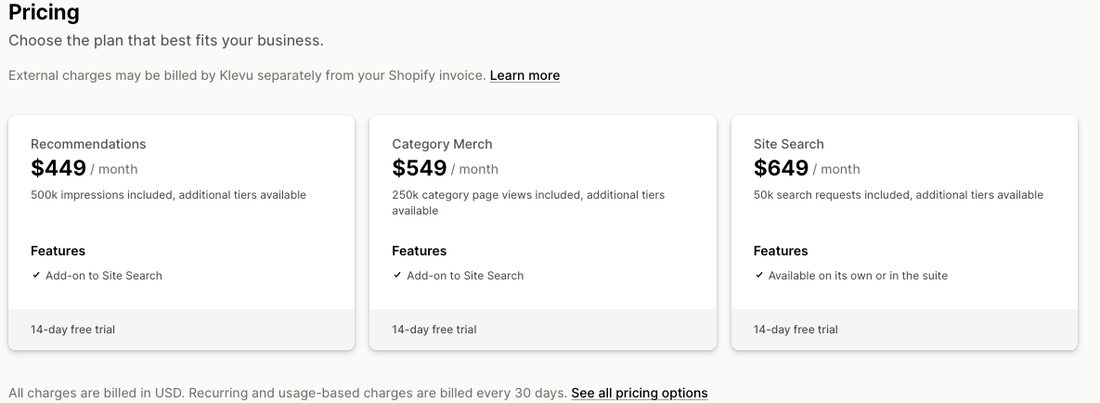
Klevu's Shopify modules stack: merchandising and recommendations are add-ons to Site Search. Source.
Enterprise and Athos pricing is quote-only, and AI Agents cost extra. Directional third-party estimates put Klevu at $499 and up, rising to thousands for larger builds.
What are customers saying?
Which vendor looks stronger depends on the review site you weight. Both hold high scores, and both scores rest on small, mostly single-platform samples.
Nosto rates 4.6 on G2 across about 235 reviews, 4.8 on the Shopify App Store from 51 reviews, and 4.0 on Capterra from a small sample.
Praise clusters on personalization and hands-on CSM support. Gripes cluster on revenue-scaled cost and annual lock-in.
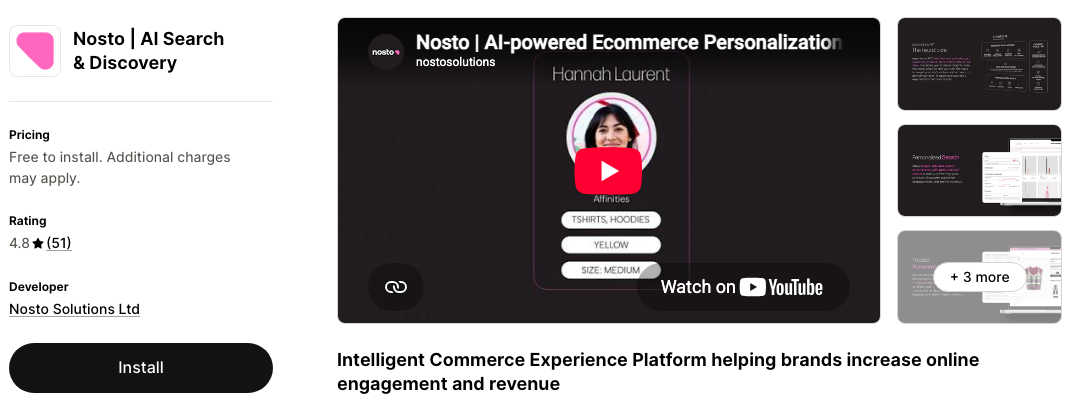
Nosto on the Shopify App Store: 4.8 stars, 51 reviews. Source.
"We've been using Nosto on the site for years and it's amazing what it can do. Louisa has been outstanding in supporting us with how to best use Nosto, what tools to use and overall strategy." Katy Perry Collections, Shopify App Store
"It is not worth the money. The worst part is that you sign a year contract and they force you to keep the expensive contract even when the services do not help your business and you want to terminate." Alodia Hair Care, Shopify App Store
Klevu rates 4.4 on G2 across 71 reviews, 4.9 on the Shopify App Store from 12 reviews, and 7 out of 10 on TrustRadius from a small sample.
Praise clusters on search relevance and fast support. Gripes cluster on premium pricing, tiered support gating, and Athos-merger uncertainty.
"The support team is wonderful at Klevu. They are a bit more expensive than other providers but they are well worth the price." GK Elite Sportswear, Shopify App Store
"The support team is very helpful, but we fall into a tier that doesn't qualify for account management even though we are using two of their products. The lack of account management leaves us in the dark on strategies." Verified reviewer, surfaced by Expertrec
Take both scores at face value and no further. Each is real, each rests on a thin sample away from the vendor's core platform, and both collect the same one-word complaint: expensive.
Top similarities between Nosto and Klevu
The differences are only one side of the ledger. The two share a surprising amount, and the overlap shapes a Shopify Plus decision as much as the gaps do.
Both are Helsinki-founded Finnish companies
Nosto launched in 2011 and Klevu in 2013, both out of Helsinki. They share the same Nordic ecommerce-search lineage, which is why their feature vocabularies and merchandising models often rhyme.
Both sell discovery as separate priced modules
Neither bundles the full stack into one flat price. Nosto prices search apart from personalization, and Klevu prices merchandising and recommendations as add-ons to search. Costs stack the more of the stack you turn on.
Both are platform-agnostic, not Shopify-exclusive
Shopify is one of several supported platforms for each, so neither is Shopify-Plus-native. That general-purpose design drives most of the differences above, from taxonomy handling to Markets to catalog sync.
Both use a separate index per market-locale
For Shopify Markets, Nosto runs one account per market and language, and Klevu runs a separate store per locale. Neither serves one unified multilingual index, so multi-region brands maintain parallel setups.
Both gate enterprise pricing behind a quote
Nosto is quote-only end to end, and Klevu's enterprise and Athos pricing is request-only above the published Shopify tiers. On either side, a serious buyer cannot self-estimate the enterprise number.
Both are capable, proven engines
No hedging on this one. Semantic search, faceting, autocomplete, rules-based merchandising, analytics: both do all of it well, and both post strong independent scores. The choice comes down to fit and packaging on Shopify Plus, not to whether the search itself works.
How to choose
Neither one wins outright. The right pick depends on your catalog and where your team already spends its hours, not on a spec sheet.
Choose Nosto if personalization and a CDP are your center of gravity, you want deep merchandiser control included rather than gated, you run multiple Shopify Markets and want full per-market functionality, and a quote-based, revenue-indexed contract fits your budget.
Choose Klevu if search relevance is your primary need, you want self-learning ranking in the base module, you prefer a published Shopify starting price you can read before a sales call, and you are comfortable adding modules and following the product into Athos Commerce.
Is there an option built only for Shopify Plus?
Nosto and Klevu are both multi-platform engines. Sell only on Shopify Plus and a native tool sheds the multi-platform overhead both carry. We built Layers to be that native tool.
What we do that neither of them does:
- Shopify-native catalog. We ingest Shopify's Standard Product Taxonomy, combined listings, and bundles by name, so there is no field mapping to maintain.
- One index across Markets. 100+ languages in a single index, not an account or store per locale, which removes the multi-index overhead both other tools carry.
- Near-real-time sync. Webhook-driven updates in near-real-time, not a slow full re-sync or a ten-minute delta floor.
- Merchandiser-owned ranking. Drag-and-drop control plus ranking by margin or return rate, with no add-on to unlock the visual dashboard.
- Native image search and MCP. A shipped Image Search API and a native MCP surface, so assistants read your merchandising rules, not just raw search.
One example. 9-figure apparel brand Rainbow Shops moved to us for exactly this. Their VP of eCommerce and Digital, David Cost:
"Layers was the first time we were able to create some customization and essentially create the same kind of sort-orders that we were used to having in Salesforce. And we could see a pretty immediate impact on the conversion rate."
After the move, Rainbow Shops reported a 30% increase in conversion rate and now re-orders every collection page daily based on the last seven days of demand.
When we are the wrong call:
- You are not on Shopify, or you run a multi-platform or headless estate. Nosto or Klevu fits better.
- Your primary need is UGC or visual social content. Nosto's Stackla territory fits better.
- You want a full personalization and CDP suite. Nosto's core is broader than our search-and-merchandising focus.
- You want a large third-party review corpus to vet. Nosto and Klevu have more listed reviews than we do; evaluate us on docs and a trial.
FAQ
Is Klevu better than Nosto for search? Klevu leads with search and ships semantic ranking in its base module. Nosto's search is credible but assembled from acquisitions and sold as a separate SKU. If search relevance is the priority, Klevu is the more focused pick; if personalization is, Nosto is.
Which is more expensive, Nosto or Klevu? Nosto is quote-only and revenue-indexed, with a Vendr average near $47,591 per year. Klevu publishes Shopify tiers starting at $449 per month, but modules stack to $1,647 for the full suite, and enterprise pricing is quote-only. Both reach five figures a year at scale.
Do Nosto or Klevu work natively with Shopify Plus? Neither is Shopify-native. Both ship a native Shopify app but are platform-agnostic engines. Neither documents support for Shopify's Standard Product Taxonomy or native combined listings.
Does Nosto or Klevu include semantic search without an add-on? Klevu includes hybrid semantic search in its base module. Nosto sells search as a separate module, and its vector layer engages conditionally rather than on every query.
Can ChatGPT or Claude connect to Nosto or Klevu? Nosto ships an MCP server with Huginn that lets assistants and external models connect, live since October 2025. Klevu does not publish a standalone MCP; its agent roadmap is moving into Athos Commerce as paid add-ons.
What does the Athos Commerce acquisition mean for Klevu? Klevu became the acquired brand inside PSG-backed Athos Commerce in January 2025. The platform is on a defined migration track, with new capabilities and agents sold under Athos. Factor that roadmap uncertainty into a multi-year decision.
Written by

Deb Mukherjee
Ecom Growth Advisor
Deb Mukherjee is an Ecom Growth Advisor who writes about ecommerce search and merchandising for Layers, the enterprise search and merchandising platform built for Shopify Plus. He works with Plus brands on search relevance, merchandising, and the catalog-data work behind product discovery at scale.
View all articlesRelated articles
More reading on search, merchandising, and product discovery.
Coveo vs Algolia: Top Differences and Similarities (2026)
A fact-by-fact comparison of Coveo and Algolia for Shopify Plus: search, ranking, merchandising, Shopify Markets, catalog sync, AI agents, pricing, and reviews. Every claim cited, verified August 2026.

Jake Casto
Aug 24, 2026 · 18 min read
Coveo vs Bloomreach: Top Differences and Similarities (2026)
A fact-by-fact comparison of Coveo and Bloomreach for Shopify Plus: search, ranking, merchandising, Shopify Markets, catalog sync, AI agents, pricing, and reviews. Every claim cited, verified August 2026.
Jake Casto
Aug 24, 2026 · 18 min read
Coveo vs Constructor.io: Top Differences and Similarities (2026)
A fact-by-fact comparison of Coveo and Constructor.io for Shopify Plus: search, ranking, merchandising, Shopify Markets, catalog sync, AI agents, pricing, and reviews. Every claim cited, verified August 2026.
Jake Casto
Aug 24, 2026 · 17 min read