Searchspring vs Klevu: Top Differences and Similarities (2026)
A fact-by-fact comparison of Searchspring and Klevu for Shopify Plus: search, ranking, merchandising, Shopify Markets, catalog sync, AI agents, pricing, and reviews. Every claim cited, verified August 2026.
Key takeaways
Overview
Both handle ecommerce search and merchandising at a high level. They now sit under one roof, but each started out chasing a different buyer.
Searchspring is a hosted site-search, merchandising, and analytics suite founded in 2007. It is platform-agnostic across Shopify, BigCommerce, and Magento. Its heritage is merchandising: a visual no-code console for pinning, boosting, scheduling, and previewing results. A dedicated merchandiser is the buyer it fits best.
Klevu is an AI-search platform built in Finland. Its engine combines keyword search with self-learning ranking and NLP across 31 languages. It ships as three stackable Shopify modules: search, category merchandising, and recommendations. It fits teams that want strong relevance out of the box.
Both merged into Athos Commerce, a PSG-backed group that also owns feed vendor Intelligent Reach.

Searchspring and Klevu now share one homepage under Athos Commerce. Source.
What follows is a capability-by-capability read, ending on the fit question: a merchandiser-led shop, or a search-led one.
Top differences between Searchspring and Klevu
Verdicts below: Yes works as stated, Gated needs a paid add-on or higher tier, Partial works with limits, No does not, and Unknown where neither the docs nor the App Store say either way. Each is sourced below. Verified August 2026.
Platform and Shopify fit
| Capability | Searchspring | Klevu |
|---|---|---|
| Built only for Shopify Plus | No | No |
| Native Shopify taxonomy ingestion | Partial | Unknown |
| Shopify combined listings and bundles | Gated | Unknown |
| Native Shopify Markets | Partial | Partial |
| One index across locales | Unknown | No |
| Catalog sync latency | Daily default, API for single items | 10-minute delta, no deletes |
| Shopify App Store rating | 3.7 / 5 (18 reviews) | 4.9 / 5 (12 reviews) |
Search
| Capability | Searchspring | Klevu |
|---|---|---|
| Semantic search and NLU | Yes | Yes |
| Query intent to auto price and measurement filters | Yes | Yes (5 languages) |
| Behavioral ML re-ranking | Yes | Yes |
| Keyword prefix, fuzzy, typo tolerance | Yes | Yes |
| Image or visual search | Unknown | Partial |
| Handles incomplete or ambiguous queries | Yes | Yes |
Merchandising
| Capability | Searchspring | Klevu |
|---|---|---|
| Drag-and-drop pin, boost, bury console | Yes | Gated |
| Multiple custom sort orders per collection | Yes (up to 15) | Gated |
| Scheduled or time-based campaigns | Yes | Gated |
| Visual preview before publish | Yes | Gated |
| Blend attributes into one weighted score | Partial | Partial |
| Margin or return rate in ranking | Partial | Partial |
AI, pricing, and reviews
| Capability | Searchspring | Klevu |
|---|---|---|
| AI ranking included without an upgrade or module | Unknown | Partial |
| Native MCP for outside assistants | No | No |
| Public merchandiser documentation | Yes | Yes |
| Pricing transparency | No (quote only) | Partial (modules published) |
| Public review base | 4.6 on G2, dozens of reviews | 4.4 on G2, 71 reviews |
How does each engine find products?
These two came at search from opposite ends. Klevu started as an AI-search engine in Finland. Searchspring started as a merchandising console, and it only picked up semantic search when it merged with Klevu.
Klevu computes self-learning scores per search term, adapting from clicks, checkouts, and ratings. Its hybrid engine "understands what shoppers mean, not just what they type," per the Athos site-search page.
Independent reviewers name relevance quality as its strongest trait. One long-form review calls the search results its single best attribute.
Searchspring's own semantic model "breaks down queries in milliseconds, identifying product types, categories, and attributes," per its product page. Its IntelliSuggest layer re-ranks the top search terms from behavioral data.
The catch is where that evidence lives. Searchspring's semantic claim sits on a product page, not developer docs, and its pricing is quote-only, so which plan tier includes it is not published anywhere.
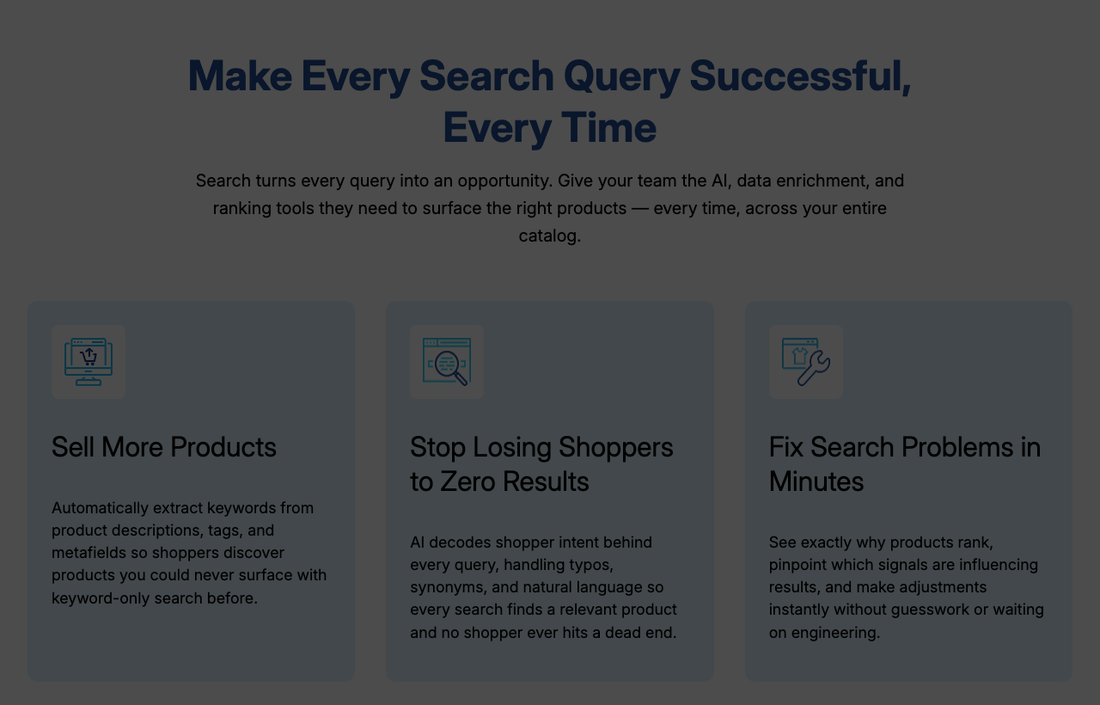
The Athos search page, which now carries both products. It cites intent decoding and rank transparency. Source.
- Klevu: a purpose-built self-learning engine, its documented strength.
- Searchspring: real semantic search added post-merger, with the plan tier undisclosed.
How does each rank results?
Ranking is where both stop short of the same thing. Neither exposes a free-form weighted formula that a merchant can edit, though each gets close from a different angle.
Searchspring lets you target products by newness, gross margin, brand, category, or engagement. Its boosting rules use "is more than" and "is less than" number criteria plus a sub-sort. It is a rule-and-priority system rather than a formula editor.
One reviewer wanted the blend it cannot do: "we can only serve results based on either relevancy or sales performance," and asked to add "stock quantity, margin, sponsorship factor" (TrustRadius).
Klevu blends stock status, self-learning scores, boosts, and semantic relevance internally. Boost scores run 1 to 999 and deboost to minus 999, with nested condition groups.
The AI owns the weighting, and there is no merchant-facing formula UI. Margin and return rate are not documented ranking inputs for either vendor.
- Searchspring: rules plus priority, with margin available but no formula.
- Klevu: AI-blended signals, tunable by boosts, but no formula UI.
Can merchandisers run each one without developers?
This is Searchspring's home turf, and the clearest split between the two. The question is not whether each has a console, but whether you pay extra to use it.
Searchspring ships a visual drag-and-drop console with pin, boost, and bury, up to 15 custom sort orders, campaign scheduling, A/B testing, and a live Search Preview. All of it is included, and it is the reason merchants choose the product.
Reviewers point to the usability for non-technical staff. One notes that "even the not so seasoned or techy members of our team have been able to log in and use" it (Software Advice).
Klevu has a visual no-code merchandising console too, though the dashboard, custom sorts, scheduling, and preview are gated behind the Category Merchandising module at $549/month.
Some first-time merchandisers also find the console dense. One review notes it "has a learning curve and can feel dense for first-time merchandisers" (AI Tools Atlas).

Searchspring's merchandising console, now on the Athos site. The visual editor is its heritage strength. Source.
- Searchspring: a full no-code console, included in the base product.
- Klevu: a capable console, gated behind a paid add-on.
How well does each fit Shopify Plus?
Neither one was born on Shopify. Both are multi-platform engines that reach it through an app, so the question that matters is how deep and how proven that connector is.
Searchspring now ships as Athos: Unified Discovery on the App Store, rated 3.7 from 18 reviews. It is platform-agnostic by design, and reviewers note the front end can need developer help. No Shopify Standard Product Taxonomy mapping is documented.
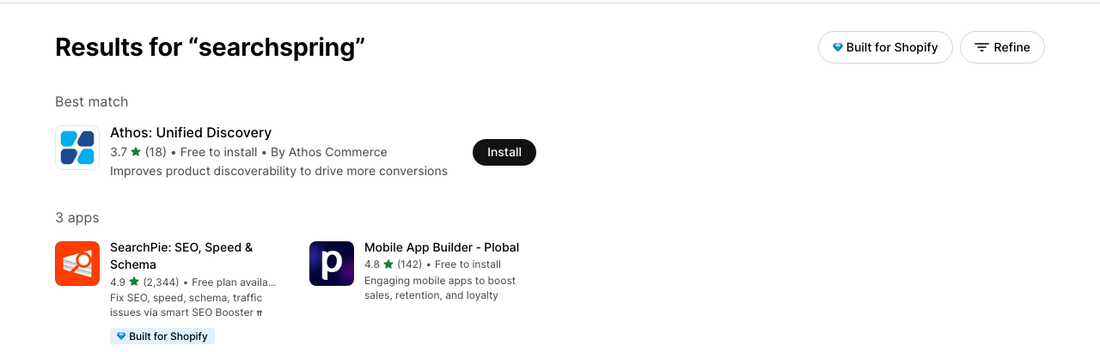
Search "searchspring" on the App Store and you get Athos: Unified Discovery, 3.7 stars, 18 reviews. Source.
Klevu's own app is rated 4.9 from 12 reviews, and one merchant calls it "the easiest integration we have done with Shopify." Beyond the basic install, though, reviewers say "you definitely need someone technical in house to help assist and customize" (TrustRadius).
Neither documents Shopify's Standard Product Taxonomy or combined listings. Klevu's rows on both sit at unknown, with no docs either way.
- Searchspring: platform-agnostic, front end can be developer-heavy.
- Klevu: quick basic install, developer-dependent past that.
How do they handle Shopify Markets?
Run more than one storefront and the per-region tax shows up right here. Both reach Shopify Markets through workarounds, not a clean native path.
Searchspring achieves multi-region through separate site and domain configs plus pricing and availability groups. There is no native Markets integration documented, and region is passed in as a merchandising segment.
Klevu is "out-of-the-box compatible with Shopify Markets," but with four documented limits. It syncs prices for the primary market only, the price slider breaks on non-primary markets, fulfillable inventory is unsupported, and it uses distinct stores per market locale.
The last limit is the one that bites. Klevu keeps a separate index per locale rather than one index across markets, so a brand live in the US, UK, and AU is running three parallel indexes at once, each with its own rules to keep in step.
For teams that want a single index across Shopify Markets, the per-region model is operational drag on both tools.
How fresh is the catalog on each?
Stale catalog data is how a shopper ends up on a sold-out product or an old price. Both engines lag webhook-driven near-real-time, and they lag it differently.
Searchspring indexes "at least daily," with higher-frequency and live options listed by tier. Near-real-time single-product updates need the Express Sync API, and one merchant flagged the default day-long delay as friction (Software Advice).
Klevu runs a delta sync every 10 minutes on Shopify. It relies on the Shopify updated_at field, falls back to a full sync past a per-batch threshold, and its delta does not handle deletions.
For a flash sale or fast-moving inventory, both floors are limits of a batch model, not settings you can turn up.
- Searchspring: daily by default, an API call for single items.
- Klevu: a 10-minute floor that misses deletions.
Which is readier for AI shopping agents?
AI assistants are starting to send shoppers, and both vendors are pointing that bet at the Athos platform instead of an open protocol. Neither publishes an MCP server.
Searchspring documents no MCP server or agent-shopping endpoint for the standalone product. Its agentic direction now sits inside Athos, whose June 2026 launch added Conversational, GEO, and Channel Assistants as hosted agents.
Klevu also documents no MCP server. Its Conversational Assistant, which does text and image discovery, is a separate paid add-on, and the three Athos AI agents cost extra on top of base plans.
So a third-party assistant like ChatGPT or Claude cannot query either engine over an open standard today. Both offer hosted assistants inside the storefront instead.
The deeper question for a Shopify Plus brand is what an agent sees. An assistant that reads your merchandising rules, not just raw search, is what decides whether it recommends the products you want to sell.
- Searchspring: hosted Athos assistants, no MCP.
- Klevu: add-on assistants, no MCP.
What does each actually cost?
At scale both land in the four-to-five-figure-a-month range, and they arrive there by opposite routes. Klevu lists its modules and lets you add them up. Searchspring puts everything behind a quote.
Klevu lists three Shopify modules: Site Search at $649, Category Merchandising at $549, and Recommendations at $449. The full suite is $1,647/month, with a 14-day trial. Enterprise and Athos pricing is "Request Pricing."
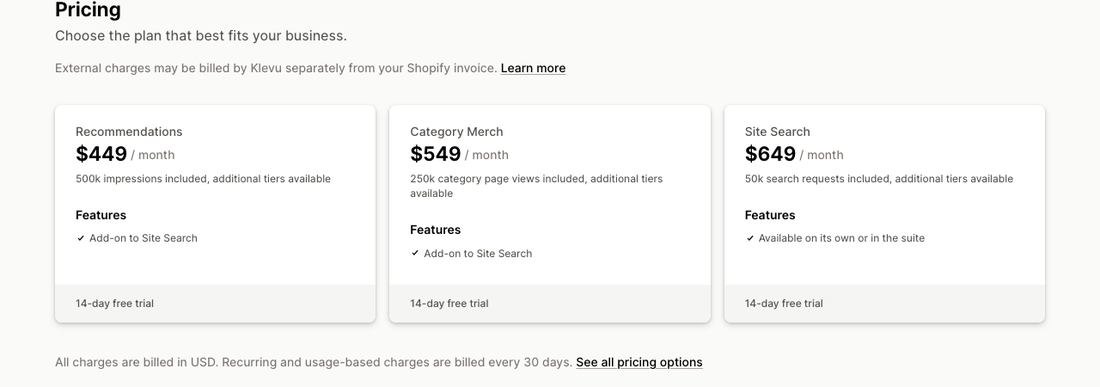
Klevu's published modules stack to $1,647/month for the full suite. Source.
- Overage: external charges may be billed separately past the included 50k requests, 250k page views, and 500k impressions.
- Gating: the merchandising console lives in the $549 add-on, and personalization and analytics are tier-gated.
Searchspring has no public matrix. Third-party directory floors list Essential near $699, Advanced near $899, and Expert near $1,099 per month, treated as lower bounds (Software Advice).
One verified merchant reports about $2,000 a month, on an annual auto-renewing contract. Onboarding is billed separately. Treat every Searchspring figure as a third-party estimate, not a vendor number.
What are customers saying?
Which vendor looks better depends on which review site you trust, and both scores are moving as ratings migrate under the merged Athos listing. Read the per-product numbers below, not the blended ones.
Searchspring rates about 4.6 on G2, 4.6 on Software Advice, 9.0 on TrustRadius, and 3.7 on the Shopify App Store. Praise clusters on merchandiser control and ease of use for non-technical staff. Gripes run to post-merger support times, price, and auto-renewal.
"We've been using Searchspring for about 2 years, and love the application. It works seamlessly with Shopify. We see a 20% increase in AOV and a significant increase in conversion from those who use our search feature." Hat Club, Shopify App Store
"I recently waited over 6 weeks for a response to a helpdesk ticket that was never resolved. They lock you into a 12 month automatically recurring contract. I would avoid Searchspring." Knifewear, 1 star, Shopify App Store
Klevu rates 4.4 on G2 across 71 reviews and 4.9 on the Shopify App Store across 12 reviews. Praise clusters on search relevance and hands-on support. Gripes cluster on price, which is the top complaint even inside five-star reviews, and on tiered support gating.
"The support team is wonderful at Klevu. They are a bit more expensive than other providers but they are well worth the price." GK Elite Sportswear, Shopify App Store
"The support team is very helpful, but we fall into a tier that doesn't qualify for account management even though we are using two of their products. The lack of account management leaves us in the dark on strategies to employ." Verified G2 reviewer, via Expertrec
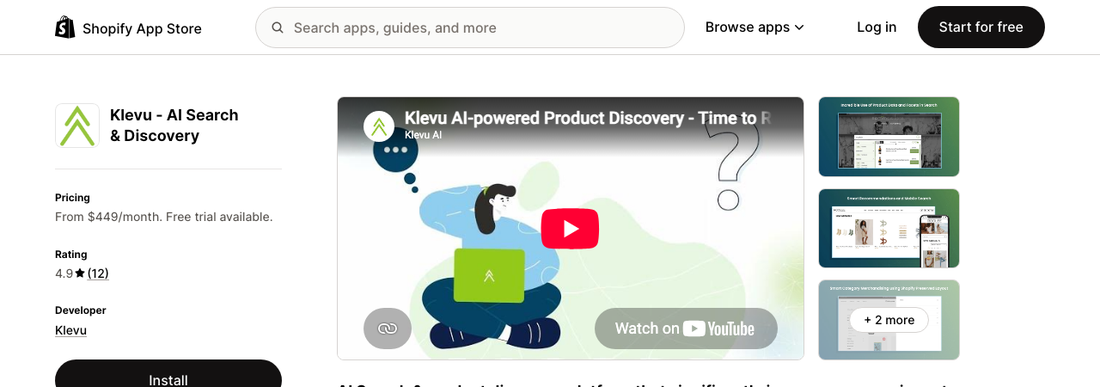
Klevu on the Shopify App Store: 4.9 stars, 12 reviews. A small, high-scoring sample. Source.
Weigh each pile of reviews by what it actually measures. Searchspring's larger corpus tells you about the console and about post-merger support strain. Klevu's 4.9 is real, but it rests on 12 reviews, a sample small enough to swing on one bad month.
Top similarities between Searchspring and Klevu
The differences are only half the decision. The overlaps matter as much to a Shopify Plus buyer, and two of them, one owner and one shared roadmap, quietly shape the whole deal.
They are the same company now
Both are owned by Athos Commerce, formed in January 2025 when PSG-backed Searchspring merged with Klevu and Intelligent Reach. Shortlisting both means comparing two products from one vendor, which weakens your leverage before pricing is even quoted.
Both sit on a legacy-sunset track
Athos launched a unified Intelligent Discovery Platform in June 2026, and its published rollout schedule puts legacy Searchspring and Klevu on a sunset beginning 2027. Every buyer today faces a future upgrade or migration onto that platform.
Neither is built for Shopify first
Both ingest a copy of your catalog and serve results through their own JavaScript layer across Shopify, Magento, BigCommerce, and Salesforce Commerce Cloud. Shopify is one target among several, which is what drives the taxonomy, Markets, and sync gaps above.
Both are quote-gated at enterprise
Klevu publishes entry modules, and Searchspring publishes nothing, but neither shows a real mid-market or enterprise number. Above the entry floor, both go opaque and route you to a sales conversation.
Neither exposes a native MCP surface
Both keep their agentic ambitions inside Athos's own hosted assistants, so a third-party AI agent cannot call either engine over an open protocol. If your plan depends on agent-driven shopping, you are buying into that roadmap either way.
Both are capable, proven search engines
Give both their due here. Keyword search, faceting, autocomplete, synonyms, self-learning ranking, merchandising: both do all of it well, and both hold strong independent scores. The choice is about fit and delivery on Shopify Plus, not whether the core search works.
How to choose
Choose Searchspring if a dedicated merchandiser owns your search and category pages, you want the no-code console included rather than gated, and you value up to 15 custom sort orders, scheduling, and live preview out of the box. Be ready for quote-only pricing and an annual contract.
Choose Klevu if you want strong relevance with little setup, self-learning ranking that adapts from behavior, and NLP across many languages. Be ready to stack the $549 merchandising module and the $449 recommendations module on top of the $649 search module to reach the full suite.
Is there an option built only for Shopify Plus?
Searchspring and Klevu are both multi-platform engines, now under one owner. Sell only on Shopify Plus and a native tool sheds the parts of both that add overhead. We built Layers to close exactly that gap.
How we take a different path from both:
- Shopify-native catalog. We ingest Shopify's Standard Product Taxonomy, combined listings, and bundles natively, so there is no field mapping to maintain. Both Athos products leave these undocumented or gated.
- One index across Markets. Over 100 languages in a single index, not a separate store per region, which removes the per-locale overhead Klevu carries.
- Near-real-time sync. Webhook-driven catalog updates, not a daily default or a 10-minute batch floor.
- Merchandiser-owned ranking, no paywall. Drag-and-drop control plus ranking by margin or return rate, with no add-on module to unlock the console.
- Native MCP. Assistants like ChatGPT and Claude read your merchandising rules, not just raw search, where both Athos products document no MCP endpoint.
One example. A 9-figure apparel brand, Rainbow Shops, moved to Layers. Their VP of eCommerce and Digital, David Cost, on the switch:
"Layers was the first time we were able to create some customization and essentially create the same kind of sort-orders that we were used to having in Salesforce. And we could see a pretty immediate impact on the conversion rate."
After the move, Rainbow Shops reported a 30% increase in conversion rate and now re-orders every collection page daily based on the last seven days of demand.
Where we are not the right call:
- You are not on Shopify, or you run a multi-platform or headless stack. Searchspring or Klevu fits better across Magento, BigCommerce, and Salesforce Commerce Cloud.
- You want a decade-long merchandising console with the deepest feature backlog. Searchspring's console is more battle-tested and has a larger review corpus.
- You want one vendor spanning offsite feed syndication and hosted GEO agents today. Athos bundles Intelligent Reach and its own assistants, which we do not replicate.
- You want A/B testing of sort configurations right now. That is not yet shipped at Layers, and all three Athos-side products document it.
FAQ
Are Searchspring and Klevu the same company? Yes. PSG-backed Searchspring merged with Klevu and Intelligent Reach in January 2025 to form Athos Commerce. Both products still run under their own brands, but new development has moved to the unified Athos platform, with legacy platforms pointed toward retirement beginning 2027.
Which is cheaper, Searchspring or Klevu? Klevu publishes Shopify modules: $649 for search, $549 for merchandising, and $449 for recommendations, reaching $1,647 a month for the full suite. Searchspring is quote-only, with directory floors near $699 to $1,099 a month. Both are enterprise-priced at scale.
Do Searchspring or Klevu work natively with Shopify Plus? Neither is Shopify-native. Both are multi-platform engines with a Shopify connector, and neither documents Shopify's Standard Product Taxonomy or combined listings. Searchspring's app is rated 3.7 from 18 reviews, and Klevu's is 4.9 from 12.
Which has better merchandising controls? Searchspring includes its no-code console in the base product, with pin, boost, bury, up to 15 custom sort orders, scheduling, and preview. Klevu has a comparable console, but it is gated behind the $549 Category Merchandising module.
Can ChatGPT or Claude connect to Searchspring or Klevu? Neither publishes an MCP server. Both route agentic features into Athos's own hosted assistants, which run inside the storefront. A third-party assistant cannot query either engine over an open protocol today.
Which has stronger AI search? Klevu was built as an AI-search engine, with self-learning ranking computed per search term and NLP across 31 languages. Searchspring added semantic search through the Klevu merger, but its product page does not disclose which plan tier includes it.
Written by

Deb Mukherjee
Ecom Growth Advisor
Deb Mukherjee is an Ecom Growth Advisor who writes about ecommerce search and merchandising for Layers, the enterprise search and merchandising platform built for Shopify Plus. He works with Plus brands on search relevance, merchandising, and the catalog-data work behind product discovery at scale.
View all articlesRelated articles
More reading on search, merchandising, and product discovery.
Coveo vs Algolia: Top Differences and Similarities (2026)
A fact-by-fact comparison of Coveo and Algolia for Shopify Plus: search, ranking, merchandising, Shopify Markets, catalog sync, AI agents, pricing, and reviews. Every claim cited, verified August 2026.

Jake Casto
Aug 24, 2026 · 18 min read
Coveo vs Bloomreach: Top Differences and Similarities (2026)
A fact-by-fact comparison of Coveo and Bloomreach for Shopify Plus: search, ranking, merchandising, Shopify Markets, catalog sync, AI agents, pricing, and reviews. Every claim cited, verified August 2026.
Jake Casto
Aug 24, 2026 · 18 min read
Coveo vs Constructor.io: Top Differences and Similarities (2026)
A fact-by-fact comparison of Coveo and Constructor.io for Shopify Plus: search, ranking, merchandising, Shopify Markets, catalog sync, AI agents, pricing, and reviews. Every claim cited, verified August 2026.
Jake Casto
Aug 24, 2026 · 17 min read