Syte vs ViSenze: Top Differences and Similarities (2026)
A fact-by-fact comparison of Syte and ViSenze for Shopify Plus: visual search, ranking, merchandising, Shopify Markets, catalog sync, AI agents, pricing, and reviews. Every claim cited, verified August 2026.
Key takeaways
Overview
Both started as camera-search companies. Point a phone at a dress, get the dress. That is where the overlap stops. One sells fashion retailers a widget; the other sells marketplaces an API for millions of SKUs. Recently, both were bought by parents that do not sell search.
Syte launched in 2015 as a camera-search engine for fashion, footwear, jewelry, and home decor. Its core is Deep Tags, visual-AI-generated metadata matched against a 15,000-attribute lexicon. Its customers skew to non-Shopify enterprise retailers like Farfetch and Marks & Spencer. It is now part of payments company Nayax and rebranded SeeIQ.
ViSenze was founded in 2012 as a visual-AI spinout of the National University of Singapore (TechCrunch). It sells an API-first multimodal engine that combines text, image, and vector search for marketplaces like Zalora and Myntra. It is now a subsidiary of Nasdaq-listed Rezolve AI.
Below, every capability gets a verdict and a source, from visual search down to who signs the contract now.
Top differences between Syte and ViSenze
Verdicts below: Yes works as stated, Gated needs a higher tier or connector, Partial works with limits, No. Where neither the vendor docs nor a third party confirm a feature, we mark it Undocumented. Each is sourced below. Verified August 2026.
Platform and Shopify fit
| Capability | Syte | ViSenze |
|---|---|---|
| Built only for Shopify Plus | No | No |
| Native Shopify app | No (JS SDK and API) | Partial (1.0-star app) |
| Ingests Shopify taxonomy | Undocumented (own lexicon) | No (own AI taxonomy) |
| Shopify Markets, multi-region | Undocumented | No (explicitly excluded) |
| Catalog sync near real time | No (scheduled feed) | Gated (API only, not Shopify) |
| Shopify App Store rating | No app | 1.0 / 5 (1 review) |
Search
| Capability | Syte | ViSenze |
|---|---|---|
| Semantic / vector embeddings | No (tags and NLP) | Yes (vectors and LLM) |
| Camera / image search | Yes | Yes |
| Autocomplete and type-ahead | Yes | Yes |
| Typo tolerance and fuzzy match | Partial (undocumented) | Yes (spell correction, fuzzy) |
| Query intent to auto-filters | Partial (no auto-apply) | Partial (explicit filters) |
| ML query-to-result reranking | Partial (manual weights) | Partial (rule boosts on ML) |
Merchandising
| Capability | Syte | ViSenze |
|---|---|---|
| Rules engine, boost / bury / pin | Yes | Yes |
| Sort orders on Shopify collections | Partial (own surfaces) | No (no collection concept) |
| Drag-and-drop pin grid | Undocumented | No (pin / hide, max 10) |
| Weighted multi-metric ranking | Yes (0 to 100 blends) | Partial (capped by relevance) |
| Contextual boosting by segment | Partial (session level) | No (query / metadata triggers) |
| Scheduled, time-based rules | Undocumented | Undocumented (recs only) |
AI, pricing, and reviews
| Capability | Syte | ViSenze |
|---|---|---|
| AI included without a tier upgrade | Undocumented (quote only) | Yes (same AI in all tiers) |
| GenAI auto-tagging | Yes (Deep Tagging, 15k) | Yes (Smart Tagging) |
| Margin / inventory in ranking | Partial (no return rate) | Partial (self-indexed) |
| Public pricing | No (demo form) | Partial (Shopify tiers public) |
| Independent review base | G2 4.6 (76 reviews) | Shopify 1.0 (1), G2 4.0 (2) |
How does each engine find products?
Ask both to find a product and they do opposite things under the hood. Syte turns the image into tags, then matches keywords against them. ViSenze skips the tags and pushes the text and image through vector embeddings on every query.
Syte's core is Deep Tags, visual metadata that its AI generates from product images. It matches those tags with NLP keyword logic, not vector embeddings (Syte blog). The tags draw on a proprietary 15,000-attribute lexicon for fashion and home decor.
That design is genuinely strong for camera search. A shopper photographs an outfit, and Syte detects each object and returns matching products. The result quality depends on how well the images are tagged.

Syte's Visual Discovery page. Its camera search reads product categories from an image against a 15,000-attribute lexicon. Source.
ViSenze uses AI vector embeddings trained on hundreds of millions of commerce products, combined with LLMs. Its Multi-Search API takes text, image, and visual similarity in one call.
Vector retrieval helps on vague queries like "summer outfit," where keyword-only search returns a blank page. Syte closes that gap with tags and NLP rather than embeddings.
- Camera search: a founding capability for both.
- Semantic vector search: included on ViSenze; not documented on Syte.
- Keyword and tag matching: the core of Syte; a secondary path on ViSenze.
How does each rank results?
Both let you shape ranking, and both stop short of a fully learned model. Syte tunes weights by hand. ViSenze layers capped boosts on an ML base.
Syte ranks with weighted strategies on 0-to-100 scales across stock, margin, reviews, best-sellers, and trending. A merchandiser sets the weights; the system does not learn them from clicks.
Its personalization overlays results at the session level. Syte explicitly rejects demographic or segment targeting, so ranking reacts to the current visit, not a stored profile.
ViSenze starts from ML vector similarity, then adds a boosts layer for freshness, discount, rating, and category consistency. Each boost takes a 0-to-1 weight.
The catch is that the boost is capped relative to the similarity score, so ML relevance always wins. Its Shopify tiers list "Dynamic Re-Ranking," but the API docs do not document how it works.
- Syte: manual weighted strategies you tune by hand.
- ViSenze: an ML base with rule boosts that cannot override relevance.
Can merchandisers run each one without developers?
Both hand merchandisers a rules engine, and neither wires it to Shopify collection pages. This is the closest the two come to each other.
Syte ships a rules engine to promote, demote, exclude, and include products. It runs on its own surfaces, not your Shopify collection pages. Its public merchandiser docs are gated behind a login, so the console is hard to inspect before you buy.
There is no documented drag-and-drop pinning, sequencing, or visual grid. What a merchandiser can actually do day to day is undocumented in public.
ViSenze's rules are solid on paper: boosts, pin and hide, conditional filters, and synonyms. Pin and hide are capped at 10 items each, and changes take up to an hour to take effect.
ViSenze has no collection or browse concept. Its sort order is set per API request, not stored per collection, so there is nothing to merchandise the way a Shopify team expects.
- Syte: rules on its own surfaces, no documented collection grid.
- ViSenze: capable rules API, but no collection pages to merchandise.
How well does each fit Shopify Plus?
Start with the obvious: neither was built for Shopify. Syte serves enterprise retailers on their own stacks; ViSenze serves marketplaces through an API. So the question is not whether Shopify runs, but how proven that path is. Barely, on the evidence below.
Syte lists zero apps on its Shopify partner page. You integrate through its JS SDK and API instead. Its own product update names Shopify Plus and Salesforce Commerce Cloud as peer platforms, not a Shopify-first design.
ViSenze does ship a Shopify app, but it rates 1.0 stars from 1 review as of August 2026. That dropped from 1.4 stars over the prior month. The single review reports a product database that never synced.
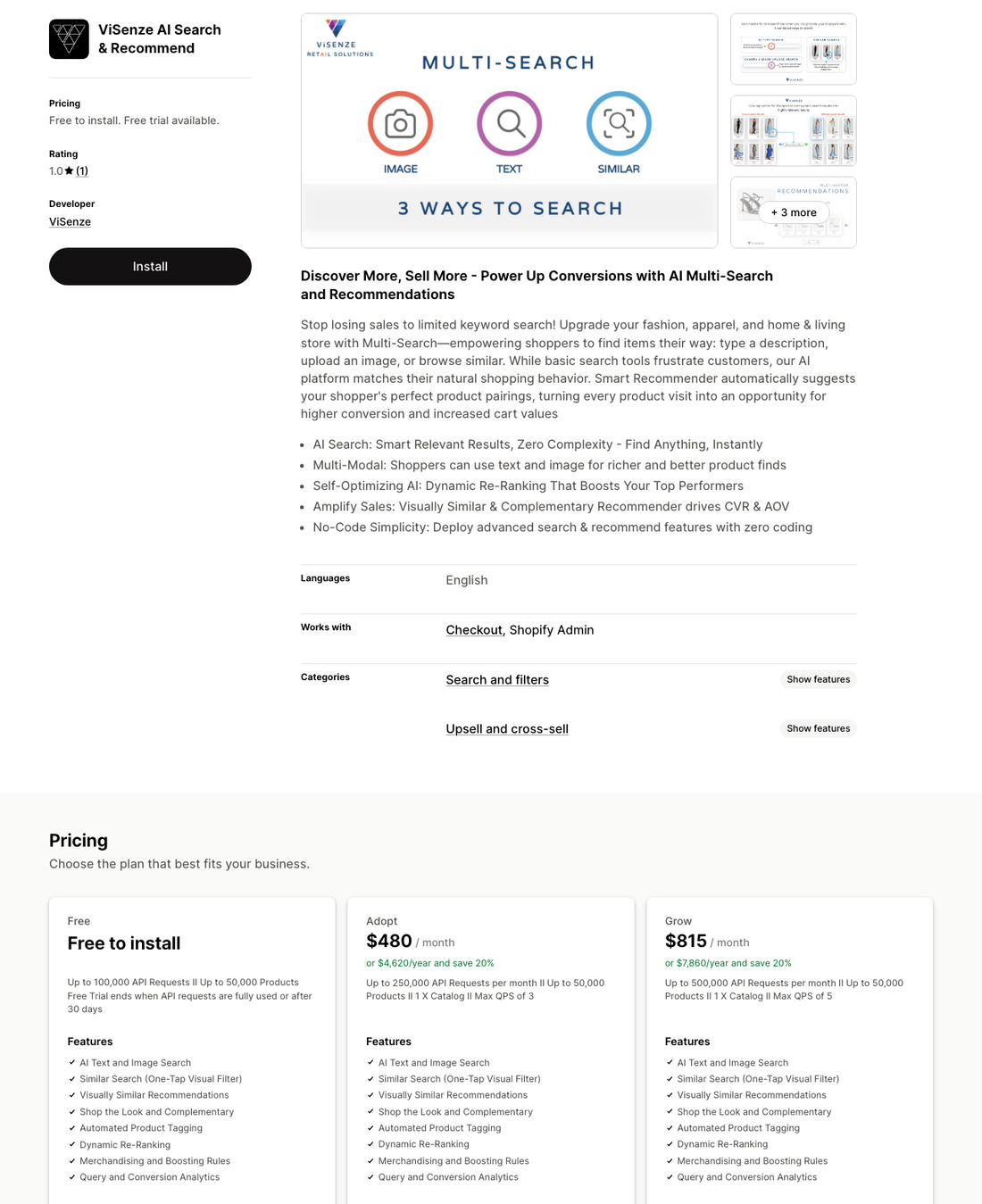
ViSenze on the Shopify App Store: 1.0 stars from 1 review, with Free, $480, and $815 tiers. Source.
Its documented commerce connectors are BigCommerce, Magento 2, and WooCommerce. Shopify is absent from that list, and larger deployments fall back to a direct API build.
How do they handle Shopify Markets?
Run one storefront and skip this section. Run five, in five currencies, and it decides how much per-region catalog work lands on your team. Neither tool reads Shopify Markets.
Syte publishes no documentation of Shopify Markets, per-market catalogs, or multi-currency. Its multilingual support appears in marketing copy, but the language count and index design are undocumented. Every part of this is unconfirmed in public.
ViSenze is explicit. Its connectors doc states it does not support ingesting platform data as a multi-locale catalog. It has its own multi-locale system, but you feed it by API or file, not by a Shopify Markets pull.
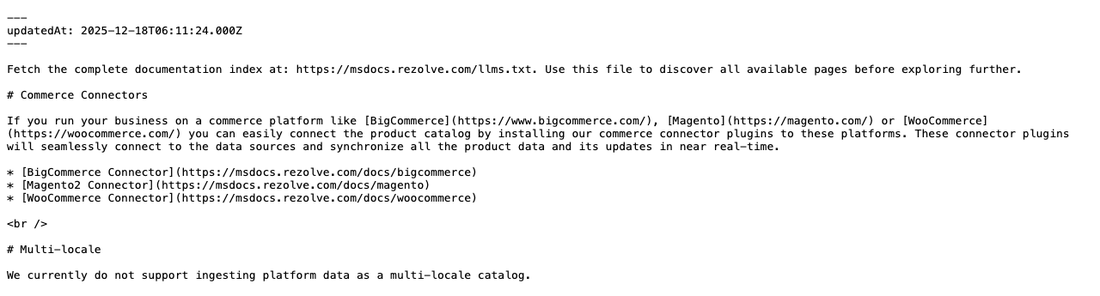
Rezolve's commerce-connectors doc lists BigCommerce, Magento, and WooCommerce. Shopify is absent, and multi-locale ingest is excluded. Source.
For a brand that wants a single index across Shopify Markets, both tools push the per-region work back onto you. Neither reads a Market's resolved price, currency, or availability on its own.
How fresh is the catalog on each?
Sync lag is what puts a sold-out hoodie at the top of a result, or shows a shopper last week's price. Syte and ViSenze handle it differently. Shopify lands on the weak side of both.
Syte's documented mechanism is scheduled exports of your product feed. That is a batch model, not event-driven sync. No webhook or real-time listener is documented on any surface.
ViSenze's API push is real time, and its connectors synchronize updates in near real time. The catch is that the near-real-time path covers BigCommerce, Magento, and WooCommerce. For Shopify, the connector is undocumented, so you build direct API sync yourself.
- Syte: scheduled batch feed exports.
- ViSenze: real-time API, but not through a Shopify connector.
Which is readier for AI shopping agents?
More shoppers now start a search inside ChatGPT or Claude instead of a search bar, and on that shift the two vendors are not close. Syte documents no agent surface at all. ViSenze has a conversational API, but no way to reach it from Shopify.
Syte documents no MCP server and no agent-facing interface. Its product is an SDK plus a widget. Post-acquisition, Nayax points the roadmap at POS and payments, the same discovery online and in-store, not agent commerce.
ViSenze ships a Multi Search Shopping Assistant API, an LLM-powered conversational layer. Parent Rezolve markets an agentic commerce platform at Shoptalk 2026.
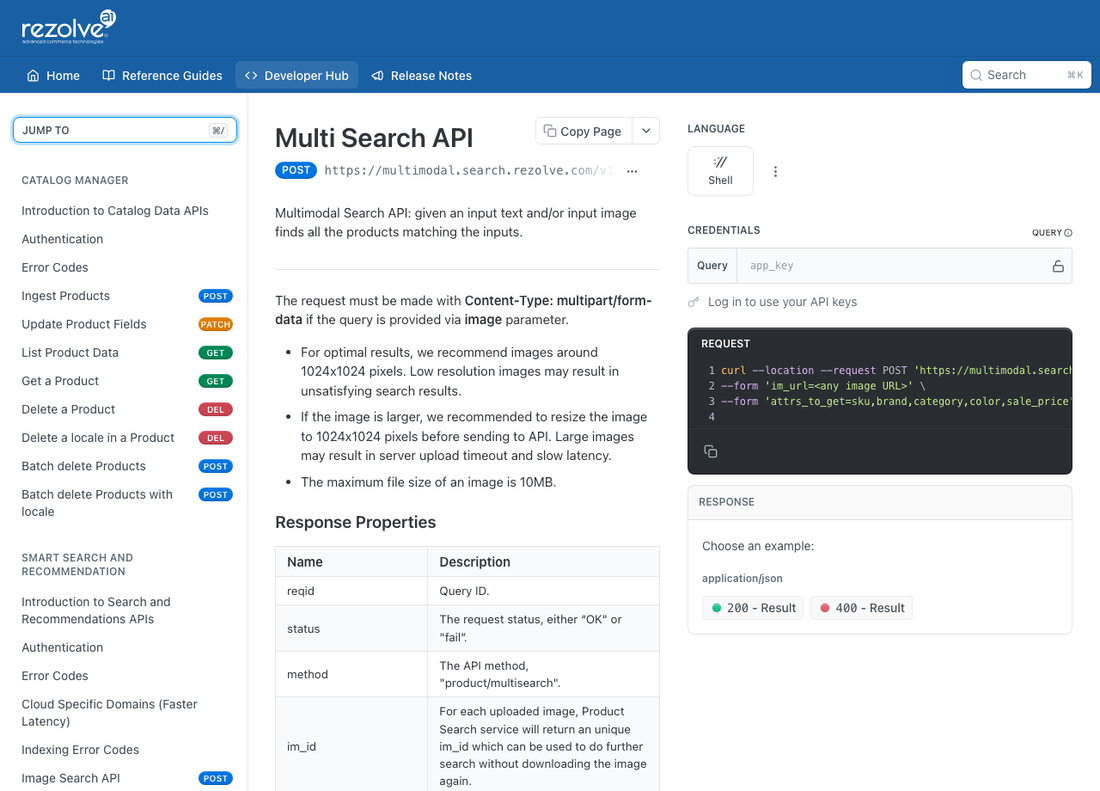
ViSenze's Multi Search API documentation. It takes text and image in one multimodal call, with a Shopping Assistant API in the left menu. Source.
The deeper question for a Shopify brand is what an agent actually sees. Neither vendor documents an MCP surface that exposes your merchandising rules and curation to an outside assistant like ChatGPT or Claude.
- Syte: no agent interface, a POS-led roadmap.
- ViSenze: a conversational shopping-assistant API, no Shopify MCP.
What does each actually cost?
Both end up at enterprise numbers. They disagree on how much to tell you first. Syte hides all of it behind a demo form. ViSenze shows you a Free tier and an $815 ceiling, then quotes everything above it.
Syte has no published tiers. Its pricing page is a demo-request form. A SAP listing describes a recurring monthly fee under an annual contract, paid quarterly, with professional services billed on a cost basis.
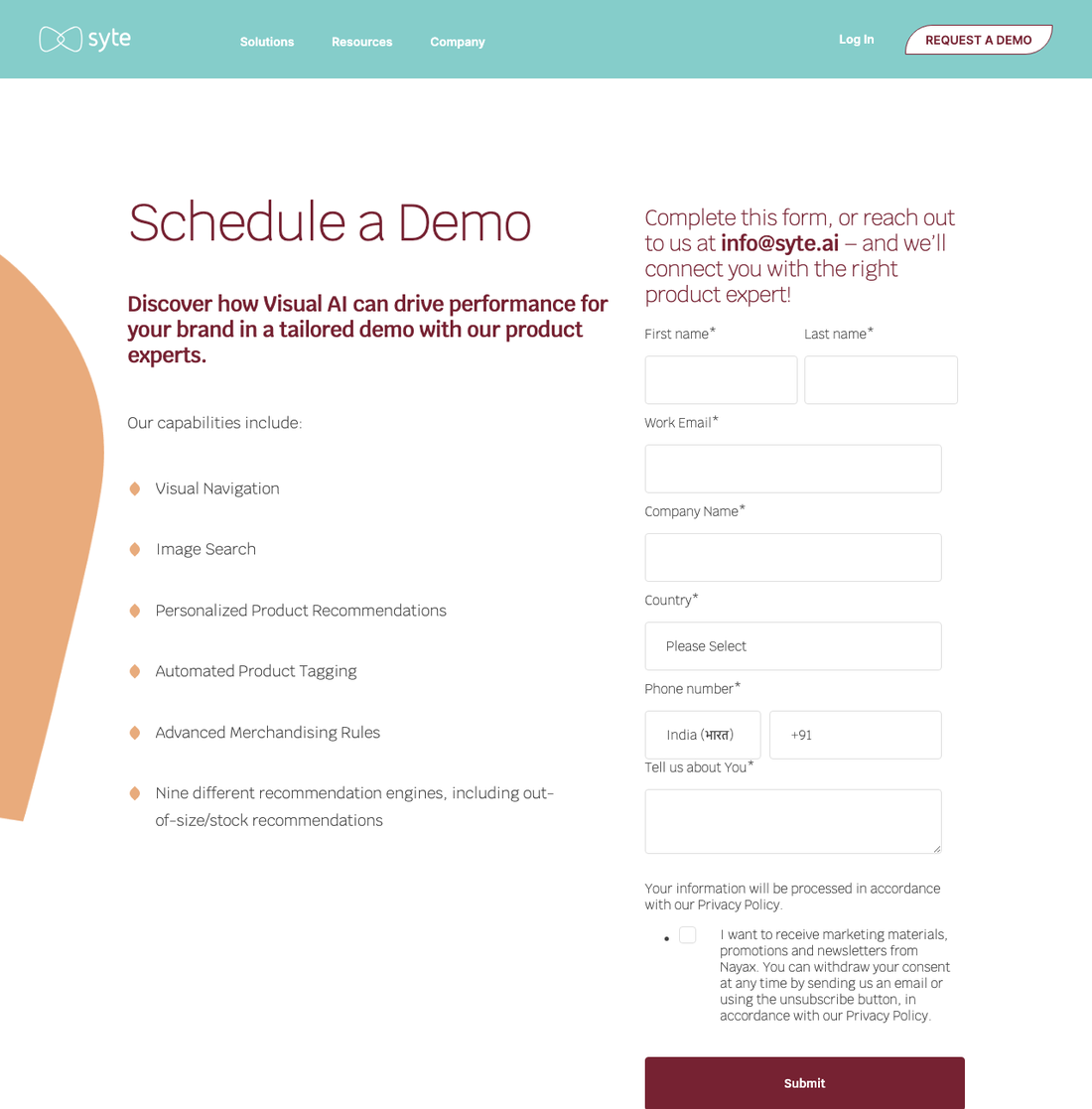
Syte's pricing page is a demo-request form with no published tiers. Source.
Public estimates put Syte around a $1,200 monthly floor, rising into five and six figures a year. Treat those as low-confidence aggregator figures, not vendor numbers (ToolChase).
ViSenze splits its model three ways. Its Shopify tiers are Free, $480, and $815 per month, each capped at 50,000 products and 250K to 500K requests. Its AWS list pricing stacks per module, with Search at $800 and Enrichment at $700 per 10,000 units.
A $20M-plus GMV Plus merchant outgrows the Grow ceilings and lands on an enterprise quote. The honest total depends on your catalog size and request volume. Usage overages make it hard to forecast, and one review says the public rates understate the real bill (augesoft).
What are customers saying?
Where you look changes the verdict. Syte has a thin but strong enterprise base. ViSenze has almost no independent footprint, and the one Shopify voice on record is a complaint.
Syte rates 4.6 on G2 across 76 reviews, with a standout 9.6 for quality of support. Capterra has zero reviews, and TrustRadius and PeerSpot carry none.
Praise clusters on image-recognition accuracy for fashion and hands-on support. The real concerns are structural: category narrowness, cost, and company viability after the Nayax acquisition.
"Syte came alongside White Rose Recycled Fashion. They are not just a service provider but a partner invested in our success." James S., Verified User in Retail, G2
"there is nothing to dislike the product works exactly as anounced" Verified User in Apparel & Fashion, G2
Syte's top critical review is basically a compliment ("nothing to dislike"), which tells you how little independent criticism there is to weigh. The sharper warning comes from an analyst, not a customer: look elsewhere if you sell outside soft goods.
ViSenze rates 1.0 on the Shopify App Store from 1 review, 4.0 on G2 from 2, and 3.0 on SoftwareFinder from 1. Capterra has none.
Praise clusters on visual-search accuracy at marketplace scale. Gripes cluster on laggy results on real catalogs, dev-heavy setup, and the neglected Shopify path.
"ViSenze makes virtual searching interesting and easier, their product discovery is very accurate." Praveen K., Mid-Market, SoftwareFinder
"The product discovery search is laggy and sometimes it's inaccurate. Will have to depend on 2/3 results on average to get correct results." Praveen K., AWS Marketplace
Weight them accordingly. Syte's are few, consistent, and from enterprise buyers. ViSenze's are almost too thin to count, and the lone Shopify-merchant review is a one-star note about a product database that never synced.
Top similarities between Syte and ViSenze
The differences fill the tables above. The traits they share matter as much on a Shopify Plus shortlist, and there are six worth naming.
Both are visual-search specialists, not full platforms
Camera and image search is the founding capability of each. General text search and merchandising came later and sit second. If your buyer journey is not camera-first, you are paying for a specialty you may not lean on.
Both were acquired by companies outside commerce search
Syte is now part of payments firm Nayax, which ran two layoff rounds in ten months. ViSenze is a subsidiary of Rezolve AI, which discloses a going-concern doubt. Neither is an independent vendor anymore, so factor parent stability into a multi-year contract.
Neither is Shopify-native
Syte ships no native app, and ViSenze's app sits at 1.0 stars with Shopify absent from its connectors. Both were built for enterprise and marketplace catalogs on non-Shopify stacks. That general-purpose design drives most of the differences above.
Neither reads Shopify taxonomy or Markets
Both generate their own AI taxonomy rather than ingesting Shopify's Standard Product Taxonomy. Neither supports Shopify Markets, combined listings, or per-market pricing. A multi-storefront brand carries that mapping work itself.
Both merchandise by rules or API, not a visual console
Each has a capable rules engine. Neither offers drag-and-drop pinning on Shopify collection pages, scheduled search rules, or per-Market sorting. Merchandising happens in parameters, not in a grid your team can see before publishing.
Both are quote-gated with thin independent review footprints
Capterra shows zero reviews for each. Real due-diligence signal is scarce, and both lean on curated vendor testimonials. You will do more reference-calling than review-reading to vet either one.
How to choose
Choose Syte if your entire buyer journey is camera-first for fashion, footwear, jewelry, or home decor, you want a deep visual lexicon, and you are comfortable integrating through an SDK on a non-Shopify or headless stack. Budget for a quote and an integration project, and weigh the Nayax roadmap.
Choose ViSenze if you run a large marketplace or enterprise catalog, you want genuine multimodal vector search over many millions of products, and you can staff the developer work. Expect to outgrow the public Shopify tiers and land on an enterprise quote, and accept the neglected Shopify connector.
Is there an option built only for Shopify Plus?
Syte and ViSenze are both general-purpose engines that changed owners in the last year. If Shopify Plus is your whole business, a tool built for it drops the field mapping, the per-region setup, and the broken connector. We built Layers to sit in that spot.
Five places we do the job differently from both:
- Shopify-native catalog. We ingest Shopify's Standard Product Taxonomy, combined listings, and bundles natively, so there is no field mapping to maintain.
- One index across Markets. 100-plus languages in a single index, with each Shopify Market's resolved price, currency, and availability applied, not a separate index per region.
- Near-real-time sync. Webhook-driven catalog updates with a full resync every eight hours, not a scheduled batch export.
- Merchandiser-owned control. Drag-and-drop pinning on collection pages, plus ranking that blends margin, inventory, and return rate into one sort score.
- Camera search, shipped natively. The visual-search capability both rivals are known for, wired into Shopify merchandising rather than a separate widget.
One example. 9-figure apparel brand Rainbow Shops switched to Layers. Their VP of eCommerce and Digital, David Cost, on the change:
"Layers was the first time we were able to create some customization and essentially create the same kind of sort-orders that we were used to having in Salesforce. And we could see a pretty immediate impact on the conversion rate."
After the move, Rainbow Shops reported a 30% increase in conversion rate.
Four places we are the wrong call:
- You are not on Shopify Plus. A marketplace or SFCC, Magento, or custom-stack retailer should stay with an API-first engine like ViSenze.
- You want a drop-in storefront UI with zero front-end work. We ship a theme app embed, SDK, and Liquid recipes, so a developer builds the search UI.
- Pure fashion camera search is your single must-have. Syte's lexicon and ViSenze's visual-AI research go deeper on raw image recognition than we do, and a camera-first brand may still want to test them.
- You need documented A/B testing of sort configurations today. That is not currently shipped on Layers.
FAQ
Is Syte or ViSenze better for ecommerce visual search? Both are strong at camera search. Syte uses visual tags against a 15,000-attribute fashion lexicon. ViSenze uses vector embeddings and LLMs across text and image. Syte suits fashion and home decor; ViSenze suits large multimodal marketplaces.
Which is more expensive, Syte or ViSenze? Syte is quote-only, with aggregator estimates around a $1,200 monthly floor rising into five and six figures a year. ViSenze publishes Free, $480, and $815 monthly tiers, but a Shopify Plus catalog outgrows them and moves to an enterprise quote with usage overages.
Do Syte or ViSenze work natively with Shopify Plus? Neither is Shopify-native. Syte ships no Shopify app and integrates through a JS SDK. ViSenze has an app rated 1.0 stars from 1 review, and Shopify is absent from its documented connectors, so larger stores build a direct API integration.
Does either support Shopify Markets? No. Syte publishes no Shopify Markets documentation, and ViSenze states it does not ingest platform data as a multi-locale catalog. Both push per-region catalogs, currency, and pricing work back onto your team.
Can ChatGPT or Claude connect to Syte or ViSenze? Neither documents an MCP server for outside assistants. ViSenze has a conversational Multi Search Shopping Assistant API, and its parent markets an agentic commerce platform. Syte documents no agent interface and points its roadmap at POS and payments.
Are Syte and ViSenze still independent companies? No. Syte is now part of payments company Nayax and rebranded SeeIQ. ViSenze is a subsidiary of Nasdaq-listed Rezolve AI, which discloses a going-concern warning. Factor parent stability into any multi-year contract.
Written by

Deb Mukherjee
Ecom Growth Advisor
Deb Mukherjee is an Ecom Growth Advisor who writes about ecommerce search and merchandising for Layers, the enterprise search and merchandising platform built for Shopify Plus. He works with Plus brands on search relevance, merchandising, and the catalog-data work behind product discovery at scale.
View all articlesRelated articles
More reading on search, merchandising, and product discovery.
Coveo vs Algolia: Top Differences and Similarities (2026)
A fact-by-fact comparison of Coveo and Algolia for Shopify Plus: search, ranking, merchandising, Shopify Markets, catalog sync, AI agents, pricing, and reviews. Every claim cited, verified August 2026.

Jake Casto
Aug 24, 2026 · 18 min read
Coveo vs Bloomreach: Top Differences and Similarities (2026)
A fact-by-fact comparison of Coveo and Bloomreach for Shopify Plus: search, ranking, merchandising, Shopify Markets, catalog sync, AI agents, pricing, and reviews. Every claim cited, verified August 2026.
Jake Casto
Aug 24, 2026 · 18 min read
Coveo vs Constructor.io: Top Differences and Similarities (2026)
A fact-by-fact comparison of Coveo and Constructor.io for Shopify Plus: search, ranking, merchandising, Shopify Markets, catalog sync, AI agents, pricing, and reviews. Every claim cited, verified August 2026.
Jake Casto
Aug 24, 2026 · 17 min read